

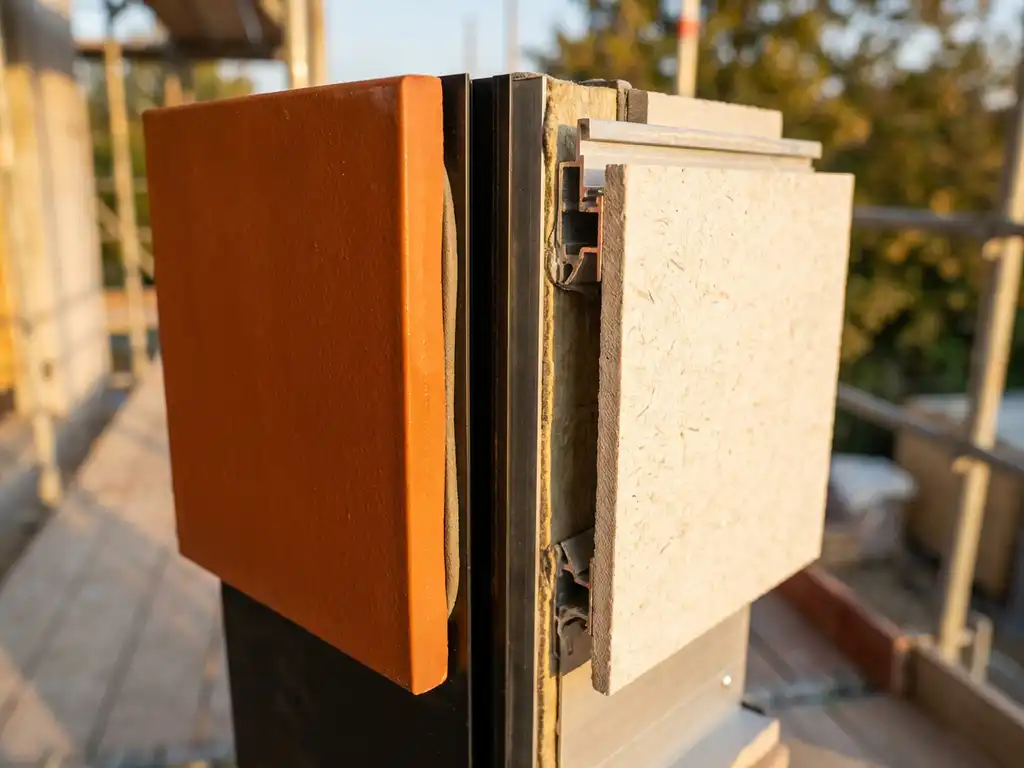
Why Material Choice Defines Façade Performance
The exterior cladding system you select fundamentally determines your building’s long-term performance, maintenance requirements, and aesthetic longevity. When comparing terracotta cladding with fiber cement cladding, the materials’ properties create clear differences in fire safety, durability, installation flexibility, and lifecycle value.
Modern ceramic façade systems deliver measurable advantages across six critical performance areas that directly affect building owners, architects, and occupants. Understanding these differences enables informed decisions that optimize both immediate construction goals and decades of building performance.
1: Superior Fire Resistance and Safety Standards
Terracotta cladding achieves the highest fire safety classification (A1, non-combustible) thanks to its ceramic composition, which contains no combustible materials and maintains structural integrity even under extreme heat exposure. The material’s firing process at temperatures exceeding 1,200 degrees Celsius creates a naturally fire-resistant barrier that requires no additional treatments or coatings.
Fiber cement cladding typically achieves lower fire ratings and may require supplementary fire-resistant treatments, depending on the specific formulation and installation method. The organic fiber content in many fiber cement products can compromise fire performance compared with purely ceramic alternatives, making terracotta vs fiber cement a critical consideration for high-rise buildings and fire-sensitive applications.
2: Unmatched Durability and Weather Resistance
The sinter-firing process used in high-quality ceramic tiles creates an exceptionally dense, non-porous surface that resists moisture penetration, freeze-thaw cycles, and chemical degradation. This manufacturing approach results in façade elements that maintain structural integrity and appearance over decades of exposure to harsh weather conditions.
Fiber cement products can experience moisture-related expansion and contraction that leads to cracking, warping, or joint failure over time. The material’s porous nature also makes it more susceptible to staining, algae growth, and gradual deterioration from environmental exposure, requiring more frequent maintenance throughout the building’s lifecycle.
3: Lighter Weight Enables Flexible Design
Modern ceramic façade systems achieve surface weights of approximately 40 kilograms per square meter, significantly reducing structural load requirements compared with traditional masonry or heavy cladding systems. This weight advantage enables architects to specify lighter substructures and reduces foundation requirements, which is particularly beneficial for timber construction and retrofit applications.
While fiber cement is also relatively lightweight, installation systems often require additional structural support and more complex fixing methods. The lower dead load of ceramic systems allows for more flexible design approaches and can enable cost savings in the overall structural framework without compromising performance or safety standards.
4: Complete Recyclability and Sustainability
Terracotta cladding manufactured from natural clay offers 100% recyclability at end of life, with ceramic elements that can be deconstructed, sorted by component type, and fully reused in new construction projects. The natural composition and firing process create a material that returns to earth-friendly components without environmental contamination.
Fiber cement products often contain synthetic binders and additives that complicate recycling and may require specialized disposal methods. The mixed-material composition makes separation and reuse more challenging, potentially contributing to construction waste streams rather than supporting circular-economy principles in building materials selection.
5: Precision Manufacturing and Installation Speed
Advanced ceramic manufacturing enables façade systems with precision tolerances within one millimeter, ensuring a consistent fit and finish across large installations. The interlocking profile design with vertical aluminum retaining systems creates a «mount and done» installation process that reduces on-site labor time and minimizes weather-related construction delays.
Fiber cement installation typically requires more complex cutting, sealing, and on-site finishing, extending installation timelines and increasing labor costs. The material’s tendency to chip or crack during cutting also creates additional waste and quality-control challenges that can affect project schedules and façade performance.
6: Permanent Color and Surface Integrity
The high-temperature firing process bonds color pigments directly into the ceramic matrix, creating permanent coloration that resists UV degradation, chemical exposure, and mechanical wear. This integrated approach eliminates the need for protective coatings or periodic refinishing, maintaining a consistent appearance throughout the building’s operational life.
Fiber cement products often rely on surface coatings or paint systems for color and weather protection, requiring periodic maintenance and refinishing to prevent degradation. Organic components can also experience color shift over time due to UV exposure, creating an uneven appearance across large façade areas and necessitating ongoing maintenance investment.
Making the Smart Choice for Your Next Project
The performance advantages of terracotta cladding become most apparent when evaluated through lifecycle analysis rather than initial material costs alone. Projects that prioritize fire safety, long-term durability, design flexibility, and minimal maintenance benefit significantly from ceramic façade systems that deliver consistent performance over decades of service.
Consider your specific project requirements, including fire ratings, structural constraints, maintenance capabilities, and sustainability goals, when evaluating cladding comparison options. A total cost of ownership analysis should include installation efficiency, maintenance frequency, and end-of-life value to accurately assess the long-term benefits of different building exterior solutions.
How TONALITY® Delivers Superior Ceramic Façade Performance
TONALITY® ceramic façade systems combine all six performance advantages through advanced manufacturing processes and precision-engineered installation systems. Our ceramic elements achieve A1 fire classification, offer 100% recyclability, and deliver permanent color integrity through specialized sinter-firing at over 1,200°C using premium Westerwald clay deposits.
- Lightweight 40 kg/m² surface weight reduces structural requirements
- Precision manufacturing within 1 mm tolerances ensures a perfect fit
- Interlocking aluminum profile system enables rapid «mount and done» installation
- Integrated graffiti protection and UV resistance eliminate maintenance needs
- Complete deconstructability supports circular-economy principles
Contact our façade specialists to discuss how TONALITY® ceramic systems can optimize performance, reduce lifecycle costs, and deliver lasting architectural excellence for your next project. Explore our completed projects to see how these performance advantages translate into real-world building success.
Related Articles
- What is the difference between terracotta and ceramic facades?
- How do aluminum and steel substructures compare for terracotta?
- 5 Things to Examine When Evaluating Terracotta Manufacturer Samples
- 5 Stunning Projects Combining Terracotta with Glass, Steel, or Timber
- What technical specifications matter for terracotta facades?