

What Makes Terracotta Suitable for Curved Building Geometries?
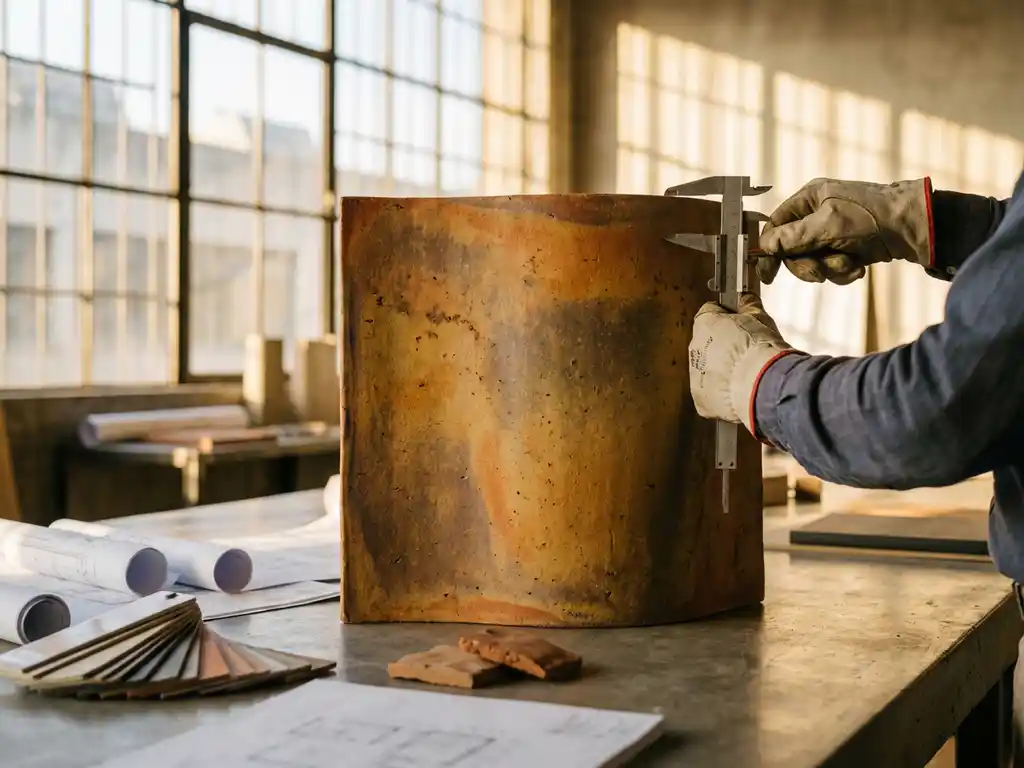
Terracotta’s inherent moldability during manufacturing makes it exceptionally well suited to curved building geometries. Unlike flat panels, which require complex cutting or bending, ceramic façade elements can be shaped during firing to meet precise curved specifications, eliminating material waste and structural compromises.
The manufacturing process allows architects to create custom curved panels that maintain structural integrity while following complex building contours. Terracotta’s ability to be fired at high temperatures exceeding 1,200 degrees Celsius creates a dense, durable surface that retains its shape even when formed into challenging geometries. This thermal stability ensures that curved elements will not warp or distort over time, preserving the building’s intended aesthetic.
Additionally, terracotta’s relatively low surface weight of approximately 40 kilograms per square meter reduces structural loads on curved frameworks. This weight advantage becomes particularly valuable in complex geometries, where traditional materials might require extensive structural reinforcement.
How Do Architects Calculate Panel Sizes for Complex Geometries?
Architects calculate terracotta panel sizes for complex geometries using parametric design software that maps building surfaces into manageable segments while minimizing panel variation. The process involves analyzing the radius of curvature, the structural grid, and manufacturing constraints to determine optimal panel dimensions that balance design intent with production efficiency.
The calculation process typically begins by dividing curved surfaces into rational segments based on the building’s structural grid. Architects must consider manufacturing tolerances, with ceramic façade systems capable of precision within one millimeter. Panel sizes generally range from 150 × 300 mm up to 400 × 1,600 mm, though complex geometries often require smaller panels to accommodate tighter curves.
Critical factors in panel size calculations include the minimum bend radius the ceramic can achieve, joint-spacing requirements, and thermal-expansion considerations. Architects also evaluate the relationship between panel size and installation complexity, as smaller panels offer greater geometric flexibility but increase installation time and joint density.
What Are the Key Installation Challenges for Curved Terracotta Facades?
The primary installation challenges for curved terracotta façades include maintaining consistent joint spacing, ensuring proper panel alignment across curved surfaces, and managing tolerance accumulation throughout the installation sequence. These challenges require specialized fixing systems and precise coordination between design intent and field conditions.
Curved installations demand exceptional accuracy in the substructure framework, as any deviation from the designed geometry is magnified across the façade surface. Installation teams must work with three-dimensional reference points rather than simple vertical and horizontal alignments, requiring advanced surveying techniques and rigorous quality-control measures.
Weather protection during installation becomes more critical with curved geometries, as exposed edges and complex joint configurations can channel water in unexpected directions. Installers must also account for the increased complexity of accessing curved surfaces, often requiring specialized scaffolding or lifting equipment that can navigate the building’s contours safely and efficiently.
How Do Fixing Systems Adapt to Non-Linear Building Surfaces?
Fixing systems for non-linear surfaces use flexible mounting profiles and adjustable connection points that accommodate varying angles and changes in curvature while maintaining structural performance. These systems typically employ multi-axis adjustment mechanisms that allow individual panels to align with the curved geometry while distributing loads effectively.
Modern ceramic façade systems feature profiled backing elements that interlock with vertical aluminum retaining profiles, providing inherent flexibility for curved applications. The fixing systems incorporate sliding connections and rotational adjustments that compensate for the geometric variations inherent in curved surfaces while maintaining consistent structural attachment.
Advanced fixing systems also accommodate thermal movement across curved surfaces, where traditional linear expansion calculations become more complex. The mounting hardware must account for differential movement patterns that occur when panels follow curved paths, ensuring long-term performance without compromising the façade’s structural integrity or weather resistance.
What Software Tools Help Architects Design Complex Terracotta Systems?
Architects rely on parametric design software such as Grasshopper, Dynamo, and specialized façade-design platforms that can model complex geometries, generate panel layouts, and produce manufacturing data directly from the building information model. These tools enable seamless integration between design intent and production requirements.
Building Information Modeling (BIM) platforms such as Revit and ArchiCAD, enhanced with specialized plugins, allow architects to create detailed terracotta specifications that account for manufacturing constraints and installation sequences. These tools can automatically generate panel schedules, joint details, and fixing-point locations while maintaining parametric relationships with the building geometry.
Advanced software solutions can also incorporate manufacturing feedback loops, allowing ceramic producers to input material constraints and production capabilities directly into the design model. This collaboration ensures that complex geometric designs remain feasible from both architectural and manufacturing perspectives, reducing costly revisions during the specification process.
How TONALITY® Supports Complex Ceramic Facade Geometries
TONALITY® provides comprehensive support for architects specifying ceramic façades on curved and complex building geometries through advanced manufacturing capabilities and technical expertise. Our specialized sinter-firing process at temperatures exceeding 1,200 degrees Celsius enables precise shaping of ceramic elements while maintaining structural integrity across challenging geometries.
Key advantages for complex architectural applications include:
- Custom panel production with millimeter-precise tolerances for exact geometric matching
- Flexible interlocking profile systems that adapt to non-linear surfaces
- Lightweight ceramic elements (40 kg/m²), reducing structural requirements for complex frameworks
- Technical consultation throughout the design process to optimize panel layouts and fixing strategies
- Comprehensive installation support to ensure proper execution of complex geometric specifications
Our experienced technical team works directly with architects during the specification phase to resolve geometric challenges and optimize panel configurations for both aesthetic and performance requirements. View our successful complex façade projects to see how ceramic systems can transform challenging architectural visions into reality. Contact TONALITY® today to discuss your complex façade project and discover how our ceramic systems can bring your architectural vision to life.
Related Articles
- What BIM and Revit objects are available for terracotta facade specification?
- What makes terracotta safer than ACM panels after Grenfell?
- 5 Historic Buildings Successfully Restored with New Terracotta
- How do architects create parametric and computational terracotta facade designs?
- How do you install terracotta facade panels?
Articles connexes
- What are building codes and why do they matter?
- How to Integrate Terracotta Facades into Revit and BIM Workflows
- Terracotta vs Zinc Cladding: Durability and Lifecycle Analysis
- How do architects create parametric designs with terracotta facades?
- How do terracotta facades improve building energy efficiency?