

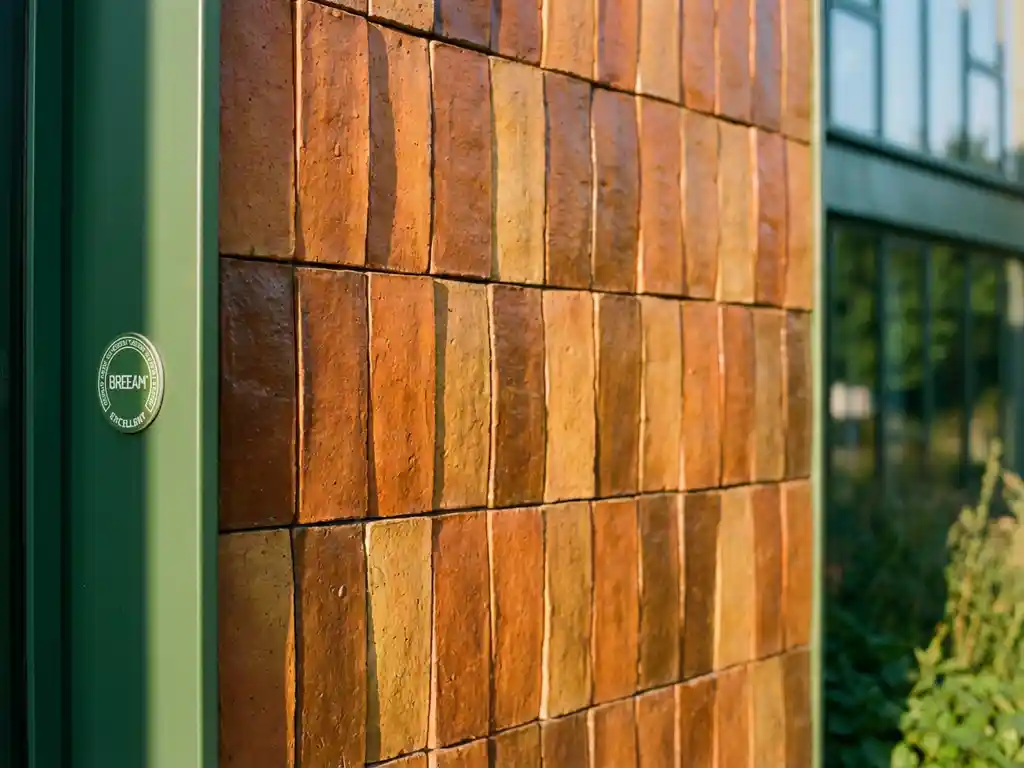
Terracotta contributes to BREEAM certification by earning credits across multiple assessment categories, including Materials, Energy, Waste, and Pollution. Its natural clay composition, durability, recyclability, and A1 fire classification help buildings achieve higher sustainability ratings. Ceramic facade materials particularly excel in lifecycle assessments due to their longevity and minimal environmental impact during production.
What is BREEAM certification and why does it matter for building projects?
BREEAM (Building Research Establishment Environmental Assessment Method) is the world’s leading sustainability assessment method for buildings. It evaluates environmental performance across nine categories, including energy, materials, waste, pollution, and health & wellbeing, to provide an overall sustainability rating.
This certification matters because it significantly enhances property value while demonstrating environmental responsibility. Buildings with BREEAM certification often command higher rental rates and sale values due to their proven sustainability credentials. The assessment also supports compliance with increasingly stringent environmental regulations across Europe and internationally.
For building projects, BREEAM certification provides a structured framework for making environmentally conscious design decisions. It encourages the selection of sustainable building materials and construction methods that reduce environmental impact throughout a building’s lifecycle. This systematic approach helps architects and developers create buildings that perform better environmentally while meeting modern sustainability expectations.
How do ceramic facade materials contribute to BREEAM credits?
Ceramic facade materials contribute to BREEAM credits through their exceptional material properties and environmental performance. They earn points in material selection criteria due to their natural composition, local sourcing potential, and impressive durability, which reduces replacement needs over the building’s lifetime.
The contribution spans multiple BREEAM categories through various mechanisms. In the Materials section, ceramic facade sustainability is demonstrated through recyclability and low-impact production processes. The durability of ceramic materials means fewer replacements and maintenance interventions, directly supporting waste reduction targets.
Environmental impact assessments favour ceramic facades because they are produced from abundant natural clay resources using established, efficient manufacturing processes. Their thermal mass properties can contribute to energy efficiency, while their non-combustible nature supports fire safety requirements. The longevity of ceramic facades also results in lower lifecycle environmental costs compared to materials requiring frequent replacement or intensive maintenance.
What are the specific environmental benefits of terracotta that support BREEAM assessment?
Terracotta offers significant environmental benefits through its natural clay composition and relatively minimal processing requirements. The material is inherently sustainable, requiring only clay, water, and high-temperature firing, without chemical additives or synthetic components that could negatively impact environmental performance.
The energy-efficiency properties of terracotta contribute to the BREEAM credits terracotta systems can achieve. Its thermal mass helps regulate internal temperatures, reducing heating and cooling energy demands. This natural temperature-regulation capability supports the Energy category within BREEAM assessments by contributing to overall building energy performance.
Longevity represents perhaps the most significant environmental advantage. Terracotta facades can last for decades without replacement, dramatically reducing the environmental impact associated with manufacturing, transporting, and installing replacement materials. At end of life, terracotta is completely recyclable, either crushed for aggregate or reprocessed into new ceramic products, supporting circular-economy principles that BREEAM assessments increasingly value.
Which BREEAM categories can terracotta facades help achieve credits in?
Terracotta facades can help achieve credits in five key BREEAM categories: Materials, Energy, Waste, Pollution, and Health & Wellbeing. Each category offers specific opportunities for credit achievement through terracotta’s inherent properties and performance characteristics.
In the Materials category, credits are earned through responsible sourcing, low environmental impact, and durability. Terracotta’s natural composition and local sourcing potential support these requirements effectively. The Energy category benefits from terracotta’s thermal mass properties, which contribute to building energy efficiency and temperature regulation.
The Waste category sees significant contributions through terracotta’s longevity and recyclability. Reduced replacement needs mean less construction waste over the building’s lifetime. In Pollution assessment, terracotta’s clean production processes and absence of harmful emissions during use support credit achievement. The Health & Wellbeing category benefits from terracotta’s natural, non-toxic composition and its contribution to comfortable internal environments through thermal regulation.
Practical examples include earning Materials credits through demonstrated recyclability, Energy credits through thermal-performance contributions, and Waste credits through lifecycle assessments showing reduced replacement needs compared to alternative facade materials.
How does TONALITY® help with BREEAM certification achievement?
TONALITY® ceramic facade systems specifically support BREEAM assessment requirements through comprehensive documentation and superior environmental performance. The A1 fire classification provides crucial safety-related credits, while the single-layer production process and 100% recyclability directly support Materials and Waste category requirements.
Key BREEAM support features include:
- A1 fire classification contributing to safety and materials credits
- Complete recyclability supporting waste-reduction targets
- Low surface weight (40 kg/m²) reducing structural requirements and embodied carbon
- Maintenance-free performance eliminating ongoing environmental impact
- Comprehensive environmental documentation for BREEAM submissions
- Natural clay composition from high-quality European deposits
The lightweight nature of TONALITY® systems enables reduced substructure requirements, supporting both Materials and Energy categories through lower embodied carbon. The permanent colour stability and integrated graffiti protection eliminate maintenance needs, contributing positively to lifecycle environmental performance assessments.
For architects and developers seeking BREEAM certification, TONALITY® provides detailed environmental product declarations and technical documentation that streamline the assessment process. Contact our technical team for comprehensive BREEAM support documentation and consultation on achieving your sustainability certification goals.