

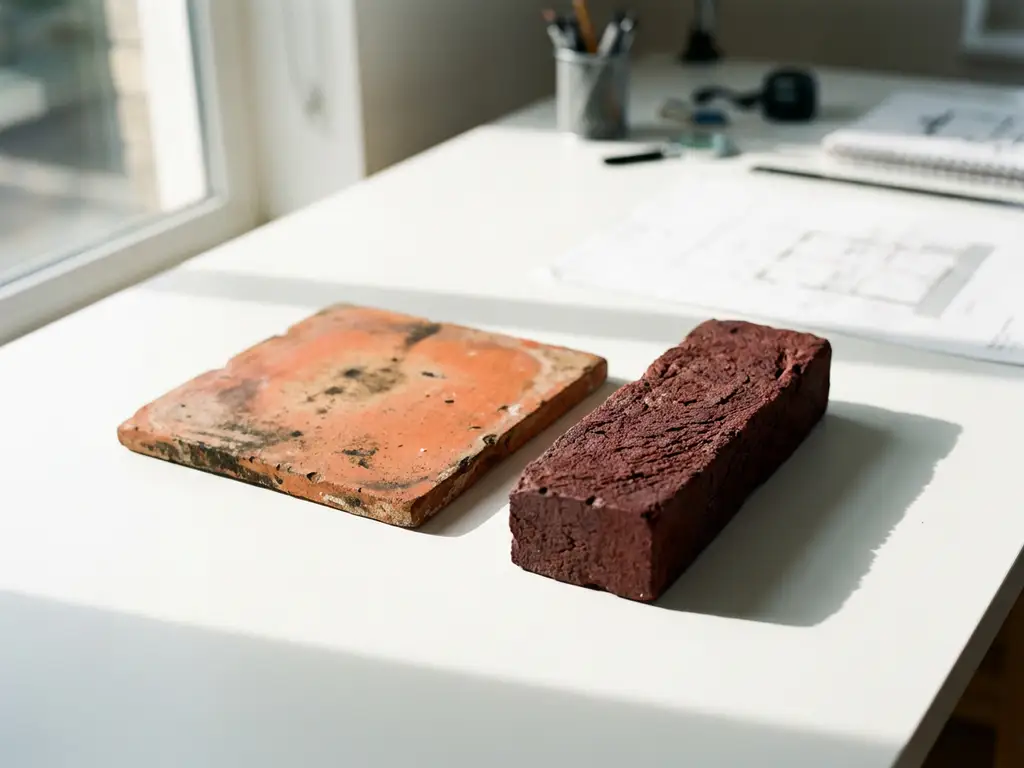
Choosing between terracotta and brick slips for facade cladding depends on your project’s specific requirements for durability, installation complexity, and design flexibility. Terracotta offers superior weather resistance and lighter weight, while brick slips provide traditional aesthetics at a lower initial investment. Both materials serve as excellent building facade options, but understanding their fundamental differences helps architects select the most suitable ceramic facade tiles or brick slip alternatives for each application.
What’s the difference between terracotta and brick slips for facades?
Terracotta is fired at temperatures exceeding 1,200°C, creating a dense, non-porous ceramic material, while brick slips are thin sections cut from standard bricks fired at lower temperatures of around 1,000°C. This manufacturing difference significantly impacts their performance characteristics and suitability for different architectural applications.
The composition varies substantially between these architectural cladding materials. Terracotta uses refined clay that undergoes a specialised sinter firing process, resulting in a completely vitrified surface with minimal water absorption. This process creates a material classified as building class A1, meaning it’s completely non-combustible and contains no organic components.
Brick slips retain the porous nature of traditional bricks, as they’re essentially thin cross-sections of full-sized bricks. Their manufacturing process involves standard brick production techniques, followed by cutting or moulding into slim profiles typically 20–25mm thick. This maintains the authentic texture and appearance of conventional masonry while reducing weight compared to full brick construction.
The structural properties differ considerably. Terracotta facade systems typically weigh around 40 kilograms per square metre, making them particularly suitable for timber construction and renovation projects where structural loading is a concern. Brick slips generally weigh more due to their density and mounting requirements, often necessitating more robust substructure support.
Which material offers better durability and weather resistance?
Terracotta significantly outperforms brick slips in durability and weather resistance due to its vitrified surface and zero water absorption. The high-temperature firing process creates a completely sealed surface that prevents moisture penetration, frost damage, and weathering deterioration over decades of exposure.
Weather resistance is perhaps the most critical difference in facade material comparison. Terracotta’s non-porous surface means water cannot penetrate the material, eliminating freeze-thaw damage that commonly affects traditional masonry. This characteristic proves particularly valuable in climates with frequent temperature fluctuations around freezing point.
UV resistance also favours terracotta cladding systems. The ceramic material maintains colour stability and surface integrity under prolonged sun exposure, while brick slips may experience gradual colour fading and surface erosion over time. This translates to reduced maintenance requirements and longer-lasting aesthetic appeal.
Maintenance considerations strongly favour terracotta systems. The smooth, dense surface resists dirt accumulation, biological growth, and staining. Many terracotta systems include integrated graffiti protection, allowing easy cleaning without surface damage. Brick slips require more frequent maintenance due to their porous nature, which can harbour moisture and contaminants.
Long-term performance analysis shows terracotta maintaining structural and aesthetic properties for 50+ years with minimal intervention, while brick slip systems typically require periodic repointing, sealing, and replacement of individual elements within 20–30 years.
How do installation methods differ between terracotta and brick slips?
Terracotta systems use mechanical fixing to aluminium support rails with interlocking profiles, while brick slips typically require adhesive bonding to substrate surfaces with additional mechanical restraint. This fundamental difference affects installation speed, structural requirements, and long-term serviceability.
Installation complexity varies significantly between these ceramic vs brick exterior options. Terracotta panels feature profiled backs that interlock with vertical aluminium retaining profiles, creating a simple « mount and done » installation process. This dry-fix system allows for thermal movement and easy replacement of individual elements if required.
Brick slip installation involves multiple stages including substrate preparation, adhesive application, positioning, and grouting. Weather conditions significantly impact installation schedules, as adhesives and mortars require specific temperature and humidity ranges for proper curing. This wet-fix approach extends installation timeframes and introduces more variables affecting final quality.
Structural loading considerations favour terracotta systems. The lighter weight reduces substructure requirements, making them ideal for retrofit applications and timber frame construction. The mechanical fixing system distributes loads efficiently through the support framework rather than relying on adhesive bond strength.
Quality control is easier with terracotta installation. The mechanical fixing system provides immediate feedback on proper alignment and secure attachment. Brick slip installations require careful monitoring of adhesive coverage, joint consistency, and curing conditions to ensure long-term performance.
What are the design possibilities and aesthetic differences?
Terracotta offers virtually unlimited colour possibilities and precise dimensional control, while brick slips provide authentic masonry textures with traditional colour ranges. Both materials support diverse architectural styles, but terracotta provides greater flexibility for contemporary design expressions.
Colour options represent a significant differentiator. Terracotta can be produced in virtually any colour specification, including vibrant hues impossible to achieve with traditional clay brick firing. The ceramic material maintains colour consistency across production runs and resists fading over time. Custom colour matching allows architects to realise specific design visions without compromise.
Size flexibility strongly favours terracotta systems. Panels can be manufactured precisely to within one millimetre tolerance, ranging from small-format tiles (150 x 300mm) to large architectural panels (400 x 1,600mm). This precision enables complex geometric patterns and seamless integration with other facade materials.
Surface textures differ considerably between materials. Terracotta can achieve smooth, textured, or patterned surfaces through moulding and firing techniques. Brick slips maintain the natural texture variations of fired clay, providing authentic masonry character that complements traditional and heritage architectural styles.
Design integration capabilities vary between systems. Terracotta’s lightweight nature and mechanical fixing system accommodate complex geometries, curves, and three-dimensional facade elements. The material’s workability allows for custom profiles and integrated features such as window surrounds and architectural details.
When should you choose terracotta over brick slips for your project?
Choose terracotta for projects requiring superior durability, lightweight construction, complex geometries, or minimal maintenance over 50+ year lifecycles. Terracotta is particularly suitable for timber construction, high-rise applications, coastal environments, and contemporary architectural designs demanding colour precision and dimensional accuracy.
Building type considerations often determine material selection. Terracotta’s A1 fire rating and lightweight characteristics make it ideal for timber frame construction, where fire performance and structural loading are critical factors. The material’s compatibility with lightweight substructures reduces foundation requirements and enables efficient construction programmes.
Environmental conditions strongly influence material choice. Coastal locations with salt spray exposure favour terracotta’s non-porous surface, which resists corrosion and staining. Similarly, urban environments with pollution and graffiti concerns benefit from terracotta’s easy-clean properties and integrated protection systems.
Project timeline requirements may favour terracotta installation. The dry-fix mechanical system allows year-round installation with minimal weather dependency. This reliability proves valuable for fast-track projects or locations with challenging seasonal weather patterns.
Lifecycle cost analysis typically favours terracotta for projects with 30+ year design lives. While initial investment may be higher, the reduced maintenance requirements, longer service life, and 100% recyclability provide superior total cost of ownership. This particularly benefits institutional, commercial, and residential developments where long-term performance outweighs initial cost considerations.
How TONALITY® ceramic facades provide the ideal solution
TONALITY® ceramic facade systems address every consideration discussed in terracotta vs brick slip comparisons through advanced manufacturing, proven installation methods, and comprehensive design support. Our systems deliver the durability, flexibility, and performance advantages that make terracotta the superior choice for demanding architectural applications.
TONALITY® systems provide specific advantages that resolve common facade material selection challenges:
- Sinter firing at temperatures exceeding 1,200°C creates unrivalled smooth, dense surfaces with zero water absorption
- Lightweight construction at 40kg/m² enables timber frame compatibility and reduced substructure requirements
- Mechanical fixing system with interlocking profiles ensures rapid, weather-independent installation
- Virtually unlimited colour possibilities with permanent UV resistance and integrated graffiti protection
- Precise manufacturing tolerances within 1mm for complex architectural geometries
- A1 building material classification providing non-combustible fire performance
- 100% recyclable materials supporting circular economy principles
Our ceramic facade tiles represent the evolution of terracotta cladding technology, combining traditional ceramic craftsmanship with modern manufacturing precision. The result is a facade system that delivers uncompromising performance, design flexibility, and lifecycle value for contemporary architectural projects. You can explore our completed projects to see how these systems perform across diverse architectural applications.
Ready to explore how TONALITY® ceramic facades can enhance your next project? Contact our technical team for detailed specifications, design support, and project-specific guidance to ensure optimal material selection and installation success.