

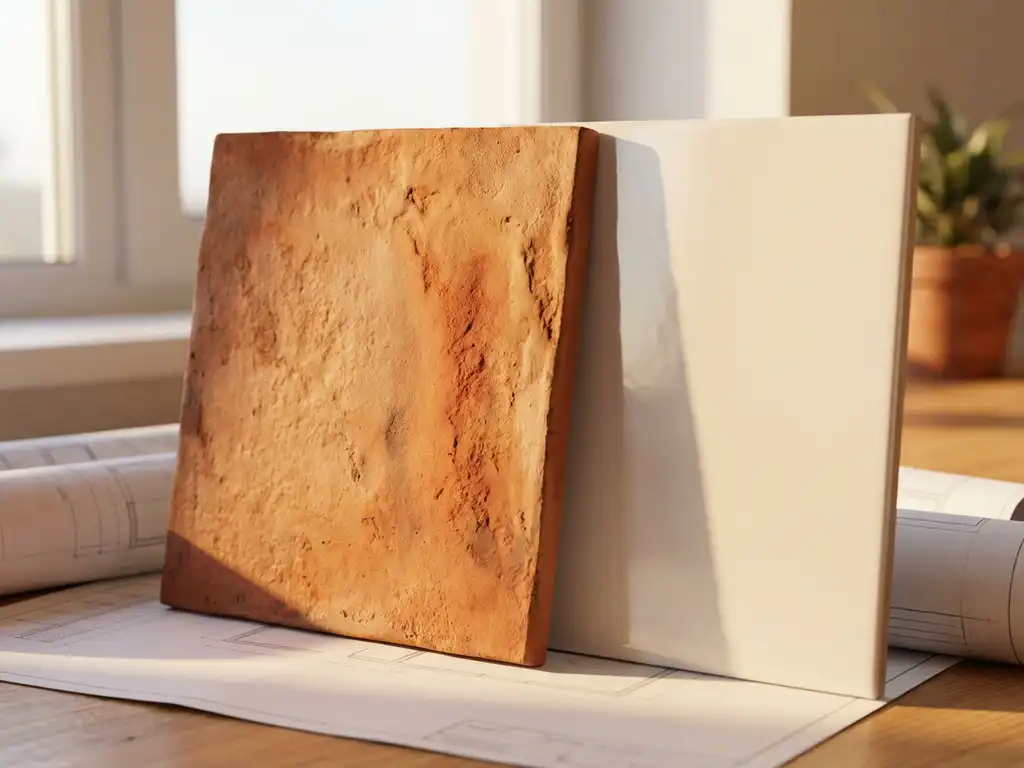
When choosing between terracotta facade panels and porcelain facade panels, the decision affects your building’s performance, aesthetics, and long-term costs. Terracotta uses natural clay fired at lower temperatures, while porcelain employs refined materials with higher firing temperatures for increased density. Both ceramic facade systems offer durability and design flexibility, but their material differences create distinct advantages for different applications.
What’s the actual difference between terracotta and porcelain facade panels?
Terracotta facade panels are made from natural clay fired at temperatures between 950–1100°C, creating a porous ceramic material with earthy characteristics. Porcelain facade panels use refined clay and additives fired at higher temperatures of 1200–1400°C, resulting in a denser, less porous material with superior strength properties.
The manufacturing process fundamentally shapes each material’s performance. Terracotta’s lower firing temperature preserves the natural clay’s character, creating slight variations in colour and texture that many architects value for an authentic appearance. The material remains breathable with natural thermal expansion properties.
Porcelain’s high-temperature firing process creates a vitrified surface that’s nearly non-porous. This ceramic cladding achieves consistent colour throughout the panel thickness and maintains a uniform appearance across large installations. The denser structure provides higher mechanical strength and better resistance to staining and weathering.
Both materials fall under ceramic facade systems, but their structural characteristics make them suitable for different architectural requirements and performance expectations.
Which facade material performs better in harsh weather conditions?
Porcelain facade panels typically outperform terracotta in harsh weather conditions due to their lower water absorption rate (less than 0.5%) compared with terracotta’s 6–12% absorption. This difference significantly impacts freeze–thaw resistance, stain resistance, and long-term durability in challenging climates.
In freeze–thaw cycles, porcelain’s minimal water absorption prevents ice formation within the material structure, eliminating the risk of cracking from internal expansion. Terracotta’s higher porosity makes it more vulnerable to freeze damage, particularly in regions with frequent temperature fluctuations around the freezing point.
UV resistance favours porcelain as well. The high-temperature firing process creates colour stability that maintains appearance over decades without fading. Terracotta can experience colour changes over time, though many consider this natural weathering aesthetically pleasing.
Both materials handle thermal expansion well, but porcelain’s uniform density provides more predictable movement patterns. This consistency simplifies structural calculations and reduces the risk of differential movement issues in facade system specifications.
For coastal environments, porcelain’s non-porous surface resists salt penetration better than terracotta, preventing long-term degradation from marine exposure.
How do installation requirements differ between terracotta and porcelain panels?
Terracotta facade panels require more robust structural support due to their weight (typically 35–50 kg/m²) and expansion characteristics. Porcelain panels are generally lighter (25–40 kg/m²) and offer more predictable dimensional stability, simplifying mounting system design and reducing structural loads.
Mounting systems for terracotta often incorporate additional movement joints to accommodate the material’s natural expansion and contraction. The installation process requires careful attention to sealant selection and joint sizing to prevent water ingress while allowing thermal movement.
Porcelain’s dimensional stability allows for tighter tolerances and more streamlined fixing systems. Many exterior facade panels in porcelain use mechanical fixing systems that can be installed more quickly with less specialised labour.
Both materials benefit from back-ventilated rainscreen systems, but porcelain’s lower thermal mass and expansion rates make system design more straightforward. The reduced structural requirements for porcelain can translate to cost savings in the supporting framework.
Installation complexity differs mainly in joint detailing and waterproofing requirements. Terracotta’s higher porosity demands more attention to weather sealing, while porcelain’s dense surface allows for simpler weatherproofing strategies.
What are the long-term maintenance costs for each facade system?
Porcelain facade panels typically require lower long-term maintenance due to their non-porous surface that resists staining, biological growth, and weather-related degradation. Terracotta’s natural porosity may require more frequent cleaning and occasional treatments to maintain optimal appearance and performance.
Cleaning requirements differ significantly between the materials. Porcelain’s smooth, dense surface can often be maintained with standard pressure washing and mild detergents. Stubborn stains rarely penetrate the surface, making removal straightforward.
Terracotta may develop biological growth in humid conditions due to its porosity, requiring specialised cleaning products and techniques. However, many building owners appreciate the natural weathering process that gives terracotta its characteristic patina over time.
Replacement considerations favour porcelain for individual panel replacement due to colour consistency. New porcelain panels will closely match the appearance of the existing installation. Terracotta replacement panels may show colour variations that require weathering time to blend naturally.
Both materials offer excellent longevity when properly installed and maintained. The choice of building facade materials often comes down to whether you prefer porcelain’s consistent, low-maintenance appearance or terracotta’s evolving, natural character that requires more hands-on care.
Which material offers better design flexibility and aesthetic options?
Both terracotta and porcelain facade panels offer extensive design flexibility, but in different ways. Terracotta provides natural colour variations and organic textures that create authentic, handcrafted appearances. Porcelain offers precise colour matching, consistent finishes, and the ability to replicate various materials, including stone, wood, and metal textures.
Size capabilities differ between the materials. Porcelain can be manufactured in larger panel sizes (up to 1600 mm × 3200 mm) with consistent quality, enabling dramatic architectural statements with minimal joints. Terracotta panels are typically smaller due to manufacturing constraints and thermal movement considerations.
Surface finish options showcase each material’s strengths. Terracotta naturally develops varied textures from the clay body and firing process, creating depth and visual interest. Porcelain can achieve virtually any surface texture through advanced manufacturing techniques, from smooth polished finishes to rough stone replications.
Colour consistency represents a key difference. Porcelain maintains uniform colour throughout production runs and over time, which is crucial for large installations requiring perfect matching. Terracotta’s natural colour variations add character but may complicate projects requiring precise colour coordination.
Custom capabilities favour porcelain for complex shapes and specific performance requirements. The material can be engineered to meet exact specifications while maintaining aesthetic goals. Understanding the surfaces and formats available for different facade systems helps architects make informed decisions about material selection.
How TONALITY® ceramic facades solve common specification challenges
TONALITY® ceramic facade systems address key specifier concerns through advanced manufacturing processes that combine the best characteristics of traditional ceramic materials with modern engineering requirements. The single-layer production method creates panels with exceptional dimensional accuracy and consistent performance properties.
Key specification advantages include:
- Simplified installation – Profiled backing system interlocks with vertical aluminium profiles for straightforward mounting
- Superior fire safety – A1 classification ensures non-combustible performance for enhanced building safety
- Reduced structural loads – Low surface weight of approximately 40 kg/m² minimises substructure requirements
- Complete recyclability – 100% recyclable materials support sustainable building practices
- Integrated protection – Built-in graffiti resistance and permanent UV stability reduce maintenance needs
- Precise manufacturing – Tolerance within 1 mm ensures consistent installation and appearance
The ceramic elements provide long-term value through maintenance-free performance and permanent colour stability. For timber construction projects, the lightweight panels offer excellent fire protection while reducing structural complexity. You can explore our project references to see how these systems perform across different applications and architectural styles.
Contact TONALITY® to discuss how our ceramic facade systems can meet your specific project requirements and specification challenges.