

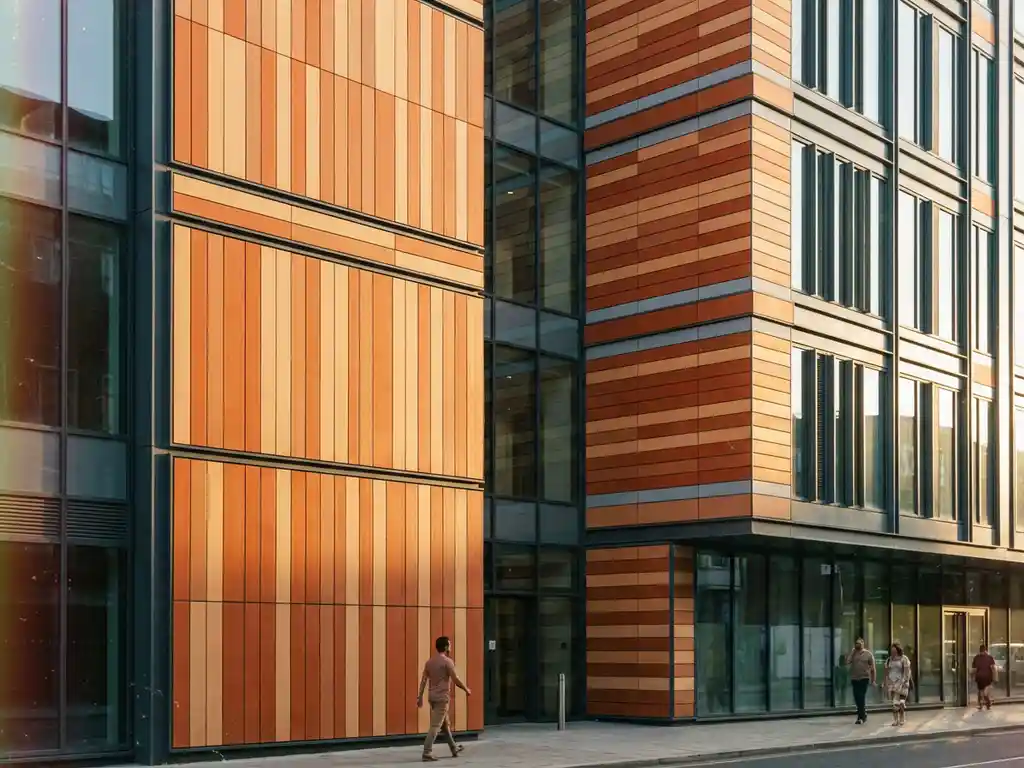
How does panel orientation affect a building’s visual height?
Vertical terracotta panels create the illusion of increased building height by drawing the eye upward, while horizontal panels emphasize width and can make buildings appear lower and more grounded. This visual effect occurs because our eyes naturally follow the dominant lines created by the orientation of the ceramic facade.
The psychological impact of this orientation choice extends beyond a simple optical illusion. Vertical terracotta panels create strong vertical lines that emphasize a building’s soaring qualities, making even modest structures appear more imposing and elegant. This effect is particularly pronounced on tall buildings, where the vertical emphasis can enhance the sense of grandeur and architectural ambition.
Conversely, horizontal terracotta cladding creates visual weight at the base of a building and can help integrate structures more harmoniously with their surroundings. The horizontal emphasis tends to make buildings feel more stable and approachable, which explains why this orientation is often chosen for residential and community buildings where a welcoming appearance is desired.
What psychological effects do vertical vs. horizontal terracotta panels create?
Vertical terracotta panels evoke feelings of aspiration, formality, and strength, while horizontal panels create impressions of stability, relaxation, and accessibility. These psychological responses stem from our innate associations with vertical and horizontal lines in nature and in built environments.
The upward thrust of a vertical ceramic facade mirrors natural elements like trees and mountain peaks, subconsciously communicating growth, achievement, and power. This makes vertical terracotta panel orientation particularly effective for corporate headquarters, institutional buildings, and luxury developments where conveying authority and prestige is important.
Horizontal terracotta panels, by contrast, echo the horizon line and the natural stratification found in landscapes. This orientation creates a sense of calm and permanence that makes viewers feel more comfortable and grounded. The horizontal emphasis also suggests openness and transparency, making it an excellent choice for public buildings, educational facilities, and healthcare environments where approachability is paramount.
Which terracotta panel orientation works best for different building types?
Commercial and institutional buildings typically benefit from vertical terracotta panels to convey authority and presence, while residential and hospitality projects often favor horizontal panels for their welcoming, human-scaled appearance. The choice should align with the building’s intended function and desired architectural character.
Office towers and corporate headquarters gain significant visual impact from a vertical ceramic facade, as the upward emphasis reinforces themes of progress and ambition. Similarly, religious buildings and cultural institutions often employ vertical terracotta cladding to create a sense of reverence and monumentality that enhances their civic importance.
Residential developments, schools, and community centers frequently use horizontal terracotta panel orientation to create more approachable facades that feel integrated with their neighborhoods. The horizontal emphasis helps these buildings avoid appearing imposing or institutional, instead fostering a sense of belonging and accessibility that residents and visitors find welcoming.
How do lighting conditions affect terracotta panel orientation perception?
Natural lighting dramatically influences how terracotta panel orientation is perceived: vertical panels create stronger shadow patterns that enhance depth and texture, while horizontal panels produce more uniform light distribution across the facade. The interplay between ceramic surface texture and orientation determines the overall visual impact throughout the day.
During morning and evening hours, when sunlight strikes facades at acute angles, vertical terracotta panels create pronounced shadow lines that emphasize the building’s height and add dramatic visual interest. These shadow patterns shift throughout the day, creating a dynamic facade that changes character with the sun’s movement.
Horizontal terracotta cladding tends to receive more consistent illumination, as horizontal surfaces can catch light more evenly. This creates a calmer, more stable appearance that remains relatively consistent throughout daylight hours. However, horizontal panels can create interesting shadow effects under overhanging elements or when the sun is at lower angles, adding subtle depth without the dramatic contrast seen with vertical orientations.
What installation considerations differ between vertical and horizontal terracotta panels?
Vertical terracotta panel installation requires more precise alignment to maintain clean vertical lines, while horizontal installation focuses on ensuring level courses and managing thermal expansion across longer horizontal runs. Both orientations demand specific attention to weatherproofing and structural support systems.
Installing a vertical ceramic facade typically involves more complex coordination of vertical alignment across multiple floors. Installers must ensure that vertical joints align perfectly from ground to roof, which requires careful planning and precise measurement. The vertical orientation also affects how rainwater flows down the facade, requiring specific attention to water-management details at horizontal joints.
Horizontal terracotta cladding installation presents different challenges, particularly in maintaining level courses across wide building faces. Thermal expansion becomes more critical with horizontal orientation, as longer horizontal runs can experience more significant movement. Additionally, horizontal installations require careful attention to the visual impact of vertical joints, ensuring they create an acceptable pattern rather than appearing random or poorly planned.
How TONALITY® Ceramic Facades Support Optimal Panel Orientation
TONALITY® ceramic facade systems provide the precision and versatility needed to achieve outstanding results with both vertical and horizontal terracotta panel orientations. Our advanced manufacturing process ensures dimensional accuracy within one millimeter, enabling perfect alignment regardless of your chosen orientation.
Key advantages of TONALITY® systems for panel orientation include:
- Precise dimensional control for seamless vertical or horizontal alignment
- Lightweight construction (40 kg/m²), reducing structural requirements for any orientation
- Interlocking aluminum profile system, simplifying installation complexity
- Wide format range (150 × 300 mm to 400 × 1600 mm), optimizing visual impact with various surfaces and formats
- Superior surface quality, maintaining consistent appearance across all orientations
Whether your project demands the soaring elegance of vertical panels or the grounded stability of a horizontal orientation, TONALITY® delivers the technical precision and aesthetic excellence your architectural vision requires. Explore our successful project references to see how strategic panel orientation has enhanced building visual impact, or contact our facade specialists to discuss how our ceramic systems can elevate your specific architectural requirements.
Related Articles
- Are ceramic facades suitable for all climates in 2026?
- Which LEED credits can terracotta facades help achieve?
- What acoustic benefits do terracotta facades provide?
- Where should expansion and movement joints be placed in large terracotta facades?
- What is biophilic design and why is terracotta ideal for it?