

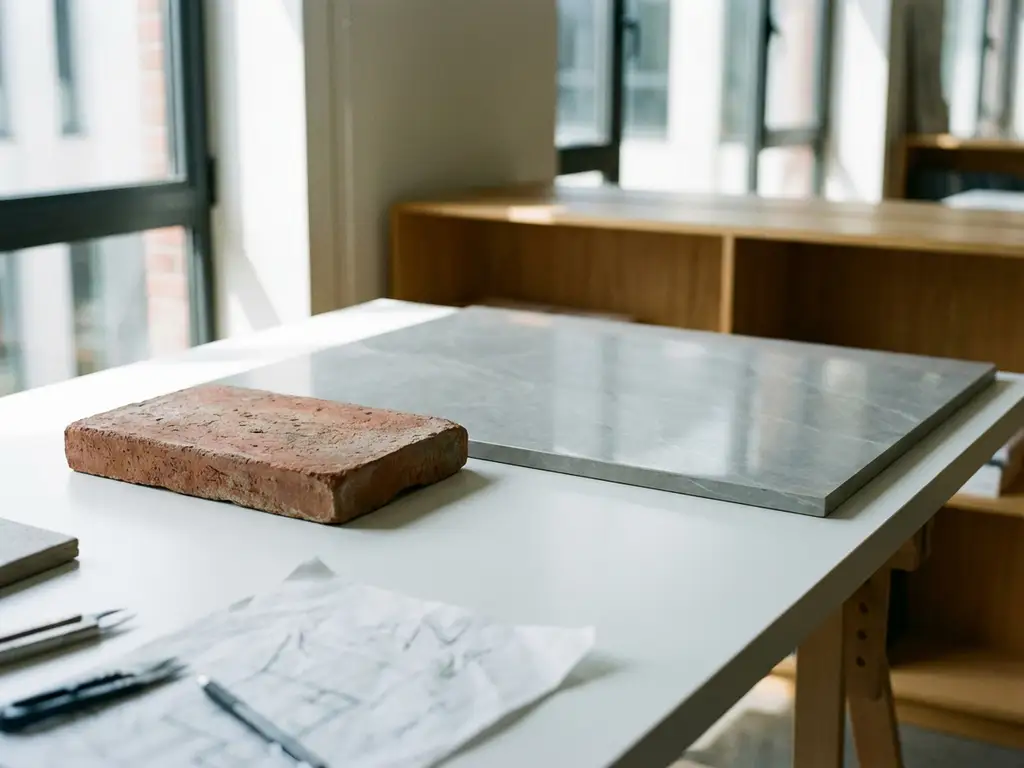
What’s the difference between terracotta and large-format porcelain façades?
Terracotta façades are made from natural clay fired at lower temperatures (900–1,000°C), while large-format porcelain façades use refined ceramic materials fired at higher temperatures (1,200°C+), resulting in denser, less porous surfaces with superior technical performance.
The manufacturing process creates distinct characteristics in each material. Terracotta maintains a more traditional, earthy appearance, with natural color variations that reflect its clay origins. The lower firing temperature preserves some porosity, which can contribute to weathering over time but also provides authentic texture and character.
Large-format porcelain façades undergo a more intensive production process involving carefully selected raw materials and higher firing temperatures. This ceramic façade comparison shows that porcelain achieves greater dimensional stability, lower water absorption rates, and more consistent surface properties. Advanced manufacturing also allows for precise control over color, texture, and format dimensions.
How do the technical specifications compare between terracotta and porcelain façades?
Porcelain façades significantly outperform terracotta in key technical specifications: water absorption rates below 0.5% versus 6–20% for terracotta, frost-resistance ratings exceeding 150 freeze–thaw cycles, and dimensional tolerances within ±1 mm compared to ±3–5 mm for traditional terracotta.
The density difference between these façade materials creates measurable performance gaps. Porcelain façade tiles achieve compressive strengths exceeding 80 N/mm², while terracotta typically ranges from 20–40 N/mm². This enhanced strength translates to better resistance to impact damage and structural stress.
Surface hardness is another critical distinction in this building-materials comparison. Porcelain façades rate 6–7 on the Mohs scale, approaching the hardness of natural stone, while terracotta typically measures 4–5. This difference affects long-term appearance retention, scratch resistance, and maintenance requirements across the building’s lifecycle.
Which façade material offers better durability and weather resistance?
Large-format porcelain provides superior durability and weather resistance due to its ultra-low porosity, complete frost resistance, and permanent UV stability. Unlike terracotta, which can experience color fading and surface degradation over decades, porcelain maintains a consistent appearance and structural integrity.
Weather resistance stems from fundamental material properties. Porcelain’s vitrified surface prevents water penetration that causes freeze–thaw damage, while terracotta’s higher porosity makes it vulnerable to moisture-related deterioration. This ceramic cladding advantage becomes particularly important in harsh climatic conditions with frequent temperature cycling.
Long-term performance data shows porcelain façades maintaining their original appearance and structural properties for 50+ years with minimal maintenance. The material’s inherent UV resistance prevents the color shifts and surface chalking that can affect terracotta installations over time, especially in high-exposure applications.
What are the installation differences between terracotta and large-format porcelain systems?
Large-format porcelain systems offer faster, more precise installation through advanced mechanical fixing systems and tighter dimensional tolerances. While traditional terracotta often requires mortar-based installation and skilled craftsmanship, modern porcelain systems use engineered mounting profiles for consistent, efficient installation.
The dimensional precision of porcelain façade tiles enables systematic installation approaches. Consistent sizing within ±1 mm tolerances allows for predictable joint widths and alignment, reducing on-site adjustments and installation time. This precision also supports innovative fixing systems that can accommodate thermal movement while maintaining weathertight performance.
Weight considerations also influence installation methodology. Modern ceramic façade systems with large-format porcelain typically weigh 40–50 kg/m², requiring appropriate substructure design but allowing for streamlined installation sequences. The reduced thickness compared to traditional terracotta can also minimize structural loading requirements.
How do the costs compare between terracotta and porcelain façade systems?
While porcelain façades typically require a higher initial investment than terracotta, they deliver superior lifecycle value through reduced maintenance needs, enhanced durability, and a longer service life. Total cost of ownership analysis consistently favors porcelain systems over 25–50-year building lifecycles.
Lifecycle cost advantages emerge from multiple factors. Porcelain’s superior weather resistance eliminates the periodic cleaning, sealing, and replacement cycles that terracotta may require. Permanent color stability and surface integrity reduce ongoing maintenance interventions that can represent significant expenses over decades.
Installation efficiency also contributes to overall project economics. The precision and systematic installation possible with engineered porcelain systems can reduce labor costs and project timelines compared to traditional terracotta installation methods. These factors, combined with enhanced performance characteristics, support the long-term return on investment for porcelain façade systems.
How TONALITY® Delivers Advanced Ceramic Façade Solutions
TONALITY® combines the best aspects of both materials through advanced ceramic façade systems that deliver porcelain-level performance with design versatility. Our sinter-fired ceramic elements achieve the technical superiority of large-format porcelain while offering extensive customization options for architectural expression.
Key advantages of TONALITY® ceramic façades include:
- Ultra-low surface weight of 40 kg/m² for reduced structural requirements
- Building material class A1 certification for non-combustible performance
- Integrated graffiti protection and permanent UV resistance
- Simple interlocking installation system for efficient project delivery
- 100% recyclable materials supporting sustainable construction goals
- Precise dimensional control within 1 mm tolerances
Discover how TONALITY® ceramic façade systems can deliver the technical performance and design flexibility your project requires. Contact our technical team to discuss your specific façade requirements and explore our comprehensive range of colors, surfaces, and formats. You can also review our successful project implementations to see how these advanced ceramic solutions perform in real-world applications.
Ähnliche Artikel
- Kann eine Schulgebäude Sanierung ohne Betriebsunterbrechung CO2-neutral umgesetzt werden?
- What makes a building design truly timeless?
- How do sustainable materials perform in extreme weather?
- What is building material class A1 in building codes?
- How do ceramic tiles compare to other sustainable options?