

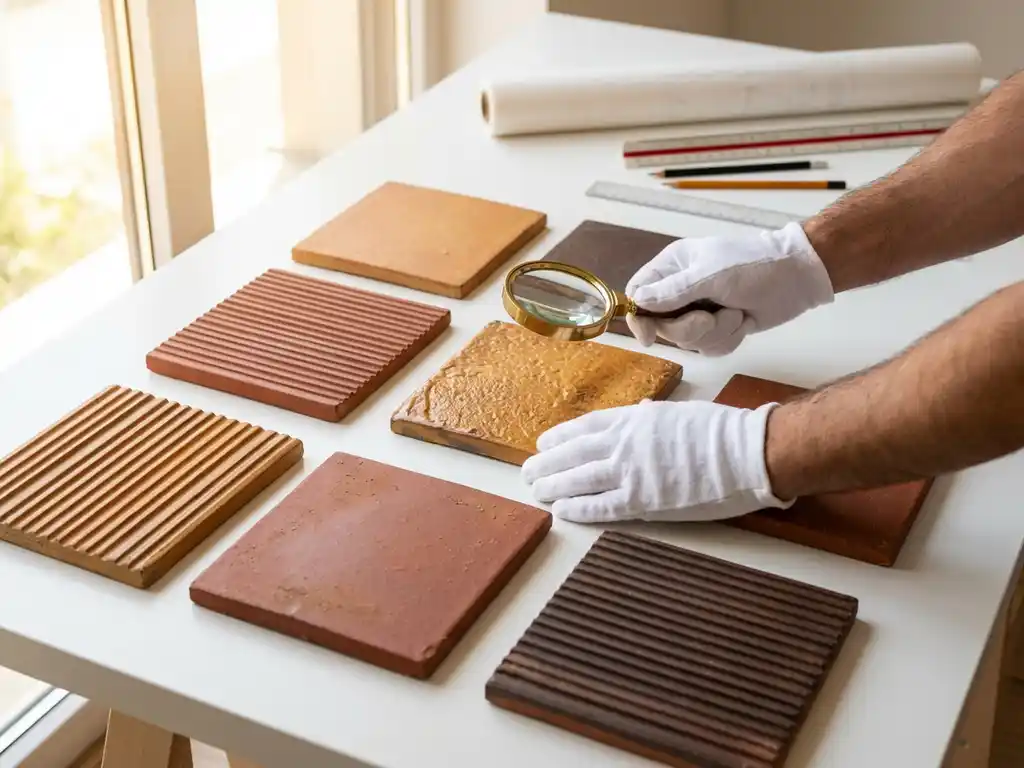
Why Sample Evaluation Determines Project Success
Selecting the right terracotta manufacturer begins with thorough sample evaluation, a critical step that directly impacts your project’s long-term performance and aesthetic success. Quality ceramic façade samples reveal essential characteristics that specifications alone cannot communicate, from surface texture variations to dimensional precision that affects installation efficiency.
Professional architects and specifiers understand that sample assessment goes beyond visual appeal. The evaluation process uncovers potential issues before they become costly problems during construction, ensuring your façade material selection aligns with both design intent and performance requirements. A systematic approach to terracotta evaluation protects project timelines and delivers lasting results.
1: Assess Surface Quality and Finish Consistency
Surface quality examination reveals the manufacturer’s production control and finishing capabilities, directly impacting your façade’s visual uniformity and weather resistance. Look for consistent color depth, uniform texture patterns, and smooth transitions across sample surfaces without visible defects, pitting, or irregular glazing.
Run your hand across multiple samples to detect subtle variations in surface smoothness that photographs cannot capture. Quality ceramic tiles should exhibit identical tactile characteristics across the entire sample set, indicating reliable manufacturing processes. Pay particular attention to edge finishing and corner details, as these areas often reveal production shortcuts that compromise both appearance and performance.
2: Test Dimensional Accuracy and Tolerances
Precise dimensional accuracy ensures seamless installation and eliminates costly field adjustments during construction. Measure sample dimensions using calibrated tools, comparing actual measurements against specified tolerances to verify manufacturing precision within acceptable limits.
Check for consistent thickness across each sample, as variations can create installation challenges and visible surface irregularities. Quality terracotta manufacturers maintain dimensional tolerances within one millimeter, enabling predictable installation sequences and uniform joint lines. Document any dimensional discrepancies, as they often indicate broader quality control issues that could affect your entire order.
3: Evaluate Structural Integrity and Durability
Structural assessment determines whether ceramic façade samples can withstand environmental stresses and maintain performance over decades of service. Examine sample density and weight, as properly fired ceramic tiles exhibit consistent density throughout their cross-section without voids or weak spots.
Test thermal shock resistance by exposing samples to temperature variations similar to your project location’s climate conditions. Quality ceramic materials demonstrate excellent thermal stability without cracking, crazing, or surface degradation. Additionally, assess frost-resistance capabilities if your project experiences freeze-thaw cycles, ensuring long-term durability in challenging weather conditions.
4: Examine Installation System Compatibility
Installation system evaluation ensures seamless integration between ceramic elements and mounting hardware, preventing field complications that delay project completion. Review back-side profiling accuracy and verify that mounting points align precisely with specified fastening systems.
Test sample attachment methods using actual installation hardware to confirm proper fit and secure connection. Quality façade systems feature interlocking profiles that engage smoothly without forcing or modification, indicating thoughtful engineering and manufacturing precision. Consider substructure compatibility, particularly for timber construction, where reduced dead weight becomes essential for structural efficiency.
5: Verify Technical Certifications and Standards
Technical certification verification confirms that ceramic façade samples meet required building standards and performance specifications for your project application. Review fire-resistance classifications, ensuring materials achieve appropriate ratings, such as an A1 non-combustible designation for projects requiring superior fire safety performance.
Examine documentation for thermal performance characteristics, UV resistance testing, and environmental impact assessments that support sustainable building certifications. Reputable terracotta manufacturers provide comprehensive technical data supporting their performance claims, including independent testing results that validate long-term durability and maintenance requirements.
Making Informed Decisions for Lasting Façades
Comprehensive sample evaluation creates the foundation for confident façade material selection, ensuring your terracotta manufacturer can deliver consistent quality throughout your project. Document evaluation findings systematically, comparing multiple manufacturers’ samples using identical criteria to make objective decisions based on performance rather than assumptions.
Remember that sample quality directly reflects production capabilities and quality control standards that will impact your entire order. Invest adequate time in thorough evaluation, as this upfront diligence prevents costly issues and ensures your ceramic façade delivers the performance, appearance, and longevity your project demands.
How TONALITY® Supports Your Sample Evaluation Process
TONALITY® provides comprehensive sample sets that demonstrate our commitment to manufacturing excellence and help you make informed façade material decisions. Our ceramic façade samples showcase the superior quality achieved through specialized sinter-firing processes at temperatures exceeding 1,200 degrees Celsius, delivering the consistency and precision your evaluation process demands.
- Precise dimensional accuracy within one-millimeter tolerances across all sample formats
- Complete technical documentation, including A1 fire classification and performance data
- Back-profiled samples demonstrating compatibility with our aluminum retaining profiles
- Surface quality examples showcasing our naturally versatile colors and textures
- Lightweight samples highlighting reduced substructure requirements for various applications
Contact our technical team to request comprehensive sample sets that support your thorough evaluation process and demonstrate why TONALITY® ceramic façades deliver lasting performance for demanding architectural projects.
Related Articles
- What are sustainable building materials?
- How to Evaluate and Shortlist Terracotta Manufacturers for Your Project
- What is an EPD and why does it matter for facade specification?
- Can terracotta facades withstand extreme weather conditions?
- How do you install terracotta facade panels?
Related Articles
- Why do hospitals and healthcare facilities increasingly specify terracotta facades?
- Terracotta vs Brick Slips: Choosing the Right Clay-Based Cladding
- What terracotta colors and glazes work best for different building contexts?
- 6 Advantages of Terracotta Over Fiber Cement Cladding
- How do aluminum and steel substructures compare for terracotta?