

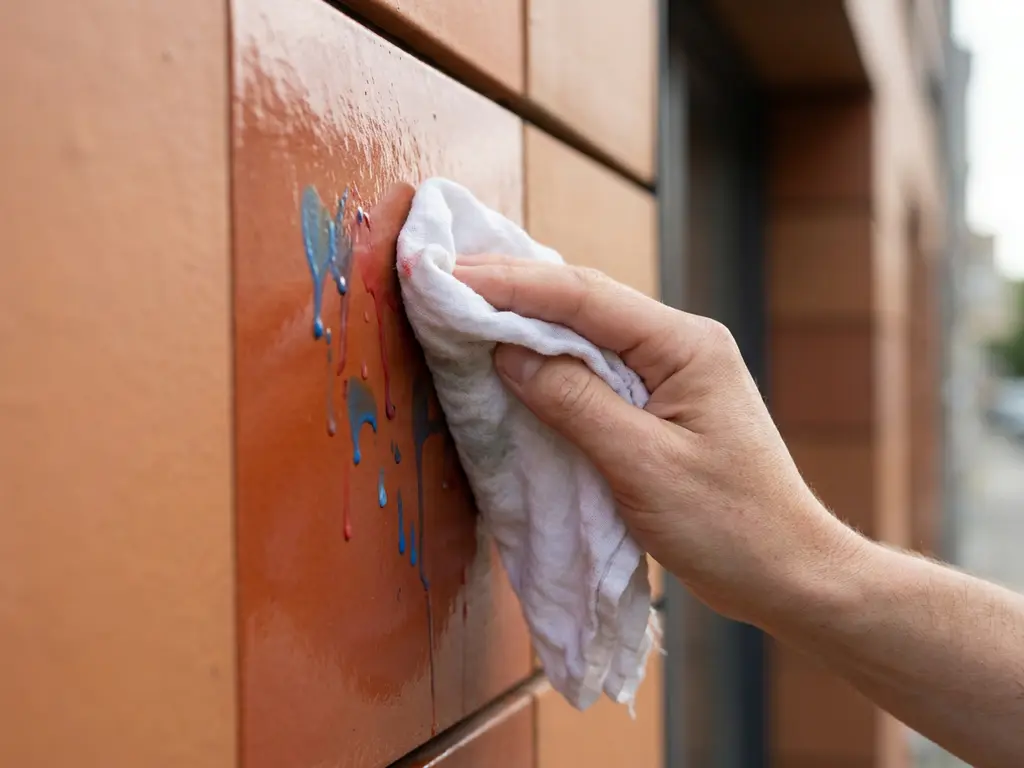
Yes, terracotta facades do offer graffiti resistance, and high-quality ceramic cladding systems take this a step further by integrating protection directly into the material itself. The dense, vitrified surface produced through high-temperature sinter firing makes it significantly harder for spray paint and markers to penetrate the tile. The sections below unpack exactly how this works, how long it lasts, and what it means in practice for contractors and project managers.
How does graffiti protection work on ceramic facades?
Graffiti protection on ceramic facades works through the material’s inherent surface density rather than a separate coating. During production, ceramic tiles fired at temperatures exceeding 1,200 degrees Celsius develop an extremely smooth, non-porous surface. Paint and ink struggle to bond with this vitrified layer, making removal far easier than on rougher or more absorbent materials.
This is fundamentally different from applied anti-graffiti coatings used on concrete or brick, which can wear away over time and need reapplication. With high-fired ceramic, the protective quality is structural. The surface itself acts as a barrier because there are no microscopic pores or surface irregularities for paint to grip. On ceramic facade tiles, this characteristic is built into every square meter from the moment of production.
In practical terms, this means that fresh graffiti applied to a ceramic facade surface sits on top of the tile rather than soaking into it. The window for clean removal is wider, and the process requires less aggressive intervention compared with more porous substrates.
Does terracotta graffiti protection last as long as the facade itself?
Yes, because the graffiti resistance of terracotta and high-fired ceramic is a property of the material rather than a surface treatment, it does not degrade, wear off, or require renewal over the facade’s lifespan. A ceramic facade element fired at high temperature retains its dense, smooth surface for decades under normal weathering conditions.
This is a meaningful lifecycle advantage for building owners and project managers. Applied anti-graffiti treatments on other materials typically have a service life measured in years, not decades, and reapplication carries both labor costs and scheduling disruption. With ceramic cladding, the total cost of ownership benefits from the absence of this recurring maintenance cycle entirely. To get a clearer sense of how this performs across real projects, exploring completed facade references can provide useful context.
UV resistance and permanent color stability reinforce this durability. The same firing process that creates the dense surface also locks in color without the use of surface coatings, meaning the facade continues to look consistent and well-maintained even in high-traffic or urban environments where graffiti incidents are more frequent.
How do you remove graffiti from terracotta cladding?
Graffiti removal from terracotta cladding is straightforward because the dense, low-porosity surface prevents paint from fully bonding. In most cases, fresh graffiti can be removed with water, a mild detergent, and a soft brush or a pressure washer. For older or more stubborn markings, a solvent-based cleaner appropriate for ceramic surfaces is typically sufficient.
The key practical points for contractors and maintenance teams are:
- Act quickly: The sooner graffiti is addressed after it appears, the easier removal becomes. Even on ceramic surfaces, extended exposure allows some paint products to cure more fully.
- Avoid abrasive tools: Steel brushes or abrasive pads are unnecessary and can scratch the smooth surface. Soft brushes and pressure washing are the appropriate first steps.
- Use compatible cleaning agents: Solvent-based removers formulated for ceramic or glazed surfaces are effective without damaging the tile. Avoid highly acidic or alkaline products unless confirmed compatible by the manufacturer.
- No surface restoration needed: Unlike painted or coated materials, successfully cleaned ceramic tiles do not require re-sealing or re-coating after graffiti removal.
This low-effort removal process is one of the practical day-to-day advantages of specifying ceramic facade systems in urban or publicly accessible locations. For teams evaluating specific products ahead of specification, requesting samples and technical downloads is a useful step before committing to a system.
Are all terracotta facades equally resistant to graffiti?
No, not all terracotta facades offer the same level of graffiti resistance. The degree of protection depends heavily on the firing temperature, production method, and resulting surface density of the ceramic. Lower-fired or traditionally produced terracotta tiles tend to have a more open, porous surface that absorbs paint more readily and makes graffiti removal more difficult.
High-performance ceramic facade systems produced through a sinter firing process at temperatures above 1,200 degrees Celsius achieve a fundamentally different surface quality. The vitrification that occurs at these temperatures closes the surface structure, creating the smooth, dense finish that underpins effective graffiti resistance. This is distinct from standard terracotta, which is typically fired at lower temperatures and retains a more textured, absorbent surface.
Surface finish also plays a role. Highly textured or deliberately rough facade tiles, regardless of firing temperature, provide more surface area and more mechanical grip for paint to adhere to. Smooth-surfaced, high-fired ceramic tiles offer the best combination of aesthetic flexibility and practical resistance to graffiti adhesion. Understanding the full range of available surfaces and formats helps specifiers match the right product to both the design intent and the performance requirements of a given project.
For project managers specifying facades for urban locations, transport infrastructure, or any building with significant public exposure, the production method and firing specification are worth examining carefully rather than assuming all ceramic or terracotta products perform equally.
What other facade materials offer built-in graffiti resistance?
Several facade materials offer meaningful graffiti resistance, though the mechanisms and maintenance implications vary. High-fired ceramic and porcelain cladding sit at the top of the performance range because their resistance is structural rather than applied. Glass and metal panels with factory-applied coatings also perform well, though the coating quality and durability differ by product.
Comparing the most common options:
- High-fired ceramic and porcelain: Built-in resistance through surface density. No maintenance required to sustain protection. Long service life with no reapplication cycles.
- Glass cladding: Non-porous and naturally resistant, but heavier, more fragile, and typically more complex to install and replace after damage.
- Powder-coated metal panels: Smooth surfaces resist paint adhesion reasonably well, but the coating can be damaged by aggressive cleaning agents used during graffiti removal, potentially requiring refinishing.
- Fiber cement with applied coatings: The base material is porous, so graffiti resistance depends entirely on the coating. When the coating degrades or is damaged, the substrate becomes vulnerable.
- Brick and concrete: Naturally porous and difficult to clean without surface damage. Typically require applied anti-graffiti treatments that need periodic renewal.
For projects where long-term, maintenance-free graffiti resistance is a design requirement, ceramic facade systems offer a strong combination of performance, durability, and reduced lifecycle burden compared with materials that depend on applied surface treatments to achieve similar results.
How TONALITY® helps with graffiti-resistant facade specification
TONALITY® ceramic facade systems are engineered to deliver graffiti resistance as a built-in material property, not an afterthought. The high-temperature sinter firing process used in production results in a dense, vitrified surface that prevents paint from bonding at a structural level — eliminating the need for applied treatments and the recurring maintenance they require.
Specifically, TONALITY® offers:
- Inherent surface density: Tiles fired above 1,200°C achieve a non-porous surface that resists paint adhesion without any additional coating or treatment.
- Permanent protection: Graffiti resistance does not degrade over the facade’s lifespan, removing the cost and disruption of periodic reapplication cycles.
- Easy cleaning: Fresh graffiti can typically be removed with water and a mild detergent, while more persistent markings respond to standard solvent-based ceramic cleaners — no abrasives, no re-sealing required.
- A wide range of surfaces and formats: Smooth-surfaced options optimized for graffiti resistance are available across a broad palette of colors and dimensions, supporting both functional and design requirements.
- Verified real-world performance: TONALITY® systems have been specified across urban, transport, and public-facing projects where long-term maintainability is a core requirement.
If you are specifying a facade for a location with significant public exposure and want to understand which TONALITY® products best meet your graffiti resistance and maintenance requirements, get in touch with the TONALITY® sales team to discuss your project in detail.