

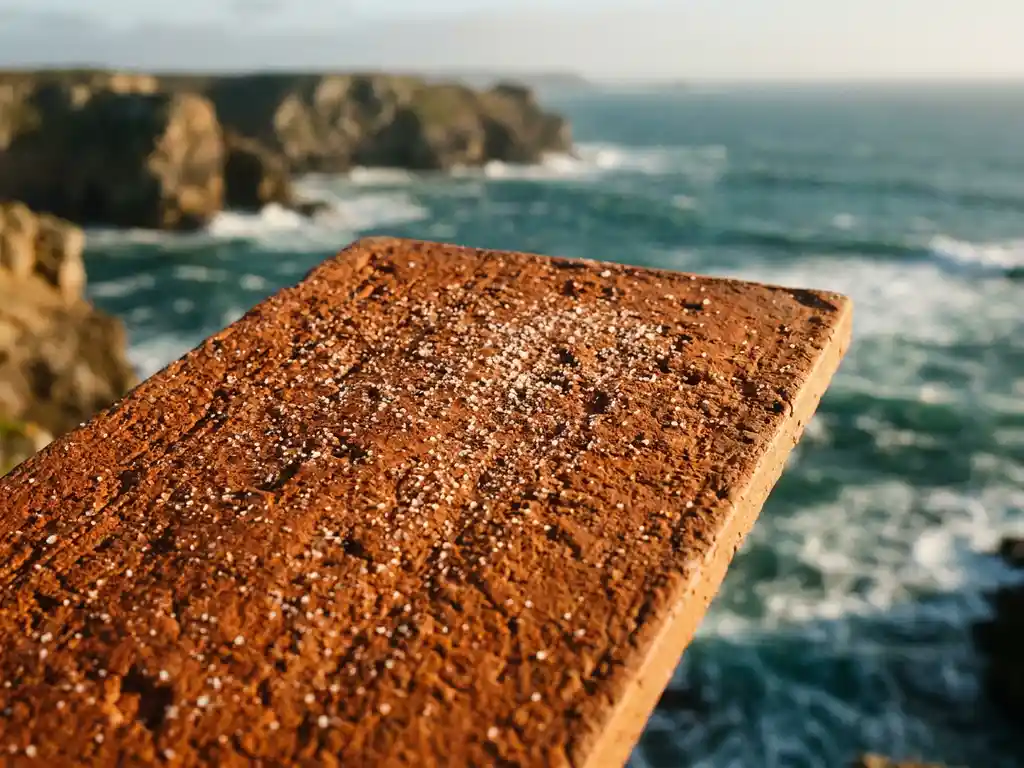
Terracotta and ceramic facades are highly resistant to salt air corrosion. Unlike metals or cementitious materials, fired ceramic does not corrode, oxidize, or absorb the moisture that salt-laden air carries. This makes terracotta one of the most dependable cladding choices for buildings in coastal environments, from seaside residences to large commercial developments near the ocean.
The sections below walk through the science behind salt air damage, why ceramic materials are naturally suited to resist it, and what to consider when specifying or maintaining a terracotta facade in a coastal climate.
How does salt air actually damage building facades?
Salt air damages facades primarily through two mechanisms: electrochemical corrosion and salt crystallization. Airborne sodium chloride particles settle on facade surfaces and, when combined with moisture, create an electrolyte that accelerates the oxidation of metals and degrades porous materials. Over time, this leads to surface spalling, staining, structural weakening, and accelerated deterioration of finishes.
For metal-based cladding systems, salt air triggers rust and galvanic corrosion, which can compromise both appearance and structural integrity. For concrete and masonry, salt particles infiltrate surface pores. When moisture evaporates, salt crystals expand inside those pores, generating internal pressure that fractures the material from within. This process, known as efflorescence or salt weathering, is one of the most destructive forces acting on coastal buildings.
Paint coatings and sealants offer some protection but are not permanent solutions. They require regular reapplication and often fail at joints and edges first, precisely the areas where moisture ingress is most likely. In high-salinity environments, the maintenance burden on vulnerable facade materials grows considerably over the lifespan of a building.
Why are ceramic and terracotta materials naturally salt-resistant?
Ceramic and terracotta materials are naturally salt-resistant because their dense, vitrified structure leaves almost no porous pathways for salt particles or moisture to penetrate. The firing process transforms raw clay into a hard, low-absorption material that salt air simply cannot work its way into. There is no metal to oxidize and no open pore network for salt crystals to exploit.
The key lies in how ceramic facades are produced. When clay is fired at temperatures exceeding 1,200 degrees Celsius, a sintering process fuses the material into an exceptionally dense matrix. The resulting surface has very low water absorption, which directly removes the primary mechanism through which salt causes damage. Without moisture retention, salt crystallization cannot occur at a meaningful level.
This is fundamentally different from materials that rely on surface coatings to resist the environment. Ceramic’s resistance is intrinsic to the material itself, not applied on top of it. That distinction matters enormously in coastal settings where coatings are subjected to constant UV exposure, temperature cycling, and salt-laden wind, all of which degrade protective layers over time. Architects and specifiers looking to explore the full range of terracotta surfaces and formats available for coastal projects will find a broad selection suited to demanding environmental conditions.
What makes a terracotta facade suitable for coastal buildings?
A terracotta facade is suitable for coastal buildings because it combines inherent material stability with permanent surface performance. It does not corrode, does not absorb salt moisture, and does not require surface treatments to maintain its protective qualities. Its color and UV resistance are built into the fired ceramic body, not dependent on coatings that coastal conditions would quickly degrade.
Beyond the material itself, the ventilated facade system that supports terracotta cladding is well adapted to coastal climates. The air gap between the ceramic elements and the building structure allows moisture to drain and evaporate rather than accumulate behind the cladding. This ventilation reduces the risk of trapped humidity, which is a significant concern in any high-moisture environment.
Terracotta elements are also dimensionally stable. They do not expand or contract significantly with humidity changes, which means joints and connections remain consistent over time. In coastal environments where temperature and humidity fluctuate regularly, this dimensional stability prevents the micro-cracking and joint failure that affect less stable cladding materials. The combination of material durability, low maintenance requirements, and long-term appearance retention makes terracotta a practical and economical choice when lifecycle value is the measure. For a closer look at how these qualities translate into real-world projects, completed facade references from a range of building types and climatic conditions offer useful context.
How do aluminum substructure components hold up against salt air?
Aluminum substructure components perform well in salt air environments when correctly specified and installed. Aluminum naturally forms a stable oxide layer on its surface that acts as a self-protecting barrier against further corrosion. Unlike steel, aluminum does not rust. In coastal applications, anodized or powder-coated aluminum profiles provide an additional layer of protection that extends service life significantly.
The important consideration is material grade and connection detailing. Marine-grade aluminum alloys are formulated for higher salt resistance and should be specified in aggressive coastal environments. Equally important is avoiding galvanic corrosion at fixing points, which occurs when dissimilar metals come into contact in the presence of an electrolyte such as salt water. Proper isolation between aluminum profiles and any steel fixings, using appropriate washers or coatings, prevents this from becoming a long-term issue.
Ventilated facade systems that use aluminum retaining profiles benefit from the same airflow that protects the ceramic cladding. Moisture does not pool behind the facade, which reduces the electrochemical activity that would otherwise accelerate corrosion at connection points. When the full system is correctly detailed, aluminum substructures in coastal buildings can perform reliably for decades without significant maintenance intervention.
Which facade materials perform best in coastal environments?
Fired ceramic and terracotta consistently rank among the best-performing facade materials in coastal environments because of their non-porous surfaces and complete absence of metallic components in the cladding layer itself. Other strong performers include fiber cement, high-pressure laminate panels, and certain natural stones with low porosity. Materials to avoid or treat with caution include uncoated steel, standard concrete, and timber without robust protective systems.
Materials with strong coastal performance
- Fired ceramic and terracotta: Non-porous, non-corrosive, UV stable, and permanently color-fast with no surface treatments required
- Fiber cement: Low absorption and good dimensional stability, though surface coatings still require periodic maintenance
- Natural stone (granite, quartzite): Dense, low-porosity stones resist salt penetration well, though sedimentary stones like limestone are more vulnerable
- High-pressure laminate (HPL): Resistant to moisture and UV when correctly specified, though edge protection is important in high-humidity conditions
Materials that underperform in coastal conditions
- Uncoated or poorly coated steel: Highly susceptible to salt-induced corrosion and requires intensive maintenance programs
- Standard concrete and render: Porous surfaces allow salt infiltration, leading to spalling and reinforcement corrosion over time
- Untreated or inadequately treated timber: Absorbs moisture readily and is vulnerable to rot and salt weathering without robust protective systems
The decisive factor in most material comparisons is not just initial resistance but how performance holds up over a twenty to forty year building lifespan. Ceramic and terracotta facade systems deliver consistent performance throughout that period without the recurring maintenance costs that affect lower-grade alternatives. Specifiers who want to evaluate material options in detail can request samples and technical downloads to assess surface quality and system specifications before committing to a specification.
How do you maintain a terracotta facade in a salty coastal climate?
Maintaining a terracotta facade in a coastal climate is straightforward because the material requires very little intervention. Routine maintenance consists primarily of periodic visual inspections and occasional washing with clean water to remove salt deposits and airborne particulates. No sealing, recoating, or surface treatment is needed to maintain the facade’s protective performance or appearance.
The recommended maintenance rhythm in coastal environments is a visual inspection once or twice a year, with particular attention to the substructure connections, drainage channels, and any sealant joints at penetrations. These are the areas most likely to show early signs of wear, not the ceramic elements themselves.
When washing is required, low-pressure rinsing with water is sufficient for standard salt and dust accumulation. Ceramic facade systems also commonly feature integrated graffiti protection, which simplifies cleaning further if the building is in an urban coastal location. Avoid abrasive cleaning tools or aggressive chemical cleaners, as these are unnecessary for ceramic and could affect sealant materials at joints.
The long-term maintenance picture for terracotta in a coastal climate is one of the material’s strongest arguments. The absence of coatings that degrade, surfaces that corrode, or pores that accumulate salt means the facade continues to perform and look as intended year after year. For building owners and project managers focused on total cost of ownership rather than upfront specification decisions alone, that low-maintenance lifecycle is a compelling and measurable advantage.
How TONALITY® helps with salt-resistant coastal facade design
TONALITY® offers a complete terracotta facade system specifically suited to the demands of coastal environments, combining material performance with engineering precision. For architects, developers, and building owners specifying facades in high-salinity locations, TONALITY® addresses the key challenges directly:
- Inherently salt-resistant ceramic panels: TONALITY® terracotta elements are fired at high temperatures to achieve very low water absorption, eliminating the pore structure that salt crystallization requires to cause damage.
- Ventilated facade system design: The TONALITY® system incorporates a rear-ventilated air gap that prevents moisture accumulation behind the cladding, reducing humidity-related risks in coastal climates.
- Durable aluminum substructure: Profiles are specified and detailed to resist galvanic corrosion, ensuring the full system performs reliably over decades without significant maintenance intervention.
- Wide range of surfaces and formats: TONALITY® offers an extensive selection of finishes and panel dimensions suited to diverse coastal building types, from residential to large-scale commercial facades.
- Low lifetime maintenance costs: With no coatings to reapply and no corrosion to manage at the cladding level, TONALITY® systems deliver a measurably lower total cost of ownership in aggressive coastal conditions.
To discuss your coastal facade project or request technical documentation and samples, get in touch with the TONALITY® team and find out how the system can be specified for your building.