

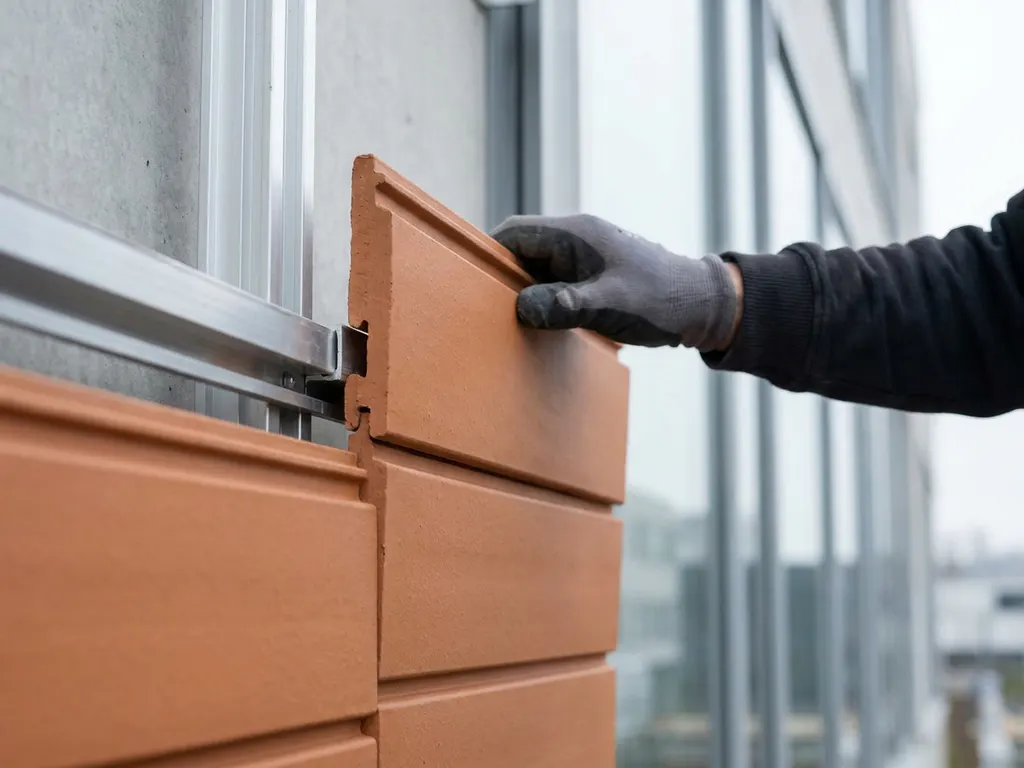
Terracotta facade panels are fixed to a building structure using a rear-ventilated cladding system, where ceramic elements clip or hook onto vertical aluminum retaining profiles anchored to a substructure. The panels do not rely on adhesive bonding to the wall surface, which means the facade remains fully accessible and replaceable throughout the building’s lifetime. The sections below unpack each aspect of this system in practical detail.
What fixing systems are used for terracotta facade panels?
Terracotta facade panels are fixed using mechanical retention systems, most commonly aluminum retaining profiles that engage with profiled grooves on the back of each ceramic element. The panels clip into these vertical rails without the need for adhesives, mortar, or wet trades. Two widely used system types are adaptive systems that accommodate dimensional tolerances and base clinch rail systems that offer a particularly streamlined installation sequence.
The profiled back of each ceramic element is the key to how the system works. The grooves or ribs cast into the rear face of the panel interlock with the aluminum retaining profile, holding the panel securely while still allowing for thermal movement. Because ceramic expands and contracts at a different rate than the substructure behind it, this mechanical float is not a design compromise but a deliberate engineering feature that protects both the panel and the building fabric over decades of use.
Open joints between panels allow any moisture that penetrates the outer face to drain freely and evaporate, which means the fixing system itself is never under sustained water pressure. This significantly extends the service life of both the fixings and the panels compared with sealed or bonded systems where trapped moisture can cause long-term deterioration. Architects and specifiers who want to explore the full range of terracotta facade surfaces and formats will find that panel geometry directly influences which fixing approach is most appropriate for a given project.
How does a ventilated facade system work with ceramic panels?
A ventilated ceramic facade system creates a continuous air cavity between the back of the terracotta panels and the building’s external wall. Cooler air enters at the base of the facade, warms as it rises, and exits at the top, carrying moisture vapor with it. This stack effect keeps the wall construction dry, reduces thermal stress on the building envelope, and contributes meaningfully to overall energy performance.
The cavity is typically between 20 mm and 40 mm wide, though exact dimensions depend on the height of the building and the thermal specification being targeted. The aluminum substructure that carries the ceramic panels also defines and maintains this cavity, so the ventilation gap is a structural feature of the system rather than an afterthought.
From a practical standpoint, the ventilated principle also means that individual panels can be removed and replaced without disturbing the waterproofing layer behind them. For a project manager, this translates directly into lower long-term maintenance costs and straightforward remediation if a panel is ever damaged.
What substructure is needed to support terracotta cladding?
Terracotta cladding is supported by a grid of vertical and horizontal aluminum profiles anchored back to the primary building structure through adjustable bracket fixings. The substructure must be capable of transferring wind loads, the self-weight of the panels, and any seismic or impact loads specified for the project. The weight of the ceramic elements is the single biggest driver of how robust that substructure needs to be.
Lightweight ceramic facade systems with a surface weight of around 40 kilograms per square meter place considerably less demand on the substructure than heavier stone or concrete alternatives. Lower dead loads mean smaller bracket sections, fewer anchor points into the structural wall, and reduced requirements on the wall itself to carry the cladding. For projects where the existing structure has limited spare load capacity, this can be the deciding factor in material selection.
The adjustability built into modern bracket systems is also worth noting for installation teams. Three-dimensional adjustment at each bracket allows the facade plane to be set accurately even where the background wall has surface irregularities, which is a common reality on both new-build concrete frames and existing buildings being re-clad. Reviewing completed terracotta facade references can give project teams a clearer picture of how substructure solutions have been applied across different building types and structural conditions.
Can terracotta panels be fixed to timber frame buildings?
Yes, terracotta panels can be fixed to timber frame buildings, and the combination works particularly well when lightweight ceramic elements are specified. Timber frame structures have lower load-bearing capacity at the wall surface compared with concrete or masonry, so the reduced self-weight of ceramic cladding is a direct advantage. Panels with a surface weight of around 40 kilograms per square meter are well suited to timber construction and require significantly less substructure material than heavier alternatives.
Fire performance is the other critical consideration for timber frame projects. Ceramic facade panels are classified as building material class A1, meaning they are non-combustible and contain no combustible components whatsoever. This classification is not a marketing claim but a defined standard under European construction product regulations, and it means the facade cladding itself does not contribute to fire spread even when applied over a combustible structural frame.
The combination of low weight, non-combustibility, and a rear-ventilated installation method makes ceramic cladding one of the most technically straightforward choices for timber frame facades, both for new residential construction and for modular or volumetric building systems where speed and weight management are priorities on site.
What’s the difference between open-joint and closed-joint terracotta facades?
In an open-joint terracotta facade, there are visible gaps between adjacent panels and no sealant is used to close them. In a closed-joint system, the panels butt together tightly or a sealant fills the joint, creating a more continuous surface appearance. Open-joint systems are the standard approach for ventilated ceramic facades because the gaps are integral to how the ventilation and drainage functions work.
Open joints allow air to circulate freely within the cavity, moisture to drain, and the system to accommodate thermal movement without stress concentrations at panel edges. The joints are not a weakness in the weather defense of the facade because the primary waterproofing is provided by the membrane or render finish on the structural wall behind the cavity, not by the ceramic panels themselves.
Closed-joint systems are sometimes chosen for aesthetic reasons, particularly where a client wants a more monolithic surface appearance. However, they require more precise panel manufacturing tolerances, more careful detailing at movement joints, and ongoing maintenance of any sealant used. Over a long building lifecycle, the simplicity and self-maintaining nature of an open-joint ventilated system generally represents a stronger long-term value proposition. Teams in the early stages of specification can request samples and technical downloads to evaluate surface options and joint behavior before committing to a system.
How long does it take to install a terracotta facade system?
Installation time for a terracotta facade system depends on the project scale, panel format, and site conditions, but the mechanical clip-and-lock approach used in modern ceramic facade systems is specifically designed to minimize installation time compared with wet-trade alternatives. Once the substructure is set out and fixed, experienced installation teams can typically work at a pace that makes ceramic cladding competitive with other premium facade materials in the program.
Several factors directly accelerate the process. Panels manufactured to tight dimensional tolerances, within one millimeter across formats ranging from 150 x 300 mm up to 400 x 1,600 mm, arrive on site ready to fix without cutting or adjustment in most cases. The mount-and-done principle of retaining profile systems means each panel clicks into position without the curing times, weather dependency, or inspection hold points associated with adhesive or mortar-based systems.
Low panel weight also has a practical effect on installation pace. Lighter panels can be handled by smaller site teams without mechanical lifting assistance for standard formats, which reduces crane dependency and keeps installation moving even in constrained site conditions. For project managers focused on program certainty, these characteristics combine to make ceramic facade systems a reliable choice where schedule risk needs to be managed carefully.
How TONALITY® helps with terracotta facade installation
TONALITY® provides a fully engineered terracotta facade system that addresses every practical challenge covered in this article — from fixing method and substructure design to panel weight, fire classification, and installation speed. Specifically, TONALITY® offers:
- Mechanical clip-and-lock fixing systems compatible with adaptive and base clinch rail profiles, eliminating wet trades and reducing on-site installation time.
- Lightweight ceramic panels with a surface weight of around 40 kg/m², making the system suitable for timber frame, modular, and structurally constrained buildings.
- A1 non-combustible classification across the panel range, meeting the most demanding fire performance requirements without compromise.
- Tight manufacturing tolerances of within one millimeter across a wide format range, so panels arrive ready to fix and the program stays on track.
- Open-joint ventilated system design that ensures long-term moisture management, thermal performance, and straightforward panel replacement throughout the building’s lifetime.
Whether you are at concept stage or ready to specify, the TONALITY® team can support your project from system selection through to technical detailing. Get in touch with the TONALITY® sales team to discuss your project requirements and request a tailored recommendation.