

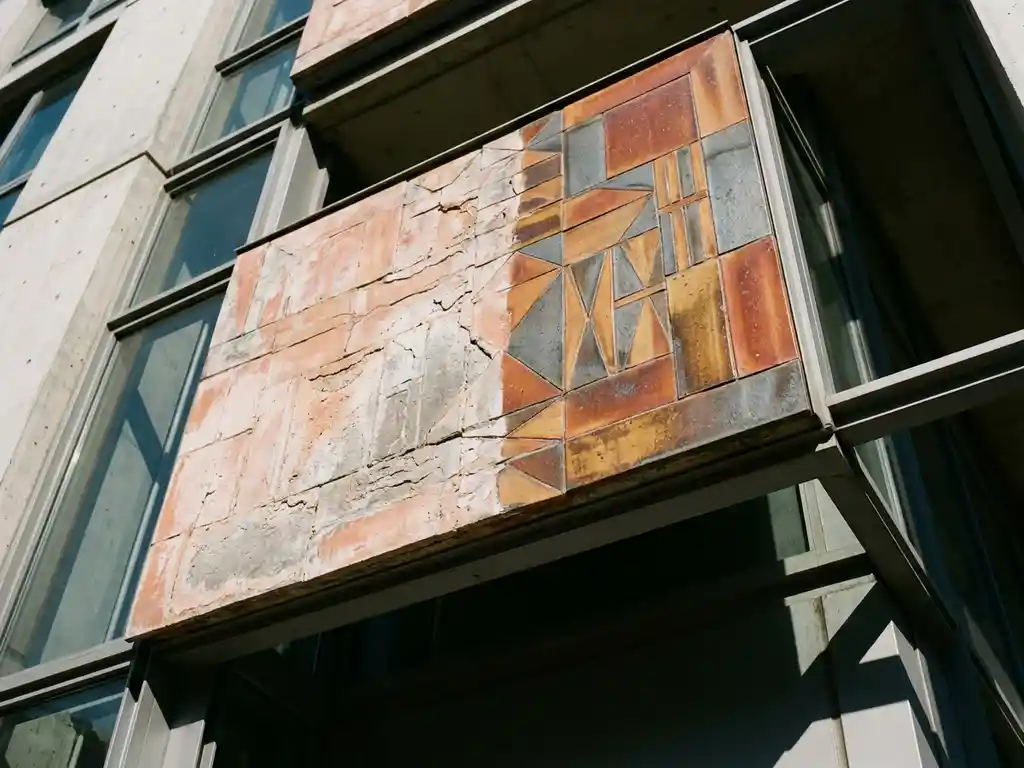
Ceramic cladding does not fade the way most other materials do because its color is not a surface coating — it is fired into the material itself at extreme temperatures. This makes ceramic facades one of the most UV-stable cladding options available, with color and surface quality that remain consistent for decades without repainting or refinishing. The sections below explore the science behind that stability, how ceramic compares to competing materials, and what long-term maintenance actually looks like in practice.
Why doesn’t ceramic fade the way other cladding materials do?
Ceramic cladding does not fade because its pigmentation is integral to the material, not applied to its surface. During production, mineral oxides are mixed into the clay body and fired at temperatures exceeding 1,200 degrees Celsius. This process permanently fuses color into the ceramic matrix, making it chemically stable and impervious to UV radiation in a way that painted, coated, or laminated materials simply cannot replicate.
Most other cladding materials rely on surface treatments to achieve their appearance. Painted metal panels, fiber cement boards, and even some composite systems carry their color in a topcoat that sits above the substrate. UV radiation breaks down the molecular bonds in these coatings over time, leading to chalking, fading, and color shift. In contrast, ceramic has no topcoat to degrade. The surface you see on day one is the same material all the way through.
This distinction matters enormously for architects specifying facades on long-life buildings. A material that holds its appearance without intervention delivers a consistent visual identity across the full lifespan of a structure, which is something surface-coated alternatives cannot reliably promise.
How does the sinter firing process protect ceramic facades from UV?
The sinter firing process creates an exceptionally dense, low-porosity surface that resists UV degradation at a structural level. When ceramic is fired above 1,200 degrees Celsius, the clay particles fuse together and vitrify, forming a hard, glass-like matrix. This sintered surface has virtually no open pores for UV-induced oxidation to take hold, and its mineral composition is inherently stable under solar radiation.
UV degradation in building materials typically occurs through two mechanisms: photochemical breakdown of organic compounds and thermal cycling that causes surface expansion and contraction. Ceramic addresses both. Its mineral-based composition contains no organic compounds that UV can break down. And because the sintered surface is so dense and dimensionally stable, the micro-cracking that accelerates UV damage in other materials does not occur in the same way.
The result is a surface that behaves almost like fired glass in terms of UV resistance. The range of ceramic surfaces and formats available today demonstrates how this process can produce everything from smooth, reflective finishes to textured natural surfaces, all with the same underlying UV stability built in at the production stage.
How does ceramic cladding compare to other materials in long-term UV exposure?
Across the most common facade materials, ceramic cladding solutions consistently outperform alternatives in long-term UV resistance. Painted metal fades and chalks, requiring recoating cycles every ten to fifteen years in demanding climates. Fiber cement holds color better than metal but still relies on surface sealants that degrade under sustained UV and moisture. Timber requires regular treatment to prevent UV-induced graying and surface breakdown. HPL panels can delaminate and discolor under prolonged solar exposure. Ceramic requires none of these interventions.
Organic and composite materials
Materials with organic components are the most vulnerable to UV degradation. Timber, polymer-based composites, and certain fiber-reinforced panels all contain molecular structures that UV radiation attacks directly. Over years of exposure, these materials lose surface integrity, change color, and require active maintenance to preserve both appearance and performance. The lifecycle cost of this maintenance accumulates significantly over a building’s operational life.
Inorganic mineral-based materials
Stone and brick share some of ceramic’s UV resistance because they are also mineral-based and contain no organic compounds. However, natural stone can stain, and traditional brick often shows efflorescence and surface weathering that alters its appearance over time. Sintered ceramic combines the mineral stability of these materials with a controlled, consistent surface quality that natural materials cannot always guarantee. The manufacturing process eliminates the variability inherent in natural stone while retaining its fundamental UV resistance. Architects looking for real-world performance evidence across different climates and building types will find that completed reference projects illustrate this consistency in practice.
What maintenance does ceramic cladding need after years of sun exposure?
Ceramic cladding requires minimal maintenance after prolonged UV exposure. Because the surface does not fade, chalk, or degrade under sunlight, there is no need for repainting, resealing, or surface treatment at any point in the facade’s service life. Routine maintenance is limited to occasional washing to remove dirt and atmospheric deposits, which restores the original appearance without any specialist products or processes.
Many ceramic facade systems also incorporate integrated graffiti protection as a standard feature. This means that even surface contamination from vandalism or heavy urban pollution can be removed without damaging the facade surface. The combination of UV stability and ease of cleaning makes ceramic a genuinely low-maintenance choice over a building’s full operational life.
From a lifecycle value perspective, the absence of maintenance cycles is significant. Buildings clad in materials that require periodic recoating or surface treatment carry ongoing costs that compound over decades. Ceramic eliminates these cycles entirely, which is a meaningful consideration when evaluating total cost of ownership rather than upfront specification alone. Architects can request samples and technical documentation to assess surface performance in detail before specifying.
Does UV exposure affect the structural integrity of ceramic facade systems?
UV exposure does not affect the structural integrity of ceramic facade systems. The ceramic elements themselves are classified as building material class A1, meaning they are non-combustible and contain no organic components that UV radiation can degrade. The sintered ceramic body retains its dimensional stability, compressive strength, and surface hardness regardless of cumulative solar exposure over decades.
The substructure and fixing system deserve equal consideration. In well-designed ceramic facade systems, the vertical aluminum retaining profiles and associated fixings are engineered to handle thermal cycling and long-term environmental exposure. Aluminum is inherently corrosion-resistant, and the mechanical interlocking system used in ceramic facade installations distributes load evenly without relying on adhesives or sealants that might degrade under UV and heat cycling.
The low surface weight of sintered ceramic, typically around 40 kilograms per square meter, also reduces the mechanical stress on fixings over time compared to heavier cladding materials. Less weight means less dynamic loading during wind events and thermal movement, which contributes to the long-term structural reliability of the system as a whole. For project teams who want to evaluate technical specifications in detail before committing to a system, it is worth taking the time to review available technical documentation and material samples alongside performance data from comparable installations.
How TONALITY® helps with UV-stable ceramic facade performance
TONALITY® ceramic facade systems are engineered specifically to deliver the UV stability described throughout this article, combining the material science of high-temperature sinter firing with a complete facade system designed for long-term performance. Here is what that means in practice:
- Permanent color stability: All TONALITY® ceramic elements are fired above 1,200 degrees Celsius, ensuring color is integral to the material and cannot fade, chalk, or peel under UV exposure.
- Integrated graffiti protection: The dense sintered surface resists contamination and allows easy cleaning without specialist products, keeping facades looking consistent over decades.
- 100% recyclable and non-combustible: Classified as building material class A1, TONALITY® elements contain no organic compounds and retain full structural integrity throughout their service life.
- Precision manufacturing: Tiles are produced to within one millimeter across a format range from 150 x 300 mm up to 400 x 1,600 mm, giving architects full design control without compromising technical performance.
- Low-maintenance lifecycle: No repainting, resealing, or surface treatment is required, delivering genuine long-term value through reduced maintenance costs over a building’s full operational life.
If you are specifying a facade that needs to hold its appearance and structural performance across decades of UV exposure, get in touch with the TONALITY® team to discuss your project requirements and explore the full range of ceramic cladding solutions available.
Related Articles
- Can ceramic cladding solutions be retrofitted onto existing building facades?
- What seismic engineering considerations apply to terracotta facade design?
- Terracotta vs Brick Slips: When to Choose Each
- 7 Ways to Create Depth and Shadow Play with 3D Terracotta Panels
- How to mount terracotta cladding on concrete walls?