

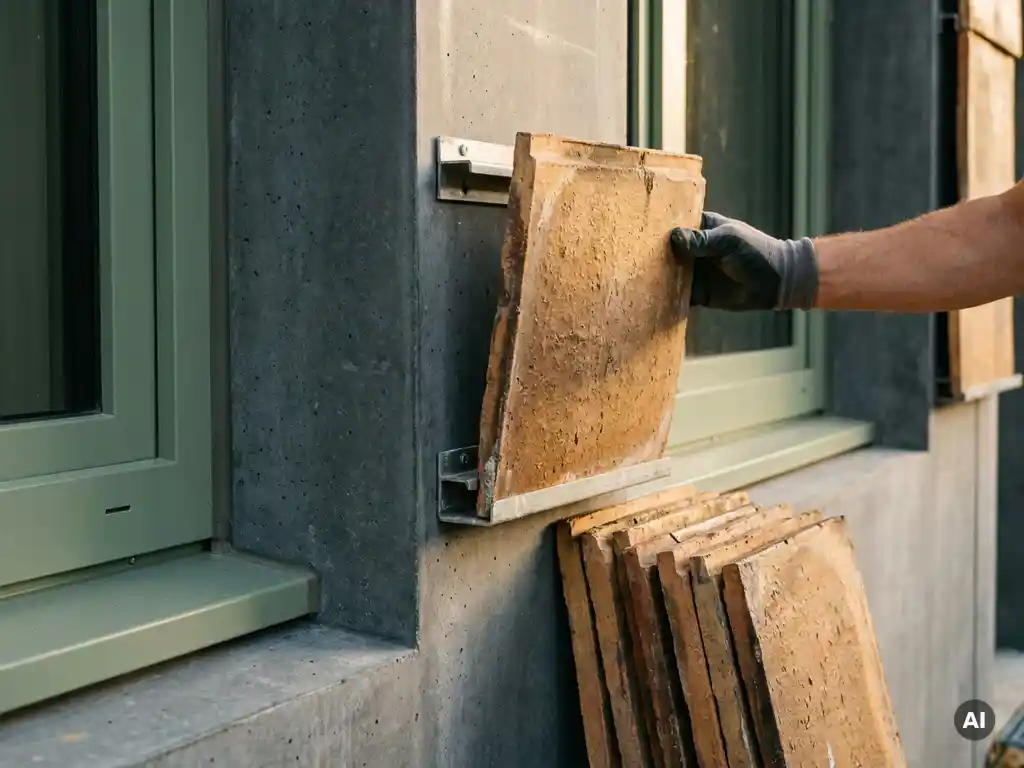
The conversation around sustainable facades is shifting. For years, recyclability was the headline claim, the proof point that a building material was doing its part for the planet. But as we move closer to 2030, a more demanding standard is emerging: reuse. Not breaking a material down and reforming it, but recovering it intact and putting it straight back to work. For architects, specifiers, and developers, this distinction is starting to matter enormously, both for regulatory compliance and for long-term asset value. Here is why facade reuse is becoming the metric that matters most.
Why reuse is overtaking recycling in facade design
Recycling has long been positioned as the responsible end-of-life option for building materials. But recycling still consumes energy, generates process emissions, and typically downgrades the material in the process. Reuse, by contrast, preserves the embodied energy and material quality already invested in a product. When a facade tile can be removed, cleaned, and reinstalled on another building, nothing is lost.
This distinction is becoming central to how sustainable facade systems are evaluated. Whole-life carbon assessments, circular economy frameworks, and procurement criteria are all beginning to separate genuine reuse from simple recyclability. The result is a growing preference for facade materials and systems that are designed from the outset to be recovered and redeployed, not just melted down or crushed at the end of a building’s life.
1: Embodied carbon targets make reuse non-negotiable
Embodied carbon, the carbon locked into materials during extraction, manufacturing, and construction, is increasingly subject to regulatory limits. Operational carbon from heating and cooling has been the traditional focus of building performance standards, but embodied carbon is now firmly on the agenda across Europe and beyond.
Reusing facade materials directly addresses embodied carbon in a way recycling cannot. When a ceramic facade tile is recovered and reused, the carbon already invested in its production does not need to be spent again. The material carries its value forward. As whole-life carbon budgets tighten through the late 2020s, specifiers will face growing pressure to demonstrate that facade choices support genuine carbon reduction, not just end-of-life disposal with a green label.
For developers and building owners, this creates a strong incentive to select facade systems where reuse is a realistic outcome, not a theoretical possibility. Real-world project examples increasingly show that material longevity and deconstruction potential are being built into briefs from the earliest design stages.
2: Circular economy legislation is reshaping procurement
Regulatory frameworks across Europe are accelerating the shift toward circular economy facades. The EU’s Construction Products Regulation, updated sustainability reporting requirements, and national-level green public procurement criteria are all moving in the same direction: materials must demonstrate a credible second life.
For public sector projects in particular, procurement teams are beginning to require documentation of reusability, not just recyclability percentages. This affects which products make it onto approved material lists and which suppliers win contracts. Private developers working on assets intended for long-term portfolio retention are following suit, recognizing that buildings designed for disassembly carry lower regulatory and reputational risk as legislation evolves.
The practical implication for facade specification is straightforward: materials that can be documented, tracked, and recovered intact will have a procurement advantage over those that cannot. Ceramic facade sustainability credentials are therefore becoming a commercial differentiator, not just an environmental one.
3: Deconstruction-ready systems cut lifecycle costs
A facade that is difficult to disassemble is a facade that creates waste. Systems relying on adhesives, composite bonding, or irreversible fixing methods may perform well during a building’s operational life, but they impose significant costs at the end of it, both financially and in terms of material loss.
Deconstruction-ready facade systems, those using mechanical fixing, interlocking profiles, and component-by-component removal, reduce end-of-life costs substantially. Tiles and panels can be removed without damage, sorted by material type, and either reused directly or returned to a manufacturer’s recovery programme. This approach also reduces demolition waste volumes, which carry increasing disposal costs as landfill restrictions tighten.
From a lifecycle cost perspective, the ability to recover and reuse facade elements shifts the economic calculation significantly. The initial investment in a well-designed, durable facade system becomes easier to justify when the material retains value beyond the building’s first life rather than becoming a liability at the end of it.
4: Material passports unlock second-life value
A facade tile sitting in a reclamation yard has limited value if no one knows what it is made of, how it was fired, or what performance standards it meets. Material passports solve this problem by creating a documented record of a product’s composition, manufacturing process, performance characteristics, and installation history.
As digital tools for building information management mature, material passports are becoming a practical reality rather than a conceptual aspiration. Buildings are increasingly being registered as material banks, with facade components catalogued in ways that allow future owners or developers to assess their reuse potential accurately. This traceability is what converts a recovered facade tile from scrap into a verified, specifiable product.
For manufacturers, this creates both a responsibility and an opportunity. Products with clear, consistent composition and documented performance histories are far better candidates for second-life specification than those with variable or undocumented characteristics. Precision in manufacturing, including tight dimensional tolerances and consistent material properties, becomes a direct enabler of reuse value.
5: Timber construction is driving demand for reusable cladding
The rapid growth of timber-frame and mass timber construction is creating specific demand for facade cladding systems that combine low weight with high durability and reusability. Timber structures are inherently more sensitive to facade dead loads than concrete or steel frames, which limits the range of cladding materials that can be specified without adding structural complexity.
Lightweight ceramic cladding systems are increasingly well suited to this context. Their low surface weight reduces substructure requirements, which in turn supports the lightweight logic of timber construction. Crucially, non-combustible ceramic elements classified as building material class A1 also address the fire protection requirements that are particularly stringent for timber buildings, without adding the weight penalties associated with heavier facade materials.
As timber construction scales up across Europe and beyond, the demand for cladding that is light, durable, fire-safe, and recoverable at end of life will grow with it. This intersection of structural logic and circular economy thinking is one of the clearest drivers of building material reuse 2030 ambitions in the facade sector. Exploring available surfaces and formats shows how much design flexibility is possible within these constraints.
6: What does a truly reusable facade look like?
Not every facade marketed as sustainable is genuinely designed for reuse. A truly reusable facade system has several identifiable characteristics that go beyond broad environmental claims.
- Mechanical fixing: Elements are held in place by interlocking profiles or mechanical clips, not adhesives, allowing individual tiles to be removed without damaging adjacent components.
- Dimensional precision: Tight manufacturing tolerances mean recovered tiles can be reinstalled without adjustment or reworking, maintaining the integrity of the original system.
- Consistent material composition: Single-material or clearly documented composite elements can be sorted and assessed for reuse quickly and reliably.
- Durable surface performance: UV resistance, colour stability, and surface integrity over decades mean recovered tiles are still fit for purpose when a building is eventually deconstructed.
- Non-combustible classification: A1-rated materials retain their safety credentials across multiple building lifetimes without degradation.
- 100% recyclability as a fallback: For elements that cannot be directly reused, full recyclability ensures no material is wasted.
These characteristics are not accidental. They result from deliberate design decisions made at the manufacturing stage, long before a facade tile ever reaches a building site. Facade deconstruction potential is built in, not bolted on.
Building for tomorrow means designing to disassemble today
The shift from recycling to reuse as the primary sustainability benchmark for facades reflects a broader maturation in how the construction industry thinks about materials. Recycling was always a better outcome than landfill, but it was never the whole answer. Reuse preserves material value, reduces embodied carbon, and supports the circular economy in the most direct way possible: by keeping good materials in use.
By 2030, the buildings being designed and specified today will be evaluated against standards that do not yet fully exist. But the direction of travel is clear. Facades that are durable, deconstruction-ready, precisely manufactured, and documented for reuse will be assets. Those that are not will increasingly be liabilities.
How TONALITY® supports facade reuse and circular economy goals
TONALITY® ceramic facade systems are designed with the principles of reuse built into every element. For architects and specifiers working toward circular economy targets, TONALITY® offers a concrete, practical solution:
- Deconstruction-ready installation: Ceramic elements interlock with vertical aluminum retaining profiles and can be removed component by component with minimal effort, preserving tile integrity for reuse.
- Precision manufacturing: Tiles produced to within one millimeter, in formats from 150 x 300 mm up to 400 x 1,600 mm, ensure dimensional consistency that supports reliable second-life specification.
- 100% recyclability: Where direct reuse is not the outcome, TONALITY® ceramic elements are fully recyclable and can be sorted by material type with minimum effort.
- Non-combustible A1 classification: Suitable for timber construction and buildings with strict fire protection requirements, without compromising on reuse potential.
- Permanent UV and colour resistance: Surfaces fired above 1,200 degrees Celsius maintain their appearance over decades, ensuring recovered tiles remain visually and functionally fit for reuse.
- Integrated graffiti protection: Maintenance-free performance over the building’s lifetime means tiles arrive at end of life in better condition, with greater reuse potential.
If you are specifying a facade system that needs to perform today and retain its value well beyond 2030, TONALITY® is ready to support your project. Get in touch with the TONALITY® team to discuss your requirements, or request samples and technical documentation to begin your specification process.
Related Articles
- 7 Architectural Effects Created by Combining Baguettes and Panels
- How does ceramic cladding affect a building's overall energy efficiency rating?
- Should developers use material passports for terracotta facade systems?
- How do sustainable materials perform in extreme weather?
- How do architects specify terracotta for curved and complex building geometries?