

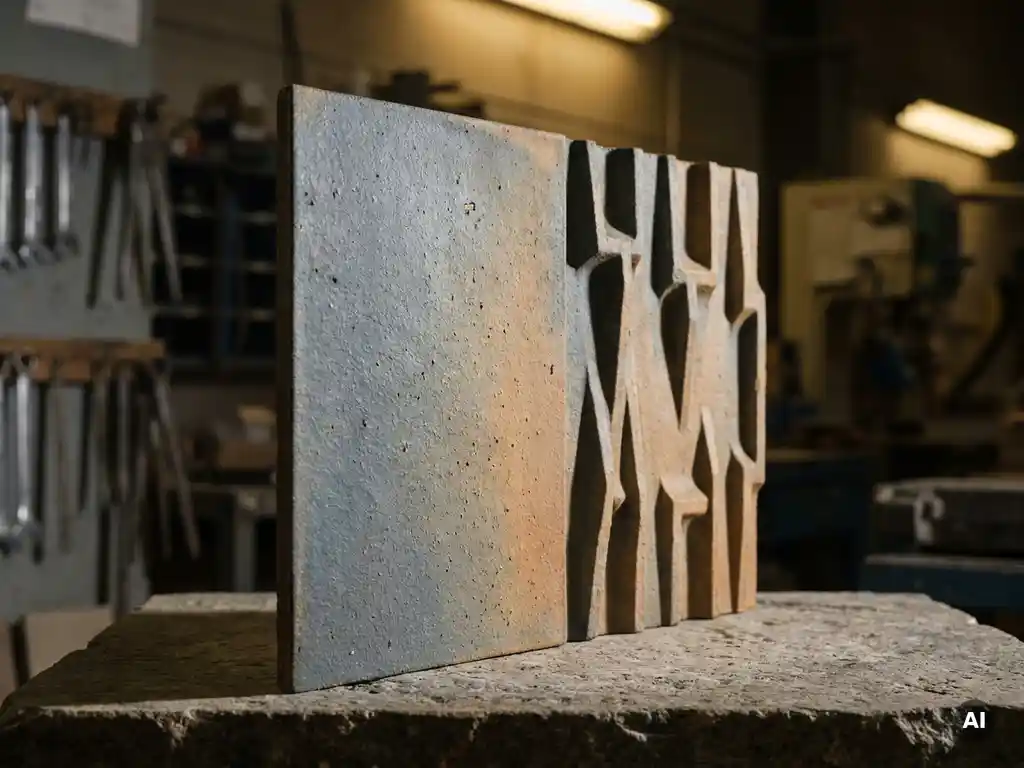
Deep profiling does not weaken ceramic facade elements when engineered correctly. In fact, back profiling is a deliberate structural and functional feature that improves how ceramic tiles interact with their mounting systems, distribute load, and maintain long-term dimensional stability. The sections below address the most common technical questions about profiling and structural performance in ceramic facades.
How does back profiling change the load-bearing behavior of ceramic tiles?
Back profiling changes the load-bearing behavior of ceramic tiles by redistributing mechanical stress across a larger contact area rather than concentrating it at a few discrete points. Instead of resting flat against a substructure, a profiled tile engages with retaining profiles along its entire length, which creates a more even stress distribution and reduces the risk of localized cracking or deformation under wind and dead loads.
The geometry of the profile matters significantly. Ribs, channels, and interlocking ridges on the back of a ceramic element are not decorative. They serve as structural features that stiffen the tile against bending in its plane. When a facade tile is exposed to wind pressure or suction, the profiled back acts like a series of small beams, resisting deflection far more effectively than a flat slab of the same thickness would. This is why back profiling often allows manufacturers to produce thinner, lighter tiles without sacrificing rigidity.
There is also a thermal dimension to this behavior. Profiling creates small air channels between the tile and the substructure, which reduces thermal bridging and allows the element to expand and contract more freely during temperature cycling. This freedom of movement actually reduces thermally induced stress within the tile body, contributing to long-term structural integrity rather than undermining it.
Does deeper profiling make ceramic facade elements weaker or stronger?
Deeper profiling generally makes ceramic facade elements stronger in bending resistance, not weaker, provided the profile geometry is properly engineered. The key principle is the same as in structural beams: material placed farther from the neutral axis contributes more to bending stiffness. Deeper ribs increase the effective depth of the tile cross-section, raising its moment of inertia and resistance to deflection.
The caveat is wall thickness. If deeper profiling is achieved by removing too much material from the tile body rather than by adding rib height, the remaining walls between ribs can become thin and vulnerable to point loads or impact. Well-designed profiling maintains adequate wall thickness throughout the element while maximizing rib depth. This balance is what separates structurally sound profiled ceramics from poorly engineered ones.
It is also worth noting that the firing process plays a decisive role here. Ceramic elements fired at temperatures above 1,200 degrees Celsius undergo a sintering process that densifies the clay body and eliminates most residual porosity. A sintered ceramic with deep profiling is a fundamentally different material from a lower-fired tile of the same geometry. The dense, vitrified matrix holds its shape under load and resists moisture ingress that could otherwise cause freeze-thaw degradation in profiled cavities.
How does the profiling interact with the aluminum retaining system?
The profiling on the back of ceramic facade elements is specifically designed to interlock mechanically with vertical aluminum retaining profiles. This connection is the primary load path for transferring the weight of the tile and any applied wind loads into the substructure. The profile geometry on the ceramic and the geometry of the aluminum clip or rail are engineered as a matched pair, not independent components.
When a profiled ceramic element slides onto a vertical aluminum retaining profile, the back ribs engage the rail flanges and create a positive mechanical lock. This means the tile is held in position without adhesive, without visible fasteners, and without requiring the ceramic itself to carry tensile stress through a drilled hole. The absence of drilled fixings is structurally significant because drilling through a ceramic element introduces stress concentrations that can initiate cracking, particularly in larger formats.
The aluminum retaining profile also accommodates differential movement. Ceramics and aluminum expand at different rates when temperatures change. The interlocking geometry allows a small degree of relative movement between the tile and the rail without generating prying forces that could crack the element. This slip-fit behavior is only possible because the profiling provides a guided contact surface rather than a rigid bond. You can explore available formats and surfaces to understand how profile geometry varies across different tile dimensions.
What quality controls ensure profiled ceramic elements meet structural standards?
Profiled ceramic elements meet structural standards through a combination of production process controls, dimensional tolerancing, and standardized mechanical testing. The most important controls operate at the manufacturing stage, where consistency in raw material composition, extrusion geometry, drying rate, and firing temperature directly determines the structural properties of the finished element.
Production process controls
Dimensional accuracy is a foundational quality metric for profiled ceramics. Tiles produced to within one millimeter across their full length ensure that the back profile aligns reliably with the aluminum retaining system across every installation. If profile depth or rib spacing varies beyond tolerance, the mechanical interlock becomes inconsistent, which can create uneven load distribution across a facade panel. Tight dimensional control is therefore not only an aesthetic requirement but a structural one.
Mechanical and fire testing
Structural performance is verified through standardized bending strength tests, which measure the force required to fracture a tile under three-point or four-point loading. These tests are conducted on representative samples from production batches and must meet minimum values defined by European product standards for ceramic cladding. Fire performance is assessed separately. Ceramic elements classified as building material class A1 are non-combustible and contain no organic binders that could compromise the tile body under thermal loading. This classification is verified through standardized fire reaction tests, not assumed from the material type alone.
Are there format or size limits where deep profiling affects performance?
Yes, format and size do influence how deep profiling affects structural performance, and larger tiles require more careful engineering of the profile geometry to maintain adequate rigidity across their full span. As tile length increases, the unsupported span between retaining profiles grows, and the bending moment generated by wind loads increases accordingly. Deeper or more closely spaced ribs are typically required in large-format tiles to keep deflection within acceptable limits.
The relationship between format and profile depth is not linear. A tile that is twice as long does not simply need twice the rib depth. Deflection under a uniformly distributed load scales with the cube of the span, which means that modest increases in tile length can require disproportionately larger increases in bending stiffness. Manufacturers address this by adjusting rib geometry, rib spacing, and overall tile thickness as formats increase.
Practical format ranges for profiled ceramic facade elements typically extend from small modular tiles around 150 x 300 mm up to large-format panels reaching 400 x 1,600 mm. At the larger end of this range, the profile geometry is more complex and the engineering tolerances more demanding. Specifiers working with very large formats should confirm that the tile’s profile has been validated for the specific wind load zone and retaining profile spacing of their project. Reviewing technical downloads and samples is a practical first step for format-specific structural data.
How TONALITY® supports ceramic facade structural performance
TONALITY® ceramic facade elements are engineered from the ground up with structural performance as a core design criterion, not an afterthought. Every element in the TONALITY® range is produced through a high-temperature sinter-firing process exceeding 1,200 degrees Celsius, resulting in a dense, vitrified ceramic body that maintains its geometry and mechanical properties over decades of facade exposure.
Key structural and engineering features of TONALITY® ceramic facades include:
- Precision-profiled backs engineered to interlock with vertical aluminum retaining profiles, distributing load evenly and eliminating the need for drilled fixings
- Dimensional accuracy to within one millimeter across formats from 150 x 300 mm up to 400 x 1,600 mm, ensuring consistent mechanical engagement across every installation
- Low surface weight of approximately 40 kilograms per square meter, reducing dead load on the substructure and making TONALITY® particularly well suited to timber construction
- Building material class A1 classification, confirming non-combustibility and structural stability under fire conditions
- Integrated UV and color resistance, ensuring the ceramic body retains its properties without surface treatments that could alter profile geometry over time
Whether you are specifying a large-format ventilated facade or a modular cladding system for a timber-frame building, TONALITY® provides engineering documentation, technical samples, and direct specialist support to confirm that the chosen format and profile configuration meets the structural requirements of your project. You can see how profiled ceramic elements perform across completed buildings in the project references section.
[cta_contact_form]
Reach out to the TONALITY® team through the contact and sales page to discuss your project requirements, request format-specific technical data, or order samples for evaluation. Structural questions about deep profiling and ceramic facade engineering are exactly what the team is there to help with.