

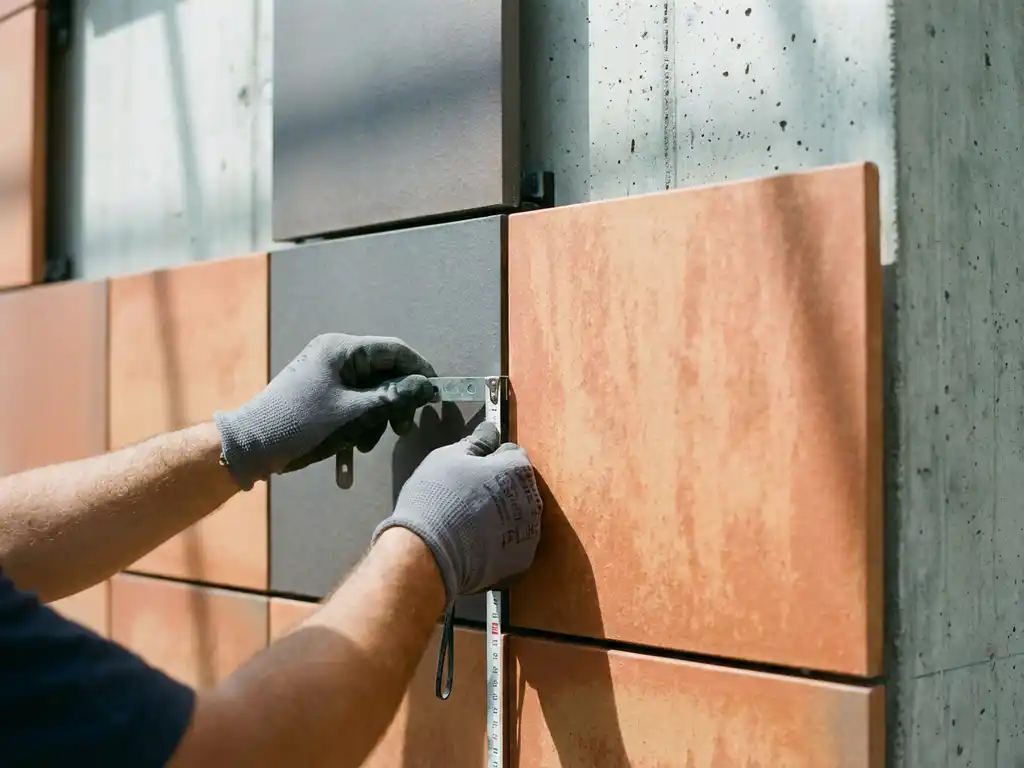
What Are Expansion and Movement Joints in Terracotta Facades?
Expansion and movement joints in terracotta facades are specially designed gaps that accommodate thermal expansion, structural movement, and the settling of building materials. These joints prevent cracking, buckling, and structural damage by allowing controlled movement between ceramic facade elements while maintaining weather protection and aesthetic continuity.
Terracotta and ceramic materials expand and contract with temperature changes, typically at different rates than the underlying structure. Without proper movement joints, ceramic facades would experience significant stress concentrations that could lead to tile displacement or cracking. These joints work in conjunction with flexible sealants and backing materials to create a weatherproof barrier while permitting necessary movement.
The joint system extends beyond simple gaps between tiles. It includes structural separation joints that divide large facade areas into manageable sections, perimeter joints around openings such as windows and doors, and interface joints where the facade meets other building materials. Each type serves a specific function in managing different movement patterns and stress distributions.
Where Should Vertical Expansion Joints Be Placed in Large Facades?
Vertical expansion joints should be positioned every 12 to 15 meters along large terracotta facades, with additional joints required at structural discontinuities, building corners, and changes in the facade plane. The exact spacing depends on material properties, climate conditions, and structural design requirements.
Strategic placement begins with identifying structural expansion joints in the building frame, as facade joint placement must align with these primary movement locations. Vertical joints should coincide with structural columns or major vertical elements where possible, creating natural break points that follow the building’s structural logic. This alignment prevents differential movement between the structure and the facade system.
Climate considerations significantly influence joint spacing. Buildings in regions with extreme temperature variations require closer joint spacing, potentially every 10 to 12 meters, while moderate climates may allow spacing up to 15 meters. The thermal expansion coefficient of ceramic materials, combined with the expected temperature range, determines the total movement that joints must accommodate.
Building geometry also dictates joint placement. L-shaped or complex building forms require joints at each directional change, while long linear facades need intermediate joints to prevent excessive stress accumulation. Corner conditions always require special attention, with joints typically placed within 3 meters of external corners to manage the complex stress patterns that develop in these areas.
How Do You Determine Horizontal Movement Joint Spacing?
Horizontal movement joint spacing in terracotta facades typically ranges from 3 to 6 meters vertically and is determined by calculating thermal movement, structural deflection, and the facade system’s ability to accommodate differential movement between floors. The spacing must account for both expansion of the ceramic elements and movement of the supporting structure.
Floor-to-floor movement is the primary driver for horizontal joint placement. Each building level experiences different loads, temperatures, and movement patterns, making terracotta expansion joint spacing critical at these transitions. Most systems require horizontal joints at each floor line or every second floor, depending on the building height and structural system.
Calculation methods consider multiple factors simultaneously. The thermal expansion of ceramic materials over the joint-spacing distance must be combined with anticipated structural movement, including deflection under live loads and long-term creep effects. Wind loading can also influence horizontal joint requirements, particularly on tall buildings where facade elements experience significant pressure variations.
Key Calculation Factors
- Ceramic thermal expansion coefficient (typically 6-8 x 10⁻⁶ per degree Celsius)
- Maximum expected temperature differential across the facade
- Structural movement, including deflection and shrinkage
- Building height and wind exposure category
- Facade system flexibility and accommodation capabilities
What Factors Influence Joint Placement in Ceramic Facade Systems?
Joint placement in ceramic facade systems is influenced by material properties, structural design, environmental conditions, aesthetic requirements, and installation constraints. These factors must be balanced to create an effective movement accommodation system while maintaining the desired architectural appearance and performance standards.
Material characteristics drive fundamental joint requirements. Different ceramic formulations exhibit varying thermal expansion rates, moisture absorption properties, and dimensional stability. Dense, vitrified ceramics like those used in high-performance facades typically have lower expansion coefficients but require precise joint sizing due to their reduced flexibility compared to more porous materials.
Structural considerations encompass both the primary building frame and the facade support system. Steel structures exhibit different movement patterns than concrete, while timber construction introduces unique considerations for ceramic facade installation. The facade attachment method—whether mechanical fixing systems, adhesive applications, or hybrid approaches—directly influences how movement is transmitted and accommodated.
Environmental factors extend beyond simple temperature cycling. Solar exposure creates differential heating across facade surfaces, with south-facing walls experiencing greater temperature swings than north-facing ones. Wind-driven rain, freeze-thaw cycles, and seismic activity in applicable regions all contribute to movement patterns that joint systems must accommodate.
How Should Joints Be Detailed at Critical Building Transitions?
Joints at critical building transitions require specialized detailing that addresses multiple movement directions, maintains weather protection, and accommodates different material behaviors. These locations include corners, roof lines, foundation interfaces, and connections to other facade materials, each demanding specific design approaches.
Corner conditions represent the most complex joint detailing challenges. External corners experience biaxial movement as both adjacent facade planes expand and contract simultaneously. The joint system must accommodate this multidirectional movement while preventing water infiltration and maintaining structural integrity. Typically, this requires wider joint dimensions and specialized corner gaskets or sealant systems.
Roof and foundation transitions demand careful attention to differential movement between the facade system and adjacent building elements. Roof connections must manage thermal bridging concerns while accommodating significant movement from thermal cycling of roof membranes and structures. Foundation interfaces require consideration of settlement effects and moisture management to prevent long-term performance issues.
Critical Transition Details
- External corners: Biaxial movement accommodation with enhanced weatherproofing
- Window and door perimeters: Flexible connections allowing independent movement
- Roof interfaces: Thermal bridge management with movement capability
- Material changes: Transition between different expansion characteristics
- Structural joints: Alignment with primary building movement systems
Interface joints between ceramic facades and other materials require careful material compatibility assessment. Different materials exhibit varying expansion rates, moisture responses, and aging characteristics. The joint detail must accommodate these differences while maintaining long-term adhesion and weather resistance. This often involves multi-component systems with different materials optimized for specific interface requirements.
How TONALITY® Helps with Facade Movement Joint Solutions
TONALITY® ceramic facade systems are engineered with integrated movement accommodation features that simplify joint planning and installation while ensuring long-term performance. Our profiled ceramic elements interlock with vertical aluminum retaining profiles, creating a system that naturally accommodates thermal movement through its mechanical connection method.
Key advantages of the TONALITY® approach to building movement joints include:
- Precision-manufactured elements with consistent dimensional tolerances within one millimeter
- Mechanical fixing system that allows controlled movement without compromising weather protection
- Lightweight construction (40 kg/m²) that reduces structural loading and movement stresses
- Flexible installation system that accommodates standard joint spacing requirements
- A1 fire classification ensuring safety performance at critical building transitions
Our technical team provides comprehensive support for movement joint design and detailing, helping architects and contractors optimize joint placement for specific project requirements. Contact TONALITY® to discuss how our ceramic facade systems can simplify your next project’s movement accommodation requirements while delivering exceptional long-term performance.