

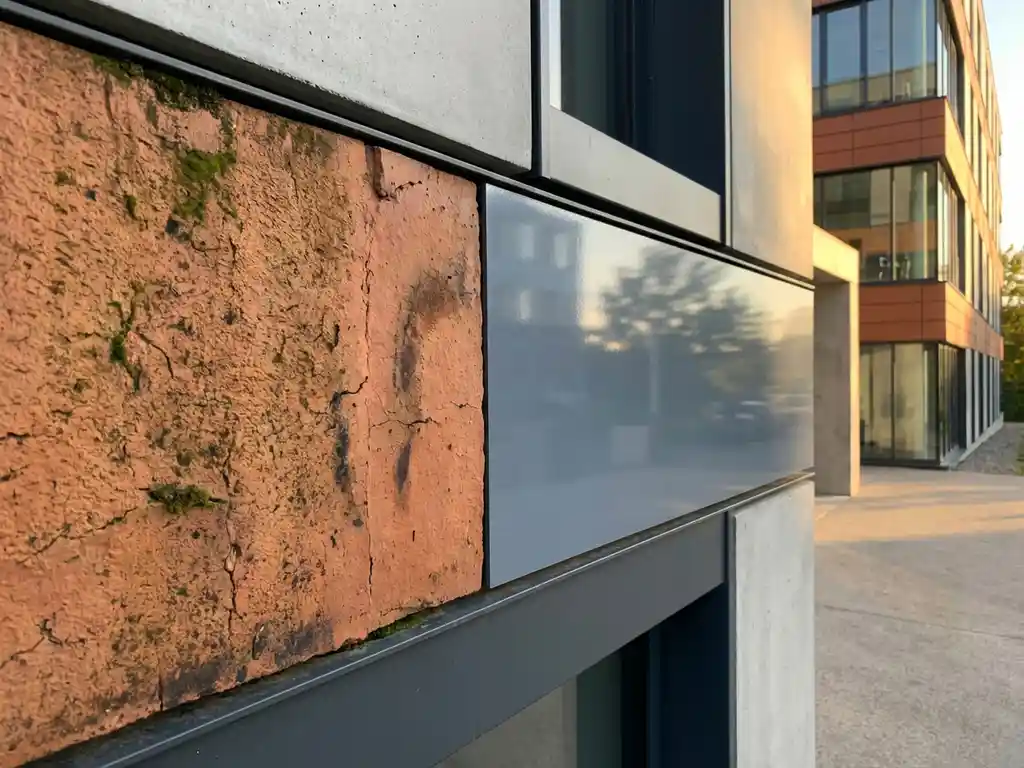
What’s the difference between terracotta and HPL façades?
Terracotta façade systems are ceramic materials made from natural clay fired at high temperatures, while HPL (high-pressure laminate) façades consist of multiple layers of kraft paper and decorative surfaces bonded together under extreme pressure and heat. The fundamental difference lies in their composition: terracotta is a natural ceramic material, whereas HPL is a synthetic composite.
Terracotta façades undergo a sintering process at temperatures exceeding 1,200°C, creating dense, non-porous surfaces with exceptional durability. This ceramic façade material achieves its strength and weather resistance through the natural transformation of clay minerals during firing. HPL façades, on the other hand, rely on thermosetting resins to bind decorative papers and core materials together, creating a laminated building-exterior material with different performance characteristics.
The manufacturing processes result in distinct material properties that significantly affect long-term façade performance. While both materials can achieve similar aesthetic results, their underlying composition determines how they behave under various environmental conditions and stressors.
How long do terracotta façades last compared to HPL?
Terracotta façades typically last 50–100 years or more with minimal maintenance, while HPL façades generally have a lifespan of 20–30 years before requiring significant replacement or renovation. The ceramic façade material’s superior longevity stems from its fired-clay composition, which resists degradation from UV exposure, temperature fluctuations, and moisture.
The extended lifespan of terracotta façade systems results from their inherent material stability. The high-temperature firing process creates a vitrified surface that maintains its structural integrity and appearance over decades. HPL façades, while initially cost-effective, may experience delamination, color fading, and surface degradation more quickly due to their composite nature and reliance on adhesive bonds.
Environmental factors significantly affect façade durability. Terracotta’s ceramic structure remains chemically stable across temperature ranges and weather conditions, while HPL materials can be more susceptible to thermal expansion, moisture infiltration, and UV-induced deterioration that gradually compromises the laminate structure.
Which façade material requires less maintenance over time?
Terracotta façades require significantly less maintenance over their lifespan than HPL façades. Ceramic façade materials are naturally self-cleaning and resistant to staining, requiring only periodic washing, while HPL façades may need regular inspection for delamination, edge sealing, and surface treatments.
The maintenance advantages of terracotta stem from its dense, non-porous surface that resists dirt accumulation and biological growth. Rain naturally cleans terracotta façades, and the material’s integrated graffiti protection reduces the need for specialized cleaning treatments. HPL façades, with their layered construction, may develop maintenance issues at joints, edges, and mounting points where moisture can penetrate the laminate structure.
Long-term façade maintenance costs favor terracotta due to its durability and resistance to common building-exterior problems. While HPL systems may require periodic resealing, component replacement, or surface restoration, terracotta maintains its appearance and performance with minimal intervention throughout its extended service life.
What are the fire safety differences between terracotta and HPL?
Terracotta façades offer superior fire safety with an A1 classification (non-combustible), while HPL façades typically achieve B or C fire ratings and contain combustible components. The ceramic façade material is inherently fireproof due to its fired-clay composition, whereas HPL contains organic resins and paper layers that can contribute to fire spread.
The fire safety advantages of terracotta façades stem from their ceramic nature. Having already been subjected to temperatures exceeding 1,200°C during manufacturing, terracotta cannot ignite or release toxic gases during a fire. This makes ceramic façade systems particularly valuable for high-rise buildings and structures with stringent fire-safety requirements.
HPL façades present different fire-safety considerations due to their composite construction. While modern HPL products incorporate fire-retardant treatments, the presence of organic materials means they can still contribute fuel to fires under extreme conditions. Building codes increasingly favor non-combustible façade materials like terracotta for critical applications where fire safety is paramount.
How do installation costs compare between terracotta and HPL façades?
Installation approaches differ significantly between terracotta and HPL façades, with each system offering distinct advantages in terms of labor requirements and structural considerations. Terracotta façade systems often feature simplified mounting mechanisms, while HPL façades may require more complex fixing details and substructure preparation.
Modern terracotta façade systems use innovative installation methods that can reduce on-site labor time. The lightweight nature of ceramic façade elements—typically around 40 kilograms per square meter—allows for reduced substructure requirements compared to traditional ceramic materials. This weight advantage can offset material costs through simplified structural support systems.
Long-term value analysis reveals important life-cycle considerations beyond initial installation. While façade materials may have different upfront requirements, the extended lifespan and reduced maintenance needs of terracotta systems contribute to a favorable total cost of ownership over the building’s service life. HPL systems may offer different initial cost structures but require more frequent replacement cycles.
Which performs better in extreme weather conditions?
Terracotta façades demonstrate superior performance in extreme weather conditions due to their ceramic composition and thermal stability, while HPL façades may experience thermal movement, moisture-related issues, and UV degradation under harsh environmental conditions. The fired-clay structure of terracotta provides exceptional resistance to temperature fluctuations and moisture cycles.
Extreme temperature variations affect façade materials differently based on their composition and thermal properties. Terracotta’s ceramic structure maintains dimensional stability across wide temperature ranges, while HPL materials may expand and contract in ways that stress mounting systems and create maintenance issues over time.
Moisture resistance is another critical performance factor in extreme weather. The dense, non-porous surface of ceramic façade materials prevents water infiltration and freeze–thaw damage, while HPL systems may be more vulnerable to moisture penetration at joints and edges. UV resistance also favors terracotta, as the fired ceramic surface maintains its color and structural integrity under intense solar exposure that can degrade HPL surface treatments.
How TONALITY® provides superior ceramic façade solutions
TONALITY® delivers premium terracotta façade systems that address all the performance advantages discussed in this comparison. Our ceramic façade elements combine the natural durability of Westerwald clay with innovative installation systems that maximize long-term value.
- A1 fire classification for maximum building safety
- 50+ year lifespan with minimal maintenance requirements
- Lightweight design at 40 kg/m² reduces structural loads
- Integrated graffiti protection and permanent UV resistance
- Simple mount-and-done installation system
- 100% recyclable for sustainable building practices
Our ceramic façade systems deliver the performance advantages that make terracotta the superior choice over HPL for long-term building-exterior applications. View our successful project references to see how our innovative ceramic façade solutions have enhanced buildings worldwide with unmatched durability and performance. For more information about our products and services, contact TONALITY® today.