

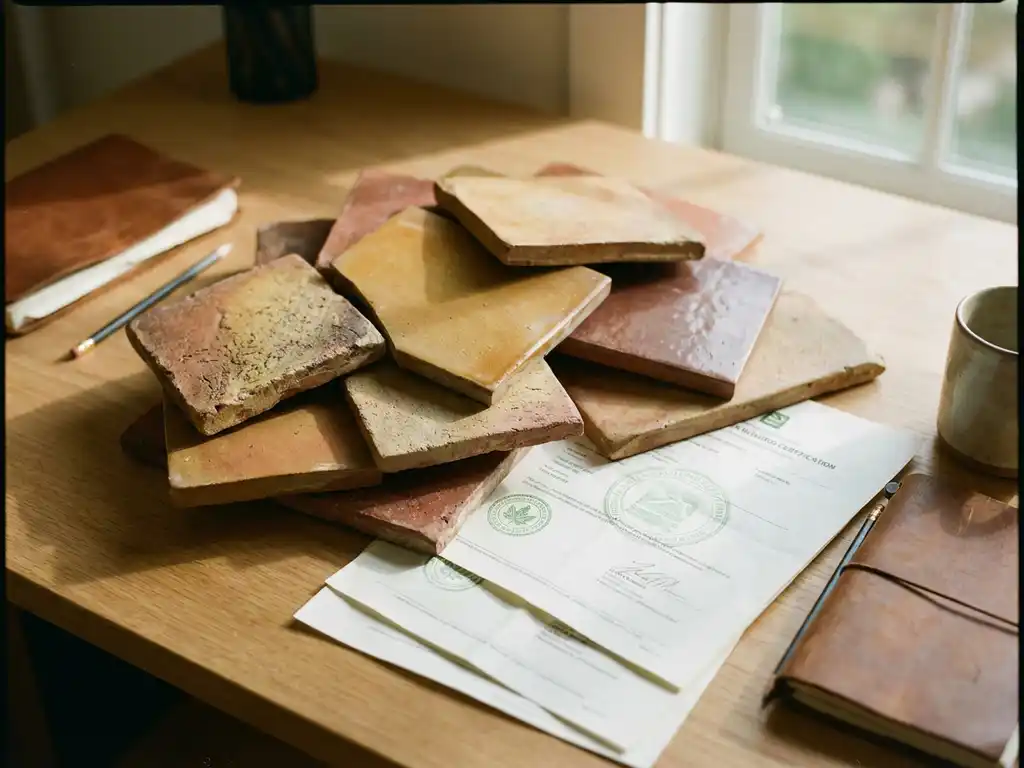
Why green certifications favor ceramic façades
Green building certifications worldwide increasingly recognize ceramic façades as premium sustainable building materials that deliver exceptional environmental performance. These certification systems evaluate buildings across multiple criteria, including energy efficiency, material sustainability, durability, and life-cycle impact—areas in which ceramic cladding consistently excels.
Ceramic façades earn high scores in green building certifications due to their inherent properties: an A1 non-combustible fire rating, exceptional thermal performance, 100% recyclability, and long-lasting, maintenance-free durability. Their natural clay composition and high-temperature firing process create building materials that align closely with sustainability goals while meeting stringent performance requirements across diverse climate zones and architectural applications.
1: LEED certification rewards terracotta durability
LEED (Leadership in Energy and Environmental Design) awards significant points for ceramic façades under its Materials and Resources credits, particularly recognizing their exceptional durability and low maintenance requirements. Terracotta façades can contribute to LEED certification through their extended service life, which reduces replacement frequency and associated environmental impacts over decades of building operation.
The certification system specifically values ceramic cladding for its potential as a regional material when sourced locally, opportunities for recycled content, and contribution to building longevity. LEED projects that use ceramic façades often earn points in multiple categories simultaneously, as these materials support both environmental goals and long-term building performance standards that the certification prioritizes.
2: BREEAM recognizes ceramic thermal performance
BREEAM (Building Research Establishment Environmental Assessment Method) highly values ceramic façades for their superior thermal mass and contribution to building energy efficiency. The dense, fired ceramic structure provides excellent thermal regulation, helping buildings maintain stable interior temperatures while reducing heating and cooling energy demand across seasonal variations.
Under BREEAM’s Energy and Materials sections, ceramic cladding systems earn recognition for minimizing thermal bridging and for compatibility with insulation systems. The certification acknowledges that properly installed ceramic façades can create continuous thermal barriers while maintaining breathability, contributing to overall building-envelope performance that BREEAM assessors consistently rate favorably in sustainability evaluations.
3: DGNB values ceramic life-cycle sustainability
The German DGNB (Deutsche Gesellschaft für Nachhaltiges Bauen) certification places exceptional emphasis on life-cycle assessment, where ceramic façades demonstrate outstanding environmental credentials. DGNB evaluates the complete material journey from raw material extraction through manufacturing, installation, the use phase, and end-of-life disposal—criteria in which ceramic cladding consistently achieves top performance ratings.
Ceramic façades contribute to DGNB certification through their potential for local raw material sourcing, energy-efficient manufacturing processes, and complete recyclability at the end of a building’s life. The certification particularly values the maintenance-free service life of ceramic materials, which eliminates ongoing environmental impacts associated with cleaning, repairs, or premature replacement that other façade materials typically require.
4: HQE certification and ceramic fire safety
France’s HQE (Haute Qualité Environnementale) certification awards premium recognition to ceramic façades for their superior fire-safety characteristics and contribution to occupant health and safety. Ceramic materials achieve the highest A1 non-combustible classification, providing passive fire protection that HQE evaluators consistently recognize as exceeding standard building safety requirements.
The certification system values ceramic cladding for its smoke-free performance in a fire and its structural integrity under extreme temperatures. HQE projects incorporating ceramic façades benefit from enhanced safety ratings while simultaneously achieving environmental targets, as these materials contain no toxic components or volatile organic compounds that could compromise indoor air quality during their service life.
5: Green Star Australia embraces terracotta
Green Star Australia’s certification framework recognizes ceramic façades as exemplary sustainable building materials, particularly valuing their performance in the harsh Australian climate. The certification awards points for ceramic cladding’s UV resistance, thermal stability, and ability to maintain aesthetic and structural integrity across extreme temperature variations and intense solar exposure.
Australian Green Star projects benefit from ceramic façades‘ contribution to water-efficiency credits, as these materials require minimal cleaning and no chemical treatments for maintenance. The certification also recognizes the potential for local manufacturing of ceramic materials, supporting regional economic development while reducing transportation-related environmental impacts for construction projects across Australia’s diverse geographic regions.
6: CASBEE Japan and ceramic energy efficiency
Japan’s CASBEE (Comprehensive Assessment System for Built Environment Efficiency) certification highly values ceramic façades for their contribution to building energy performance and seismic resilience. The lightweight nature of ceramic cladding systems reduces structural loads while providing excellent thermal performance—criteria that CASBEE considers essential for sustainable building design in Japan’s climate and seismic conditions.
CASBEE recognizes ceramic façades for their integration with advanced building-envelope systems, including ventilated façade configurations that enhance natural cooling and reduce reliance on mechanical systems. The certification particularly values the precision manufacturing of ceramic elements, which enables tight building-envelope construction that minimizes air infiltration and optimizes energy-efficiency performance throughout building operation.
7: VERDE Spain highlights ceramic recyclability
Spain’s VERDE certification system emphasizes circular-economy principles, where ceramic façades excel through their complete recyclability and material-recovery potential. VERDE evaluates the entire material life cycle, awarding high scores to ceramic cladding for its ability to be fully reclaimed, processed, and reused in new construction applications without quality degradation or performance compromise.
The certification recognizes ceramic materials for their contribution to waste-reduction strategies and resource-conservation goals. VERDE projects that use ceramic façades benefit from credits related to material reuse potential and end-of-life planning, as these materials can be systematically deconstructed and sorted for complete material recovery, supporting Spain’s national sustainability and circular-economy objectives.
8: AQUA Brazil recognizes terracotta benefits
Brazil’s AQUA certification (Alta Qualidade Ambiental) awards significant recognition to ceramic façades for their performance in tropical and subtropical climates, particularly valuing their resistance to humidity, temperature fluctuations, and biological growth. Ceramic cladding systems contribute to AQUA certification through their ability to maintain performance and appearance without chemical treatments or frequent maintenance interventions.
The certification system recognizes ceramic façades for their contribution to building durability and occupant comfort in Brazil’s diverse climate zones. AQUA evaluators particularly value the thermal mass of ceramic materials, which helps moderate interior temperatures naturally, reducing cooling energy demand while maintaining comfortable interior environments throughout Brazil’s extended warm seasons and periods of high humidity.
9: Living Building Challenge and ceramic materials
The Living Building Challenge, one of the world’s most rigorous sustainability certifications, recognizes ceramic façades as materials that can meet its stringent „Red List“ requirements and contribute to net-positive building performance. Ceramic materials align with the Challenge’s philosophy through their natural composition, non-toxic properties, and ability to support buildings that give back more than they consume over their operational life.
Projects pursuing Living Building Challenge certification benefit from ceramic façades‘ contribution to the Materials Petal requirements, particularly their potential for regional sourcing and lack of harmful chemicals. The Challenge values ceramic cladding for its integration with biophilic design principles and its ability to age gracefully while maintaining performance, supporting the certification’s emphasis on buildings that improve their environments over time.
10: WELL Building Standard ceramic contributions
The WELL Building Standard recognizes ceramic façades for their significant contribution to occupant health and wellness, particularly through their impact on indoor air quality and thermal comfort. Ceramic materials emit no volatile organic compounds and require no chemical treatments for maintenance, supporting WELL’s emphasis on creating healthy interior environments that promote occupant well-being and productivity.
WELL certification projects that use ceramic façades benefit from credits related to material transparency and thermal-comfort optimization. The certification values ceramic cladding systems for their contribution to stable interior temperatures and their role in creating building envelopes that support natural ventilation strategies—both critical factors in achieving WELL’s rigorous standards for occupant health and environmental quality.
Choosing ceramic façades for certified projects
Selecting ceramic façades for green building certification projects requires careful consideration of specific certification requirements and regional performance criteria. Successful certified projects typically integrate ceramic cladding early in the design process, allowing architects and engineers to optimize the building-envelope system for maximum certification points while achieving aesthetic and performance goals.
The key to maximizing certification benefits lies in understanding how ceramic façades contribute to multiple certification categories simultaneously. Projects achieve the greatest success when they leverage ceramic cladding’s durability, thermal performance, fire safety, and recyclability as integrated solutions rather than as individual features, creating synergies that enhance overall building performance and certification outcomes. You can explore successful project examples to understand how these principles apply in practice.
How TONALITY® helps with green building certifications
TONALITY® ceramic façade systems are specifically engineered to support green building certification requirements across all major international standards. Our high-quality ceramic elements deliver the performance characteristics that certification systems value most:
- A1 non-combustible fire rating for enhanced safety credits
- Exceptional thermal performance supporting energy efficiency goals
- 100% recyclable materials contributing to circular-economy requirements
- Maintenance-free longevity reducing life-cycle environmental impact
- Precision manufacturing enabling optimal building-envelope performance
- Regional sourcing potential from European clay deposits
Our technical team provides comprehensive documentation and performance data to support your certification applications, ensuring you maximize available points while achieving outstanding façade performance. Contact TONALITY® today to discover how our ceramic façade systems can elevate your next certified project to new levels of sustainability and performance excellence.
Ähnliche Artikel
- What acoustic insulation benefits do terracotta ventilated facades provide?
- Terracotta vs HPL (High-Pressure Laminate): Which Performs Better Long-Term?
- How do architects specify terracotta for curved and complex building geometries?
- How do aluminum and steel substructures compare for terracotta?
- Should commercial buildings use terracotta or metal cladding?