

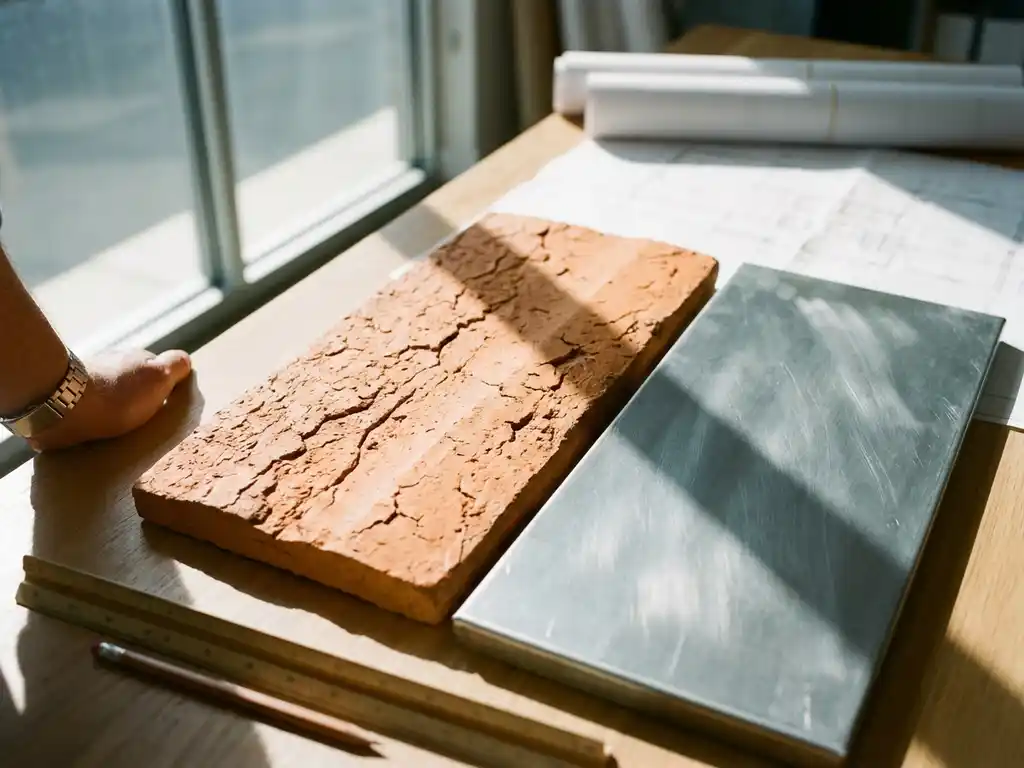
What’s the difference between terracotta and zinc cladding materials?
Terracotta cladding is made from fired clay, producing durable ceramic façade tiles, while zinc cladding consists of metal sheets or panels that develop a protective patina over time. The fundamental difference lies in their composition and manufacturing processes, which directly affect their performance characteristics.
Terracotta undergoes a high-temperature firing process that transforms natural clay into a dense, non-porous ceramic material. This process creates ceramic façades with exceptional dimensional stability and color consistency. Modern terracotta systems feature interlocking profiles that mount to aluminum substructures, offering both structural integrity and design flexibility.
Zinc cladding, in contrast, relies on the metal’s natural weathering properties to form a protective zinc carbonate layer. This patination process gives zinc its characteristic appearance, but it also means the façade’s look evolves significantly over the first few years after installation. Metal cladding systems typically require different fixing methods and allowances for thermal movement compared with ceramic alternatives.
Which cladding material offers better durability and weather resistance?
Ceramic façades demonstrate superior long-term durability and weather resistance compared with zinc cladding, particularly in harsh environmental conditions. Terracotta’s fired ceramic structure provides inherent resistance to UV degradation, thermal cycling, and chemical weathering that can affect metal systems over decades.
The sinter-firing process used in high-quality ceramic façade production creates a material with exceptional freeze–thaw resistance and dimensional stability. Unlike zinc, which can experience thermal expansion and contraction that may lead to joint stress, ceramic elements maintain their structural integrity across temperature variations. This stability translates to fewer maintenance interventions and a longer façade lifespan.
Zinc cladding, while initially weather-resistant due to its protective patina, can be susceptible to acid rain damage and coastal salt exposure. The patination process that gives zinc its weather resistance can be uneven in polluted environments, potentially leading to aesthetic inconsistencies and localized corrosion over time.
How do maintenance requirements compare between terracotta and zinc façades?
Terracotta cladding requires significantly less maintenance than zinc systems, with ceramic façades often needing only periodic cleaning rather than protective treatments or surface restoration. The non-porous surface of high-quality ceramic façade tiles resists dirt accumulation and provides natural resistance to graffiti.
Ceramic façades maintain their appearance and performance with minimal intervention throughout their service life. The smooth, dense surface created by high-temperature firing naturally sheds water and resists biological growth, eliminating the need for specialized cleaning agents or frequent maintenance cycles that metal systems may require.
Zinc cladding maintenance involves monitoring the patination process and addressing any areas where the protective layer may have been compromised. Metal cladding systems may require periodic inspection of fixing points, sealants, and thermal-movement joints. In aggressive environments, zinc surfaces might need cleaning or treatment to maintain their protective properties and aesthetic consistency.
What are the aesthetic possibilities with each cladding type?
Ceramic façades offer virtually unlimited design possibilities through precise color control, diverse surface textures, and flexible sizing options, while zinc cladding provides a more limited palette focused on metallic finishes and patina variations. Modern ceramic production allows for consistent color matching and custom surface treatments that remain stable over decades.
Terracotta systems can achieve formats ranging from small-scale tiles to large-format panels, with surfaces varying from smooth and contemporary to textured and traditional. The firing process enables deep, saturated colors that won’t fade under UV exposure, and special glazing techniques can create unique visual effects. Ceramic façade tiles can be manufactured to precise dimensional tolerances, enabling complex geometric patterns and seamless installations.
Zinc cladding aesthetics center on the metal’s natural patination process and various profile options. While this creates an attractive, evolving appearance, the color palette remains limited to zinc’s natural tones and patina variations. Metal cladding systems excel at creating continuous, flowing surfaces and can be formed into complex curves, though this often increases installation complexity and thermal-movement considerations.
How do installation costs and complexity compare?
Ceramic façade installation typically offers lower complexity and more predictable project timelines compared with zinc cladding, primarily due to lower weight and simplified fixing systems. Modern ceramic elements often feature interlocking profiles that streamline the installation process while reducing substructure requirements.
The lightweight nature of high-quality ceramic façade tiles reduces structural loading requirements, potentially lowering overall project costs through simplified support systems. Installation teams can work more efficiently with ceramic systems due to standardized fixing methods and the material’s dimensional consistency. The reduced dead load also makes ceramic façades particularly suitable for retrofit applications where structural capacity may be limited.
Zinc installation requires specialized expertise in metalworking and accommodating thermal movement. Metal cladding systems demand careful attention to expansion joints, weatherproofing details, and galvanic compatibility with other building components. While material costs may vary, the total project value should consider long-term performance, maintenance requirements, and life-cycle benefits rather than initial installation expenses alone.
How TONALITY® Ceramic Facades Excel in Modern Cladding Applications
TONALITY® ceramic façades combine the aesthetic versatility of terracotta with advanced manufacturing precision to deliver superior building-envelope solutions. Our ceramic elements are produced using specialized sinter firing at temperatures exceeding 1,200°C, creating unrivaled surface density and long-term performance characteristics.
- Lightweight ceramic construction at only 40 kg/m² reduces structural requirements
- Interlocking back profiles with aluminum retaining systems enable simple „mount-and-done“ installation
- A1 fire classification provides non-combustible building-material performance
- Integrated graffiti protection and permanent UV resistance eliminate maintenance concerns
- 100% recyclable ceramic elements support sustainable construction practices
- Precise manufacturing tolerances within one millimeter ensure consistent installation quality
Discover how TONALITY® ceramic façade systems can enhance your next project with unmatched durability, design flexibility, and long-term value. Contact our technical team to explore custom solutions tailored to your specific architectural requirements.
Ähnliche Artikel
- Wie unterscheiden sich Bundesförderung und Landesförderung bei Schulgebäuden?
- How do sustainable materials reduce construction costs?
- How do ceramic tiles compare to other sustainable options?
- How to Design Terracotta Cladding for High Seismic Risk Zones
- Which LEED credits can architects achieve with terracotta facade specification?