

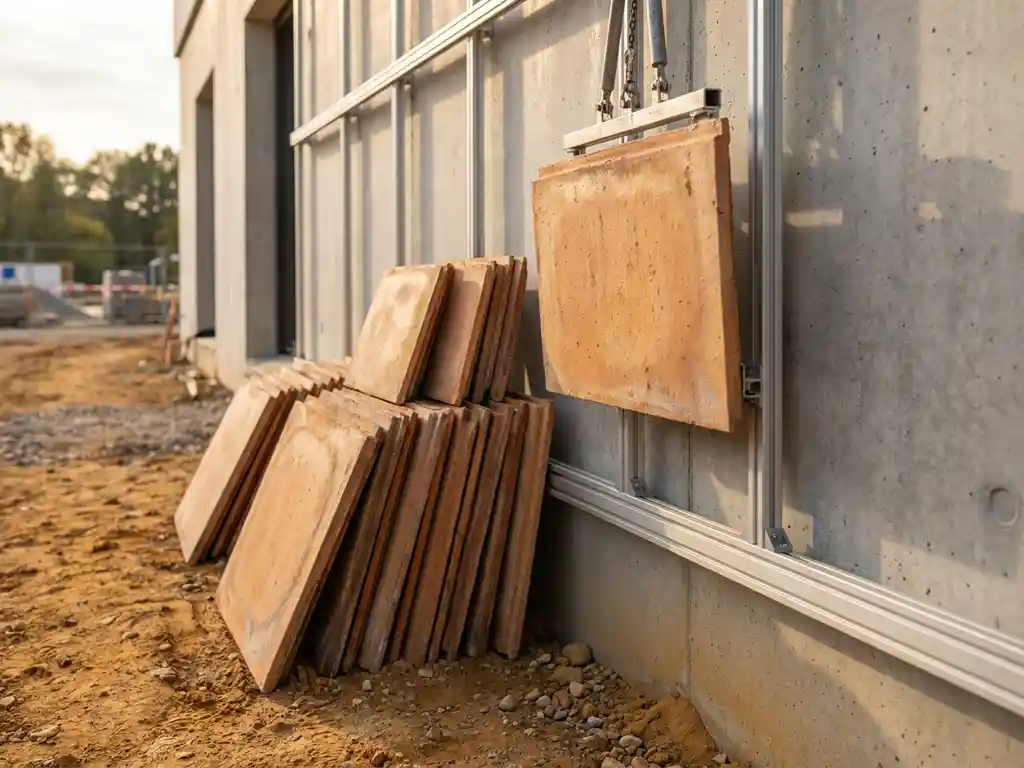
Terracotta facades contribute to a circular economy by offering a fully recyclable, non-combustible cladding material with a long service life, minimal maintenance requirements, and the ability to be deconstructed, sorted by component type, and reused with very little waste. In 2026, as the construction industry faces growing pressure to reduce embodied carbon and close material loops, ceramic facade systems stand out as one of the most genuinely circular cladding options available. The sections below explore exactly how that circularity works in practice.
What makes terracotta a naturally circular building material?
Terracotta is a naturally circular building material because it is made from raw clay, a mineral resource that requires no synthetic binders or composite additives, and can be returned to the material cycle at the end of its life without generating hazardous waste. The fired ceramic structure is chemically stable, meaning it does not degrade or leach substances over decades of use, which preserves its material quality for future recovery.
The circular credentials of terracotta begin at the source. Clay is one of the most abundant raw materials on Earth, and when sourced responsibly from high-quality regional deposits, the extraction footprint is significantly lower than that of materials requiring energy-intensive refining or long-distance shipping. Drawing on the largest and highest-quality clay deposits in Europe, located in the Westerwald region of Germany, keeps the raw material chain short and traceable — a key factor when assessing the true environmental cost of a terracotta facade system.
During production, the sinter firing process at temperatures exceeding 1,200 degrees Celsius creates a dense, vitrified surface that requires no additional coatings, sealants, or chemical treatments to perform. This single-material composition is precisely what makes terracotta so well suited to circular systems: there are no laminated layers to separate, no adhesive residues to remove, and no composite structures that complicate sorting at end of life.
How are ceramic facade tiles recycled or reused at end of life?
Ceramic facade tiles can be recycled or reused at end of life through deconstruction of the facade system by component type, followed by sorting and reprocessing of the ceramic elements. Because the tiles are not bonded with adhesives but instead interlock with aluminum retaining profiles, they can be removed cleanly and either reinstalled in another project or crushed and reincorporated into ceramic production as secondary raw material.
The key enabler here is the mechanical fixing system. Modern terracotta facade systems use a mount-and-done interlocking approach where ceramic elements engage with vertical aluminum profiles without mortar or adhesive bonding. This means that at the end of a building’s service life, or during a renovation, the facade can be taken apart in reverse order with minimal effort, leaving the tiles intact and undamaged.
Tiles that remain structurally sound after removal can be directly reused on other projects, which represents the highest-value circular outcome: no reprocessing energy required, full material quality retained. Tiles that are damaged or no longer suitable for direct reuse can be crushed and used as aggregate or reintroduced into ceramic production streams. Either way, the material does not end up in a landfill, and its value is not lost. High-quality terracotta ceramic facade elements are 100% recyclable and designed for component-level deconstruction — a claim that can be verified through product documentation and material samples.
How does low facade weight reduce a building’s material footprint?
Low facade weight reduces a building’s material footprint by requiring less structural support, lighter substructures, and fewer fixings, which in turn means less steel, aluminum, and concrete are consumed in the overall facade assembly. Every kilogram saved in cladding weight has a multiplying effect on the resources needed to hold that cladding in place.
Single-layer ceramic facade elements typically carry a surface weight of approximately 40 kilograms per square meter. This relatively low dead weight allows for lighter aluminum substructures compared to heavier stone or composite cladding systems, which directly reduces the embodied carbon and raw material consumption of the complete facade build-up.
The weight advantage becomes especially significant in timber construction, where structural load limits are more constrained than in concrete or steel-frame buildings. Lighter facades open up more design possibilities in low-carbon structural systems, meaning that choosing a lightweight ceramic cladding can support a broader shift toward sustainable construction methods. Fewer materials in the substructure also means fewer components to account for at end of life, keeping the circular loop simpler and more efficient.
What role does fire classification play in sustainable facade selection?
Fire classification plays a direct role in sustainable facade selection because non-combustible materials classified as A1 eliminate the need for additional fire protection layers, intumescent coatings, or suppression systems that add material complexity, cost over the building’s lifecycle, and waste at end of life. Choosing a material that is inherently non-combustible simplifies the facade assembly and reduces its overall environmental burden.
Terracotta ceramic is classified as building material class A1, the highest fire resistance classification, meaning it contains no combustible components whatsoever. This is not a surface treatment or an added property; it is an inherent characteristic of the fired clay material itself. No organic binders, no polymer coatings, and no combustible fillers are present in the ceramic structure.
From a sustainability perspective, this matters for several reasons. First, it reduces the number of additional protective layers required in the facade specification, keeping the material stack simpler and more recyclable. Second, it contributes to the long-term durability of the facade by eliminating materials that can degrade, off-gas, or require periodic replacement. Third, in the context of increasingly stringent building regulations around fire safety in 2026, specifying an A1-rated facade material removes compliance uncertainty and reduces the risk of costly design revisions later in a project.
How do terracotta facades compare to other cladding materials for circularity?
Terracotta facades compare favorably to most other cladding materials for circularity because they combine single-material composition, mechanical fixing systems, inherent non-combustibility, and full recyclability in a way that composite, coated, or polymer-based alternatives cannot match. Many competing materials either contain multiple bonded layers that prevent clean sorting, rely on surface coatings that degrade over time, or cannot be cleanly separated from their substructures at end of life.
Terracotta versus fiber cement and composite panels
Fiber cement and composite panels often combine mineral and organic components in a bonded structure that is difficult to separate for recycling. While they can offer good performance during their service life, the mixed-material composition limits end-of-life options and typically results in the panels being treated as waste rather than recovered as a resource. Terracotta, by contrast, is a single inorganic material that can be cleanly sorted and reprocessed.
Terracotta versus natural stone
Natural stone shares terracotta’s mineral character and is also fully recyclable in principle, but stone cladding is typically much heavier, requiring more substantial substructures and increasing the total material footprint of the facade assembly. Stone panels are also frequently bonded with adhesive or mortar systems that complicate removal and reuse. Terracotta’s mechanical interlocking system and lower weight give it a practical circularity advantage in most modern facade applications.
Across the comparison, what sets ceramic facade cladding apart is the combination of material purity, system design, and long-term performance stability. Permanent UV resistance and integrated graffiti protection mean the surface does not require recoating or retreatment over the facade’s lifespan, which removes a significant source of maintenance-related waste and chemical use. For construction project managers and contractors evaluating sustainable facade materials in 2026, the lifecycle picture for terracotta is consistently strong across durability, recyclability, and material efficiency. Real-world applications confirm this — browsing completed terracotta facade projects illustrates how circular principles translate into built outcomes across a wide range of building types and climates.
How TONALITY® supports circular facade design
TONALITY® is purpose-built to deliver on the circular principles outlined throughout this article. From raw material sourcing in the Westerwald clay region to the mechanical interlocking system that enables clean deconstruction, every aspect of the TONALITY® ceramic facade system is designed to keep material value in the loop for as long as possible. Specifically, TONALITY® offers:
- 100% recyclable ceramic elements made from a single inorganic material with no adhesive bonding, enabling clean separation and reprocessing at end of life
- A1 non-combustible classification that eliminates the need for additional fire protection layers, reducing material complexity and lifecycle waste
- Lightweight single-layer panels at approximately 40 kg/m², minimizing substructure requirements and the total material footprint of the facade assembly
- Permanent surface performance with no coatings or treatments required over the facade’s lifespan, removing a major source of maintenance-related chemical use and waste
- Mount-and-done interlocking profiles that allow the facade to be disassembled by component type with minimal effort, preserving tile integrity for direct reuse or high-grade recycling
If you are specifying a facade system that needs to meet circular economy requirements, achieve A1 fire classification, and perform without ongoing maintenance intervention, contact the TONALITY® team to discuss your project requirements and request technical documentation.
Related Articles
- Does deep profiling affect the structural performance of ceramic elements?
- Can ceramic cladding solutions be retrofitted onto existing building facades?
- How does facade circularity influence planning permission in 2026?
- What are the biggest terracotta facade trends in 2026?
- What are common maintenance issues with ceramic facades?