

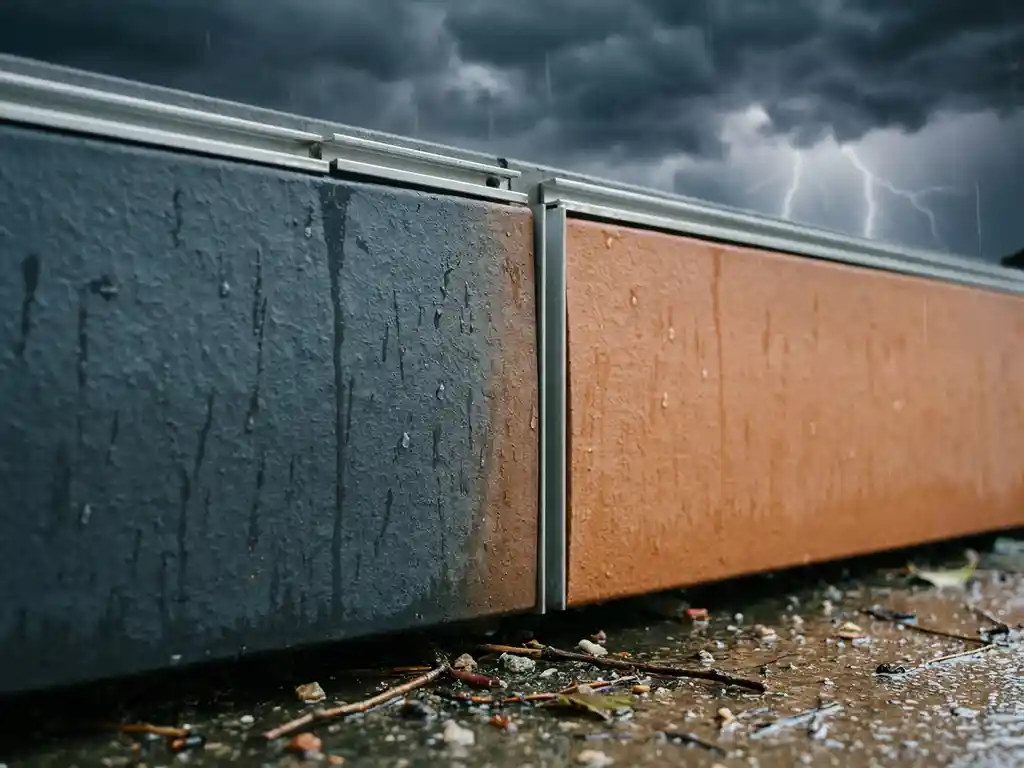
Sustainable facades perform exceptionally well in extreme weather conditions when manufactured from the right materials. Ceramic facades, in particular, are engineered to withstand temperature extremes, heavy rainfall, UV exposure, and high wind loads without degrading in appearance or structural integrity. The sections below address the most common questions about ceramic facade performance across challenging climates.
What makes a facade material truly weather resistant?
A truly weather resistant facade material must resist moisture absorption, maintain dimensional stability across temperature swings, hold its color under prolonged UV exposure, and retain structural integrity under wind and impact loads. The combination of low porosity, thermal stability, and surface hardness determines whether a facade will perform reliably over decades rather than years.
Not all facade materials meet these criteria equally. Organic materials like wood or fiber cement can absorb moisture, expand and contract with temperature changes, and gradually degrade under UV radiation. Ceramic cladding, by contrast, is fired at temperatures exceeding 1,200 degrees Celsius through a sinter firing process that fuses the material into a dense, low-porosity structure. This process eliminates the internal voids that allow water penetration and frost damage to take hold.
Equally important is surface density. A smooth, dense surface sheds water efficiently, resists dirt adhesion, and prevents the micro-cracking that accumulates over time in more porous materials. For construction project managers evaluating long-term facade durability, surface density is one of the most reliable indicators of how a material will age in harsh climates.
How do ceramic facades perform in freezing and thawing cycles?
Ceramic facades perform very well in freezing and thawing cycles because their extremely low water absorption rate prevents the internal ice expansion that causes frost damage. When water cannot penetrate the material, freeze-thaw cycling has no mechanism to crack or spall the surface, making ceramic cladding one of the most frost-resistant facade options available.
Frost damage in facade materials follows a predictable pattern: water enters pores or micro-cracks, freezes and expands, and progressively widens those cracks over repeated cycles. Materials with high absorption rates deteriorate visibly within a few winters in cold climates. The dense sintered structure of high-quality ceramic tiles leaves almost no pathway for water ingress, breaking this cycle entirely.
This characteristic is particularly valuable in Central European climates, where temperature fluctuations around the freezing point are frequent throughout winter. Facades in these conditions can experience dozens of freeze-thaw cycles in a single season. Ceramic elements that maintain their structural and aesthetic properties through these cycles represent a significant long-term advantage over materials that require periodic replacement or surface treatment to prevent frost damage.
Does UV exposure cause ceramic facade colors to fade?
UV exposure does not cause ceramic facade colors to fade. The color in ceramic tiles is not a surface coating or applied pigment but is instead integrated into the material itself during the firing process. Because there is no organic binder or surface layer to break down under ultraviolet radiation, ceramic cladding maintains its original color permanently without any protective treatment.
This is one of the clearest distinctions between ceramic facades and alternatives such as painted metal panels, fiber cement boards, or polymer-based cladding systems. In those materials, UV radiation gradually degrades the surface finish, leading to fading, chalking, or discoloration that requires repainting or replacement over time. The lifecycle cost implications of this difference are substantial: a facade that retains its appearance without intervention reduces maintenance planning, scaffolding costs, and disruption to building occupants over a building’s service life. You can explore completed projects to see how ceramic facades maintain their appearance in real-world conditions over time.
For architects and specifiers working on projects where long-term visual consistency matters, permanent color stability is a decisive advantage. The inherent UV resistance of ceramic elements means the facade appearance on day one remains consistent decades into the future regardless of sun exposure.
How do ventilated facade systems handle wind and rain loads?
Ventilated facade systems handle wind and rain loads through a pressure-equalized cavity that neutralizes driving rain penetration and dissipates wind pressure across the substructure. The air gap between the ceramic cladding and the building envelope allows moisture to drain and evaporate freely, while the mechanical fixing system transfers wind loads directly to the building structure without relying on sealants or adhesives.
The ventilated cavity is central to the system’s weather performance. When wind-driven rain strikes the facade surface, some water inevitably enters the cavity through joints. In a pressure-equalized system, the air pressure inside the cavity equalizes with the external pressure, removing the pressure differential that would otherwise force water deeper into the construction. Water that enters the cavity drains downward by gravity and exits at the base of the facade without reaching the thermal insulation or structural wall behind it.
Wind load performance depends on the mechanical connection between the ceramic elements and the aluminum retaining profiles. Profiled ceramic backs interlock with vertical aluminum profiles, creating a secure mechanical connection that distributes loads evenly. This approach avoids reliance on adhesive bonding, which can degrade under thermal cycling and moisture exposure, and instead provides a connection that remains stable across the full range of weather conditions a building will encounter over its service life. If you would like to assess material options hands-on before specifying, ordering samples is a practical first step.
Are ceramic facades a fire risk in extreme heat conditions?
Ceramic facades are not a fire risk in extreme heat conditions. Ceramic is classified as a building material class A1, which means it is non-combustible and contains no combustible components whatsoever. In a fire event, ceramic facade elements do not contribute to flame spread, do not release toxic gases, and do not structurally fail in ways that could accelerate fire progression across a building’s exterior.
This classification is particularly significant in the context of recent regulatory changes across European markets, where high-rise and timber-frame buildings face increasingly strict requirements for non-combustible external cladding. The failures of combustible cladding systems in major fire incidents have focused regulatory and design attention on facade material classification as a primary safety criterion rather than a secondary consideration.
For timber construction specifically, the fire safety profile of ceramic cladding is especially relevant. Timber frame buildings require careful fire protection detailing at every layer of the building envelope. A non-combustible A1-rated facade cladding provides an outer layer that actively resists ignition from external fire sources such as adjacent building fires or ground-level incidents, complementing the fire protection measures applied to the structural frame itself.
How long do sustainable ceramic facades last in harsh climates?
Sustainable ceramic facades last for several decades in harsh climates, with service lives that routinely extend beyond 50 years when properly installed. Because the material does not absorb moisture, fade under UV radiation, corrode, or degrade through freeze-thaw cycling, the primary determinants of facade lifespan are the quality of the substructure and the fixing system rather than the ceramic elements themselves.
Longevity in facade systems is best evaluated through total cost of ownership rather than upfront material selection alone. A facade that requires no repainting, no surface sealing, and no periodic replacement of degraded elements delivers compounding value over a building’s service life. Maintenance interventions are not only a direct cost but also involve scaffolding, access planning, and disruption to building operations that multiply the real impact of each intervention.
The 100% recyclability of ceramic elements adds a further dimension to the sustainability case. At the end of a building’s service life, ceramic facade elements can be deconstructed and sorted by component type with minimal effort, supporting circular economy principles and reducing construction waste. For project managers and developers working within environmental certification frameworks in 2026, this end-of-life recyclability contributes directly to whole-life carbon assessments and circular economy credits within schemes such as BREEAM and DGNB.
In practical terms, specifying a ceramic facade in a demanding climate is a decision that pays dividends across the entire building lifecycle. The combination of weather resistance, color permanence, fire safety, and recyclability makes ceramic cladding one of the most comprehensively durable facade solutions available for new construction and renovation projects alike.
How TONALITY® helps with weather-resistant ceramic facades
TONALITY® brings together the technical properties described throughout this article into a complete, engineered facade system designed specifically for demanding climatic conditions. Whether your project faces harsh winters, high UV exposure, or strict fire safety requirements, TONALITY® addresses each challenge with a proven ceramic cladding solution:
- Frost resistance: TONALITY® ceramic elements are produced through a high-temperature sinter firing process that achieves extremely low water absorption, effectively eliminating frost damage across repeated freeze-thaw cycles.
- Permanent color stability: Color is integrated into the ceramic body during firing, not applied as a surface coating, ensuring the facade retains its appearance for the full service life of the building without repainting or retreatment.
- Non-combustible A1 classification: Every TONALITY® facade element is classified as building material class A1, meeting the most stringent fire safety requirements for high-rise and timber-frame construction.
- Ventilated system performance: The TONALITY® mechanical fixing system uses interlocking aluminum profiles and profiled ceramic backs to deliver reliable wind and rain load resistance without dependence on adhesive bonding.
- Sustainability credentials: TONALITY® elements are 100% recyclable and support whole-life carbon assessments under BREEAM, DGNB, and comparable certification frameworks.
To find out how TONALITY® can be specified for your next project, get in touch with our team for expert guidance and project-specific advice.
Related Articles
- How does the color stability of terracotta cladding compare to other materials?
- How does climate influence architectural design decisions
- What makes terracotta inherently safer than ACM panels for high-rise buildings?
- How to Integrate Terracotta Facades into Revit and BIM Workflows
- How do you install terracotta facade panels?