

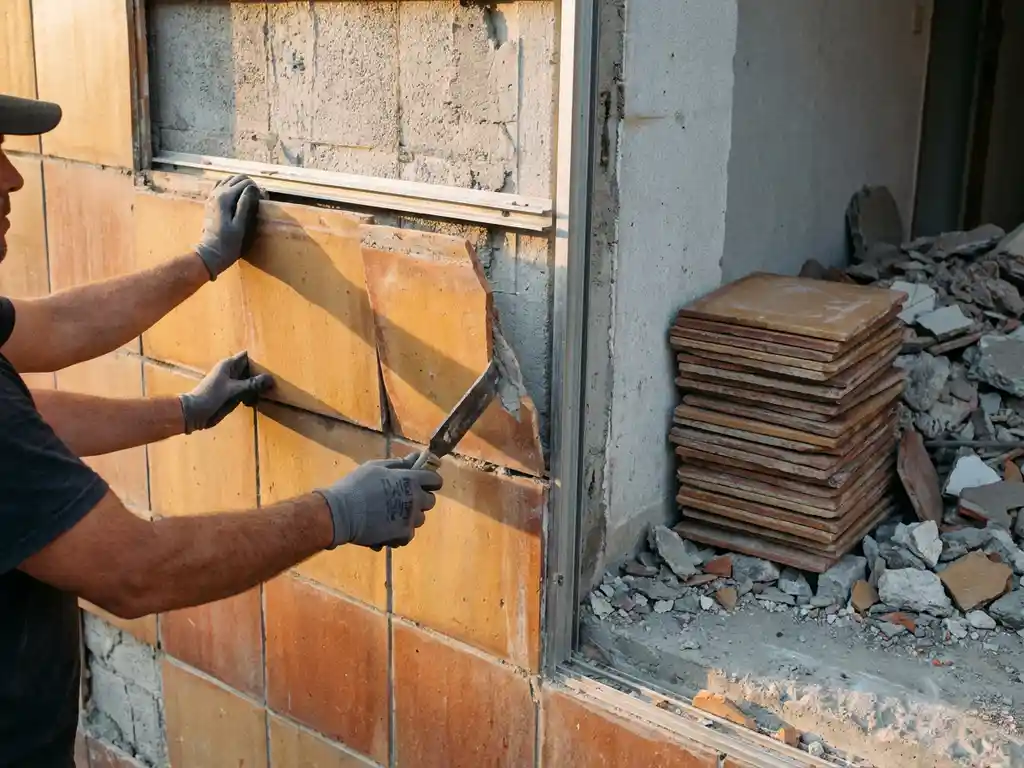
Terracotta facade demolition offers genuine urban mining opportunities, particularly for recovering high-quality ceramic material that can re-enter the construction supply chain. Because ceramic is an inorganic, non-combustible material, it retains its physical and chemical properties across decades of use, making recovery both practical and economically sensible. The sections below explore exactly what gets recovered, how recycling works, and what the regulatory landscape looks like in Germany.
What materials can be recovered from terracotta facade demolition?
Terracotta facade demolition yields several recoverable material streams, with the ceramic cladding itself being the most valuable. The aluminum substructure profiles, mechanical fasteners, and any thermal insulation layers can all be separated and recovered. Because terracotta is a single-material, inorganic product, it does not degrade in the way that composite or coated materials do, which means the ceramic fraction retains its structural integrity even after many years of service.
The ceramic elements themselves are the primary target for urban mining terracotta facades. Depending on the condition of the tiles after removal, they can follow one of two recovery pathways: direct reuse as cladding elements on another building, or crushing and reprocessing into secondary raw material for new ceramic products, road sub-base, or aggregate fill. Neither pathway requires complex chemical separation, which keeps the recovery process straightforward. To understand the full range of terracotta surface formats and system configurations that influence how tiles are removed and sorted, it is worth reviewing the available profile options before planning a deconstruction project.
The aluminum retaining profiles that form the substructure represent a secondary but significant material stream. Aluminum is one of the most recycled metals in construction, and the profiles used in ventilated facade systems are typically made from high-grade alloys that command strong secondary market value. Separating aluminum from ceramic requires no specialist equipment, which is an important practical consideration for demolition contractors managing tight project timelines.
How is terracotta ceramic recycled after a building comes down?
Terracotta ceramic is recycled through one of two routes after a building is demolished: whole-tile reuse or mechanical size reduction into ceramic aggregate. Whole tiles that survive demolition intact and meet dimensional tolerances can be cleaned, inspected, and installed directly onto new or renovated facades. Tiles that are cracked or chipped are crushed into granules, which are then used as secondary raw material in ceramic production or as aggregate in construction applications.
The crushing and reprocessing route is well established in the ceramics industry. Crushed terracotta, sometimes called ceramic grog, is blended back into clay body formulations for new tile production. This closed-loop approach reduces the demand for virgin clay extraction and lowers the energy input required per unit of finished product. Because terracotta is fired at temperatures exceeding 1,200 degrees Celsius during its original manufacture, the resulting material is chemically stable and does not introduce contaminants into a new production batch.
For project managers and contractors, the practical implication is that ceramic facade demolition recycling generates very little landfill waste. Unlike composite cladding panels that combine materials bonded together with adhesives, terracotta tiles are single-composition elements. This means sorting is fast, processing is clean, and the recovered material commands a defined secondary value rather than being treated as waste. Reviewing completed terracotta facade projects can give a useful sense of the system configurations most commonly encountered during refurbishment and end-of-life deconstruction.
What makes terracotta easier to deconstruct than other facade materials?
Terracotta is easier to deconstruct than most alternative facade materials because it uses a mechanical fixing system rather than adhesive bonding. The tiles interlock with vertical aluminum retaining profiles and can be removed individually without damaging adjacent elements or the substructure. This means selective removal is possible, which is valuable in partial renovation projects where only sections of a facade need replacing.
Contrast this with facade systems that rely on mortar bedding, structural adhesives, or bonded composite panels. These systems require cutting, grinding, or chemical release agents to separate the cladding from the substrate, which damages the material being removed, contaminates the recovered fraction, and significantly increases labor time. Facade deconstruction reuse rates are consistently higher for mechanically fixed systems precisely because the material survives removal in a usable condition. Downloading technical documentation and material samples ahead of a deconstruction project can help teams plan separation sequences and confirm fixing types in advance.
The low surface weight of ceramic facade systems is another factor that simplifies deconstruction. Lighter individual elements are easier to handle manually, reduce the risk of breakage during removal, and require less heavy lifting equipment on site. For contractors managing demolition or refurbishment projects in occupied or constrained urban sites, this translates into faster work and lower logistical overhead.
Well-designed terracotta facade systems are typically configured so that ceramic elements can be deconstructed and sorted by component type with minimal effort, which directly supports the kind of clean material separation that makes urban mining viable rather than theoretical.
What is the circular economy value of ceramic facade materials?
The circular economy value of ceramic facade materials is high because the material retains its physical properties indefinitely, requires no surface treatments that would compromise recyclability, and can re-enter the construction supply chain without complex processing. Unlike materials that degrade, off-gas, or require chemical stripping before recovery, terracotta simply needs to be cleaned and sorted.
From a lifecycle perspective, the value of ceramic building material recyclability compounds over time. A building clad in terracotta today can be deconstructed in thirty or fifty years with the ceramic fraction still recoverable as either a reuse product or a quality secondary raw material. This long-term retention of material value is a core principle of circular economy thinking, and it distinguishes ceramic from facade materials that have a single useful life before becoming landfill.
There is also a carbon accounting dimension to consider. When recovered ceramic replaces virgin raw material in new production, it reduces the extraction and processing energy embedded in the new product. This embodied carbon benefit is increasingly relevant to project teams working toward whole-life carbon targets under green building certification schemes. The ability to quantify and document end-of-life material recovery strengthens the environmental case for ceramic cladding at the design stage, not just at demolition.
Which building regulations affect facade material recovery in Germany?
In Germany, facade material recovery is shaped by the Kreislaufwirtschaftsgesetz, the Circular Economy Act, which establishes a hierarchy of waste avoidance, preparation for reuse, recycling, and other recovery. Under this framework, demolition waste must be managed according to the hierarchy, meaning that reusable materials like intact terracotta tiles should be considered for direct reuse before being sent for recycling or disposal.
The Gewerbeabfallverordnung, the Commercial Waste Ordinance, requires that construction and demolition waste be sorted at source where technically feasible. This means contractors on German demolition sites are legally required to separate ceramic, metal, and other material streams rather than mixing them. For terracotta cladding material recovery, this regulatory requirement aligns well with the material’s physical properties, since terracotta separates cleanly from aluminum substructures without contamination.
Germany’s building material classification system also plays a role. Ceramic facade elements classified as building material class A1, which means non-combustible and containing no combustible components, face fewer handling restrictions during demolition than materials with fire retardant coatings or combustible cores. This classification simplifies the waste management documentation process and reduces the risk of recovered material being reclassified as hazardous waste, which would restrict its reuse options.
As of 2026, the broader European context is also relevant. The EU Construction Products Regulation revision and the proposed Buildings Directive both push toward mandatory end-of-life material declarations and deconstruction planning for new buildings. German project teams specifying facade materials now increasingly need to demonstrate that their material choices support future recovery, which positions ceramic cladding favorably against composite alternatives that cannot make the same end-of-life claims.
How TONALITY® supports terracotta facade recycling and urban mining
TONALITY® ceramic facade systems are designed from the outset with end-of-life recovery in mind, making them a practical choice for project teams that need to demonstrate circular economy performance at both the design and demolition stage. Here is how TONALITY® directly addresses the challenges covered in this article:
- Mechanically fixed systems: TONALITY® tiles are secured with aluminum retaining profiles rather than adhesives, enabling clean tile-by-tile removal and high whole-tile reuse rates after deconstruction.
- Single-material ceramic composition: TONALITY® terracotta contains no coatings, adhesive layers, or composite cores that would contaminate the recovered ceramic fraction or complicate sorting on site.
- Building material class A1: TONALITY® products meet the A1 non-combustible classification, which simplifies waste management documentation under German regulatory requirements and keeps recovery options open.
- Documented material properties: Full technical data is available to support end-of-life declarations, whole-life carbon assessments, and deconstruction planning required under evolving EU and German building regulations.
If you are planning a facade project and want to ensure your material specification supports future recovery, get in touch with the TONALITY® team to discuss system options and receive technical guidance tailored to your project requirements.