

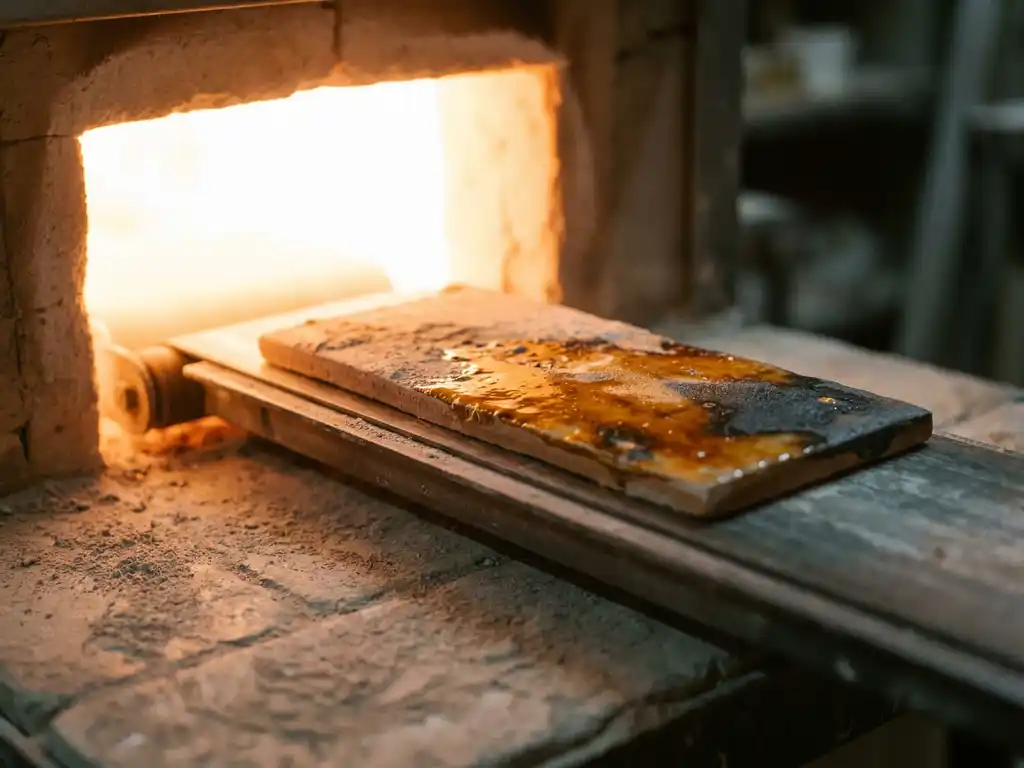
Sinter firing is a high-temperature ceramic manufacturing process in which raw clay is fired at temperatures exceeding 1,200 degrees Celsius, causing the material’s particles to fuse together into a dense, non-porous mass. This transformation is what gives sintered ceramic tiles their exceptional durability, weather resistance, and surface stability. The sections below unpack exactly how the process works and why it matters for facade design and long-term building performance.
How does sinter firing actually work?
Sinter firing works by heating ceramic material to a temperature high enough that the clay particles begin to bond at a molecular level without the material fully melting. At temperatures above 1,200 degrees Celsius, the silica and alumina compounds within the clay vitrify, filling the microscopic pores between particles and creating a dense, homogeneous structure throughout the entire tile body.
The process begins with raw clay being shaped into panels or tiles, then slowly brought up to peak firing temperature in a controlled kiln environment. The rate at which temperature rises and falls is carefully managed to prevent cracking and to ensure uniform densification across the tile. Once the sintering threshold is reached, the material undergoes a permanent physical change: the loose granular structure collapses into a tightly bonded matrix that is fundamentally different from standard fired ceramics.
What makes this relevant for facade textures and formats is that the sintering process produces a tile body that is consistent from front to back. There are no soft inner layers or structural weak points. The result is a single-layer material with predictable mechanical properties across its entire cross-section.
What makes sintered ceramic surfaces different from standard tiles?
Sintered ceramic surfaces are fundamentally denser and less porous than standard fired tiles. Where conventional ceramic tiles retain a degree of open porosity in their body, sintered tiles have that porosity eliminated through the vitrification process. This makes the surface smoother, harder, and far more resistant to the absorption of water, dirt, and contaminants.
Standard ceramic tiles are typically fired at lower temperatures, which leaves the tile body with residual micro-pores. Over time, these pores can trap moisture, allow biological growth, or absorb pollutants that discolor the surface. Sintered ceramics, by contrast, present a surface that resists penetration at a structural level rather than relying on applied sealants or coatings.
For architectural design and building exterior design, this distinction has real consequences. A sintered facade tile does not require periodic resealing, does not stain as readily, and does not degrade in the same way as a lower-fired alternative. The surface you see on installation day remains the surface you see decades later, which is a meaningful advantage for projects where long-term appearance consistency is a design priority.
Why is sinter firing important for weather resistance?
Sinter firing is critical for weather resistance because the densified, low-porosity structure of sintered ceramic is highly resistant to freeze-thaw cycles, driving rain, and thermal expansion that cause conventional facade materials to crack, spall, or degrade over time. Water cannot penetrate the tile body, so there is no internal moisture to freeze and expand in cold weather.
Facade materials face a particularly demanding set of environmental stresses. They must cope with direct UV exposure, temperature swings that can exceed 50 degrees Celsius between summer and winter, wind-driven rain, and in many urban environments, airborne pollutants and acid rain. Each of these factors exploits weaknesses in porous or structurally inconsistent materials.
Because sintered ceramic has eliminated internal porosity, it does not provide pathways for water ingress. This means the tile body does not swell, contract unevenly, or develop internal stress fractures as moisture cycles through it. The mechanical stability of the sintered structure also means the tile resists surface crazing and cracking under thermal load, which is a common failure mode in lower-quality facade ceramics.
For commercial architecture in particular, where maintenance access is costly and disruption to building occupants is a concern, this inherent weather resistance translates directly into lower lifecycle maintenance requirements and a longer serviceable lifespan for the facade system.
Does sinter firing affect the color and UV stability of facade tiles?
Yes, sinter firing significantly enhances both color permanence and UV stability. Because the color in sintered ceramic tiles is fired into the material body at extremely high temperatures rather than applied as a surface glaze or coating, it becomes an integral part of the tile’s structure. UV radiation and weathering cannot bleach, peel, or erode a color that exists within the material itself.
Surface-applied finishes on lower-temperature ceramics or other facade materials can fade, chalk, or delaminate when exposed to prolonged UV radiation. Sintered ceramic avoids this entirely because the chromatic properties are locked in during the firing process. The mineral pigments used in high-temperature sintering are themselves stable at far greater temperatures than they will ever encounter in service, which means UV exposure presents no meaningful degradation risk.
This is particularly relevant for projects where terracotta colors or other warm, earthy tones are specified. Natural terracotta hues are achieved through the iron content of the clay itself, and sinter firing preserves and stabilizes these tones without any need for post-application color treatment. The color remains consistent across the full tile body, so any surface wear or minor abrasion does not reveal a different-colored substrate beneath.
For architects working on facade design where color consistency across large surface areas is a critical specification, sintered ceramic offers a level of chromatic reliability that surface-treated alternatives cannot match over the long term.
Is sintered ceramic classified as non-combustible?
Yes, sintered ceramic is classified as non-combustible. Tiles produced through the sinter firing process are assigned building material class A1 under European fire classification standards, which is the highest possible rating and confirms that the material contains no combustible components and does not contribute to fire spread.
This classification is a direct consequence of the sintering process. At temperatures exceeding 1,200 degrees Celsius, any organic compounds present in the raw clay are completely burned away. What remains is a purely mineral, inorganic material that will not ignite, smolder, or release combustible gases when exposed to fire.
For facade design, this has significant implications for building safety compliance, particularly in multistory commercial and residential construction where fire performance of the external envelope is tightly regulated. An A1-rated facade material can be specified with confidence across virtually all building types and heights without triggering additional fire engineering requirements related to the cladding material itself.
Sintered ceramic is also particularly well suited to timber construction projects, where the non-combustible facade layer provides a protective external skin over a structure that would otherwise have more limited cladding options under fire regulations. The combination of low surface weight and A1 fire classification makes sintered ceramic one of the most practical facade solutions for modern timber-frame buildings.
How TONALITY® delivers sintered ceramic facades for architectural projects
TONALITY® manufactures sintered ceramic facade tiles using the process described throughout this article, firing elements at temperatures exceeding 1,200 degrees Celsius from high-quality clay deposits in the Westerwald region. The result is a facade system that brings together everything that makes sintered ceramic relevant for serious architectural work:
- Dense, smooth surfaces produced through full-body vitrification, requiring no sealants or surface coatings to perform
- Permanent color and UV resistance, including a wide range of terracotta colors and natural clay tones that remain consistent throughout the tile’s lifespan
- A1 non-combustible classification, making TONALITY® tiles suitable for all building types including timber construction
- A wide range of facade textures, surfaces, and formats, from 150 x 300 mm up to 400 x 1,600 mm, produced to within one millimeter precision
- Integrated graffiti protection and a low surface weight of approximately 40 kilograms per square meter, supporting light substructures and fast installation
- 100% recyclability and full deconstruction compatibility, supporting sustainable building exterior design
Whether you are specifying a commercial architecture project, exploring facade patterns and brise-soleil facade elements, or looking for a cladding system that performs without ongoing maintenance demands, TONALITY® offers a technically grounded answer backed by over two decades of manufacturing experience.
[cta_contact_form]
To explore the full range of surfaces, formats, and design possibilities, request samples and technical downloads directly, or get in touch with the TONALITY® team to discuss your project requirements in detail.