

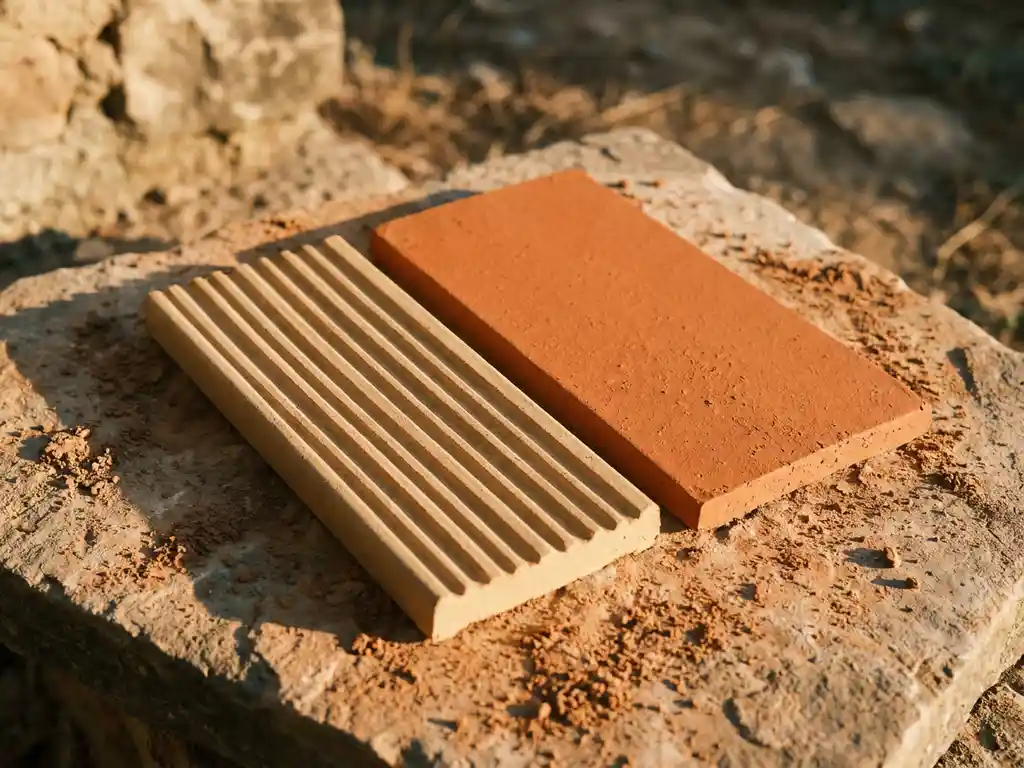
A ceramic slat and a solid terracotta facade panel are both clay-based facade cladding products, but they differ significantly in geometry, weight, structural requirements, and design potential. The ceramic slat is a profiled, elongated element designed for ventilated facade systems, while the solid terracotta panel is a thicker, flat or ribbed slab format. Understanding these differences helps architects and specifiers choose the right product for a given building type, structural context, and design ambition.
How are ceramic slats and terracotta panels actually made?
Both ceramic slats and terracotta facade panels start from clay, but the manufacturing process diverges significantly. Ceramic slats are typically single-layer extruded elements fired at temperatures exceeding 1,200 degrees Celsius in a sintering process, producing a dense, smooth, and extremely low-porosity surface. Solid terracotta panels are generally extruded or pressed at lower firing temperatures, resulting in a more porous, natural-looking surface with a coarser texture.
The sintering process used for high-quality ceramic facade elements is the key technical differentiator. At those extreme temperatures, the clay particles fuse together at a molecular level, eliminating micro-pores that would otherwise allow moisture, dirt, or pollutants to penetrate the surface. The result is a material that is inherently resistant to staining, biological growth, and weathering without any additional surface treatment.
Traditional terracotta panels, by contrast, retain a more open surface structure that gives them their characteristic earthy, handcrafted aesthetic. This is a deliberate quality in many architectural contexts, but it also means the surface behaves differently over time and may require more attention to maintain its original appearance.
What’s the difference in weight and substructure requirements?
Ceramic slats are significantly lighter than solid terracotta facade panels, and this difference has direct consequences for the substructure. High-quality single-layer ceramic facade elements can achieve a surface weight of around 40 kilograms per square meter, which allows for lighter aluminum substructures and makes the system particularly well suited to timber frame construction. Solid terracotta panels are heavier, often requiring more robust and costly load-bearing substructures.
Weight matters not only during installation but across the entire lifecycle of the building. A lighter ventilated facade system reduces the structural load on the primary construction, which can influence foundation design, especially in retrofit and refurbishment projects where the existing structure has limited spare load capacity.
The interlocking profile system used with ceramic slats also contributes to installation efficiency. Elements that mount directly onto vertical aluminum retaining profiles can be installed quickly and, importantly, can be removed and replaced individually without disturbing the surrounding cladding. This is a practical advantage during both construction and long-term building maintenance.
Do ceramic slats and terracotta panels differ in fire classification?
Yes, and this is one of the most important distinctions for building compliance. High-quality sintered ceramic facade elements are classified as building material class A1, which means they are fully non-combustible and contain no combustible components whatsoever. This is the highest possible fire classification under European building standards. Terracotta panels are also generally non-combustible, but the specific classification depends on the manufacturer and any surface treatments applied.
The A1 classification of ceramic facade cladding is particularly relevant for timber construction, where fire protection requirements are stringent. A non-combustible outer cladding layer adds a critical layer of passive fire protection without requiring additional intumescent coatings or fire barriers in the facade build-up. This simplifies compliance and reduces the risk of specification errors during the design process.
Architects specifying facade cladding for multi-storey buildings should always verify the fire classification of the specific product, not just the material category, since surface coatings or composite backing layers can affect the overall classification of a terracotta panel system.
Which offers more design flexibility, ceramic or terracotta?
Ceramic slats generally offer greater design flexibility than solid terracotta panels in terms of color range, surface finish, and format precision. Sintered ceramic elements can be produced in a wide spectrum of colors with consistent, repeatable results across production batches, and they can be manufactured to precise dimensions within one millimeter tolerance across formats ranging from 150 x 300 mm up to 400 x 1,600 mm. Terracotta panels typically offer a narrower color palette centered on natural earth tones, with more natural variation between units.
That natural variation is, of course, a design quality in its own right. Many architects choose terracotta precisely because no two panels look identical, creating a facade that reads as handcrafted and organic. Ceramic, by contrast, offers the ability to specify exactly what the finished facade will look like and reproduce it reliably across large surface areas.
Surface texture is another dimension of difference. Ceramic slats can be produced with smooth, structured, or relief surfaces, and the dense sintered material holds fine surface detail with exceptional consistency. You can explore the full range of available ceramic surfaces and formats to understand the breadth of options available for a specific project.
How do maintenance and longevity compare between the two?
Sintered ceramic facade elements require virtually no maintenance over their service life. The dense, low-porosity surface resists dirt adhesion, biological growth, and UV degradation without any surface treatment, and many ceramic facade systems include integrated graffiti protection as a standard property of the material itself. Terracotta panels, with their more open surface structure, may require periodic cleaning and, depending on the product, occasional treatment to maintain their appearance in polluted urban environments.
Longevity for both materials is excellent when correctly specified and installed. Clay-based facade cladding has a proven track record measured in decades, and both ceramic and terracotta are inherently resistant to freeze-thaw cycling when properly fired. However, the denser ceramic surface is less susceptible to the gradual surface weathering and color change that can affect more porous terracotta over time.
From a total cost of ownership perspective, the lower maintenance burden of sintered ceramic translates into meaningful long-term savings. A facade that requires no recoating, no specialist cleaning regime, and no surface restoration over a 30- to 50-year service life delivers significant value that is not visible in the initial specification decision but becomes very real over the building’s operational life.
Are ceramic facade elements more sustainable than terracotta panels?
Both ceramic slats and terracotta facade panels are fundamentally sustainable materials because they are made from natural clay without synthetic binders or petrochemical components. However, high-quality ceramic facade elements have several specific sustainability advantages. They are 100% recyclable, can be deconstructed and sorted by component type with minimal effort, and their long service life without maintenance inputs reduces the environmental footprint over the building’s lifecycle.
The lighter weight of ceramic slats also contributes indirectly to sustainability by reducing the material intensity of the substructure. Less aluminum in the supporting framework means a lower embodied carbon footprint for the complete facade system, which is increasingly important as whole-life carbon assessments become standard in sustainable building certification.
Permanent UV resistance and color stability mean that a ceramic facade does not need to be replaced or refinished to maintain its environmental and aesthetic performance. A facade that looks the same after 40 years as it did on day one is inherently more sustainable than one that requires resource-intensive interventions to restore its appearance. You can request samples and technical documentation to evaluate the material properties in detail before specifying.
How TONALITY® brings ceramic facade precision to your project
TONALITY® ceramic facade elements are engineered to answer exactly the questions raised in this comparison. Manufactured in Weroth in the Westerwald region using some of Europe’s highest-quality clay deposits, TONALITY® produces single-layer sintered ceramic slats and panels that combine the natural origin of terracotta with the technical performance of advanced ceramic manufacturing.
Here is what TONALITY® specifically offers for facade projects where performance, design, and sustainability all matter:
- Building material class A1 non-combustible certification, making the system fully compatible with timber construction and high-rise fire protection requirements
- Surface weight of approximately 40 kg/m², enabling lightweight aluminum substructures and fast, flexible installation
- Precision manufacturing to within one millimeter, with formats from 150 x 300 mm to 400 x 1,600 mm and a wide range of colors and surface textures
- Integrated graffiti protection and permanent UV resistance with no maintenance coatings required
- 100% recyclable with component-sorted deconstruction for full circular economy compatibility
- Simple mount-and-done installation via interlocking vertical aluminum retaining profiles
[cta_contact_form]
Whether you are specifying a new build, a refurbishment, or a timber frame project where weight and fire performance are critical, TONALITY® provides the technical data, samples, and project support you need to make a confident decision. Get in touch with the TONALITY® team to discuss your project requirements directly.