

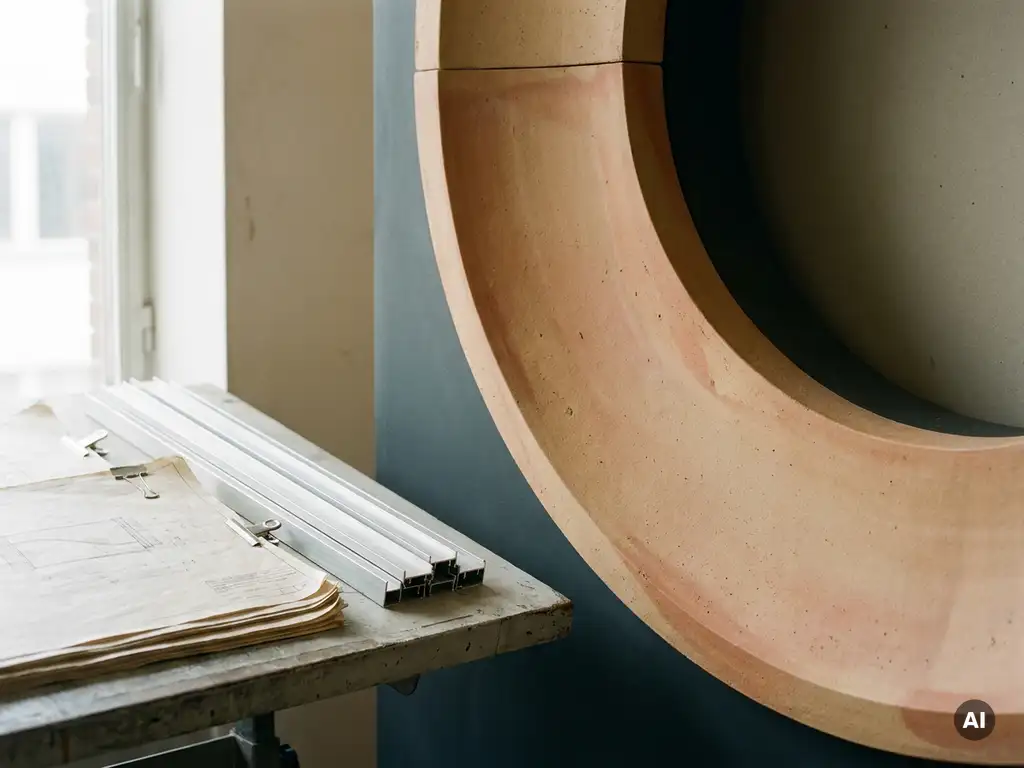
To specify a circular ceramic facade system, you need to confirm that the product is made from natural, inert materials, uses a demountable fixing method, carries relevant environmental documentation, and can be fully separated by material type at end of life. These four criteria form the practical backbone of circular facade specification and apply whether you are working on a new build or a retrofit project. The sections below address each of the key questions specifiers ask when evaluating circularity in ceramic cladding.
What makes a ceramic facade system circular?
A ceramic facade system is circular when its materials can re-enter productive use after the building’s service life ends, without significant degradation in quality or value. Circularity in facade design depends on three conditions being met simultaneously: the material must be inherently recyclable, the fixing system must allow non-destructive removal, and the product must be free of composite layers or adhesives that prevent clean separation.
Ceramic as a material has strong circular credentials by nature. It is mineral-based, contains no synthetic polymers or coatings that degrade into microplastics, and retains its material integrity over decades. A facade tile that was fired at high temperature in 2026 will be just as recyclable in 2056. This long service life combined with full recyclability is what distinguishes genuinely circular ceramic cladding from products that simply carry a sustainability label.
The fixing method is equally important. Mechanically fixed, ventilated facade systems that use interlocking profiles allow individual tiles to be removed and replaced without damaging surrounding elements. This repairability extends the useful life of the facade and reduces waste during maintenance cycles, not just at demolition.
How does material composition affect circularity in facade specification?
Material composition directly determines whether a facade product can be recycled cleanly at end of life. Single-material or mono-material products are significantly easier to process in recycling streams than composite assemblies. For ceramic facades, the key question is whether the tile itself contains any non-ceramic components, adhesive layers, or applied coatings that would contaminate the recycling process.
High-quality ceramic facade tiles produced through a sinter-firing process at temperatures above 1,200 degrees Celsius achieve a dense, smooth surface without the need for additional coatings or sealants. This means the tile is a single, homogeneous material from production through to end of life. There are no laminated layers to separate and no chemical treatments that would complicate material recovery.
From a specification standpoint, material composition also affects fire classification. Ceramic tiles classified as building material class A1 are non-combustible and contain no organic components. This classification is relevant not only for fire safety compliance but also as a circularity indicator: A1 materials are free of the combustible additives and binders that often make composite facade products difficult to recycle. When reviewing ceramic facade formats and surfaces, specifiers should confirm that the product achieves A1 classification through its inherent composition, not through a surface treatment applied after firing.
What documentation is needed to specify a circular facade?
To specify a circular ceramic facade system, you need an Environmental Product Declaration (EPD), a material passport or equivalent product data sheet confirming composition, fire classification documentation, and manufacturer guidance on end-of-life disassembly. These documents allow design teams, clients, and assessors to verify circularity claims against measurable criteria.
- Environmental Product Declaration (EPD): A third-party-verified EPD quantifies the environmental impact of the product across its lifecycle, including the end-of-life scenario. It confirms whether recycling or reuse is the declared end-of-life pathway.
- Material passport or data sheet: This document confirms the exact composition of the tile, including any treatments or coatings, and whether the product is mono-material or composite.
- Fire classification certificate: For ceramic facades, an A1 non-combustible classification is both a safety requirement and a circularity indicator.
- Disassembly instructions: Manufacturer documentation explaining how the fixing system works and how tiles can be removed without damage supports end-of-life planning and aligns with whole-life carbon assessments.
For projects targeting BREEAM, LEED, or DGNB certification, this documentation also feeds directly into materials credits. Having it ready at the specification stage, rather than sourcing it retrospectively, avoids delays during certification assessment. Manufacturers who support circular economy facade goals should be able to provide all of this documentation without a lengthy request process. The downloads and samples section of a manufacturer’s website is often the quickest place to check what is available.
How do facade fixing systems influence end-of-life reuse?
The fixing system is one of the most decisive factors in whether a ceramic facade can be reused or recycled at end of life. Mechanically fixed, ventilated systems that use interlocking aluminum profiles allow tiles to be removed individually and cleanly, while adhesive or mortar-bedded systems make non-destructive removal nearly impossible and typically result in the tiles being crushed and downcycled rather than reused.
A well-designed mechanical fixing system separates the ceramic element from the substructure so that each component can be sorted by material type at end of life: ceramic tiles, aluminum profiles, and fasteners can all be directed to their respective recycling streams without cross-contamination. This component-level sortability is a core requirement of circular economy thinking in construction.
The low dead weight of single-layer ceramic facade systems also has a practical impact on circularity. Lighter tiles reduce the structural load on the substructure, which in turn allows for lighter aluminum profiles. Lighter profiles are easier to handle during disassembly and generate less material per square meter to process. For timber construction projects in particular, the combination of low surface weight and mechanical fixing makes the entire facade assembly easier to deconstruct and sort at the end of the building’s life.
Which building types benefit most from circular ceramic facades?
Circular ceramic facades offer the greatest advantage on buildings with long service lives, high visibility requirements, and owners who evaluate performance over decades rather than years. Commercial office buildings, public institutions, educational facilities, and multi-residential developments are the building types where the lifecycle value of a circular, low-maintenance facade system is most clearly realized.
Timber construction is a particularly strong match for circular ceramic facades. Timber buildings already carry strong sustainability credentials, and pairing them with a non-combustible, recyclable cladding system reinforces those credentials while addressing the fire protection requirements that timber structures face. The low surface weight of single-layer ceramic tiles reduces the structural demand on the timber frame, making integration straightforward without requiring oversized substructure elements.
Refurbishment projects also benefit significantly. When an existing building is being reclad, a mechanically fixed ceramic system can be installed over the existing structure and removed again at the next refurbishment cycle without generating demolition waste. This reversibility is increasingly valued in urban retrofit projects where buildings may change use or ownership multiple times over their lifespan. Browsing completed facade references across building types can help specifiers assess how ceramic systems have been applied in comparable contexts.
What questions should specifiers ask facade manufacturers about circularity?
Specifiers evaluating a circular ceramic facade system should ask manufacturers a structured set of questions that go beyond general sustainability claims and focus on verifiable, product-specific information. The goal is to distinguish genuine circular design from marketing language.
- Is the product mono-material, and does it contain any coatings or additives that affect recyclability? This establishes whether the tile can enter a clean ceramic recycling stream at end of life.
- What is the declared end-of-life scenario in your EPD? An EPD that declares recycling as the end-of-life pathway is more meaningful than one that defaults to landfill.
- How does the fixing system allow for non-destructive removal? Ask for a disassembly sequence or technical drawing that shows how tiles and profiles are separated.
- Can individual tiles be replaced during the service life without disturbing the surrounding facade? Repairability extends service life and reduces waste, which is a core circular economy principle.
- What fire classification does the product carry, and is this achieved through composition or surface treatment? A1 classification through inherent composition is preferable to a treated surface that may degrade.
- What is the expected service life of the product, and what evidence supports this? Longer service life means fewer replacement cycles and lower overall material consumption.
- Do you offer take-back or end-of-life guidance for the product? Manufacturers who support circular economy goals should be able to advise on material recovery options at project closeout.
These questions are also useful when preparing a sustainability brief or pre-qualification questionnaire for facade subcontractors, as they set a consistent standard for evaluating competing systems.
How TONALITY® supports circular ceramic facade specification
TONALITY® ceramic facade systems are designed from the ground up to meet the requirements of circular economy facade specification. Every element of the system reflects a commitment to long-term performance, material integrity, and end-of-life reusability:
- 100% recyclable ceramic tiles produced from natural clay deposits, fired at over 1,200 degrees Celsius to create a dense, mono-material surface with no coatings or additives that would compromise recyclability
- Building material class A1 classification, confirming non-combustibility through inherent composition rather than surface treatment
- Mechanically fixed, ventilated facade system using interlocking aluminum profiles that allow tiles to be removed individually and sorted by material type at end of life
- Low surface weight of approximately 40 kg per square meter, reducing substructure requirements and simplifying disassembly
- Integrated UV and color stability with no maintenance coatings required, supporting long service life and reducing lifecycle material consumption
- Precision manufacturing to within one millimeter, with formats ranging from 150 x 300 mm to 400 x 1,600 mm, enabling accurate planning and minimal on-site waste
- Technical documentation available to support EPD requirements, certification assessments, and sustainability briefs
[cta_contact_form]
Whether you are specifying a new commercial building, a timber construction project, or a refurbishment, TONALITY® provides the product data, technical support, and circular design credentials to help you meet your sustainability targets with confidence. Get in touch with the TONALITY® team to discuss your project requirements and request documentation for your specification.
Related Articles
- Can ceramic cladding solutions be integrated with building-integrated photovoltaics?
- What is the difference between downcycling and upcycling terracotta facade materials?
- Can architectural design improve energy efficiency?
- What is parametric design in architecture?
- Why are earth tones dominating modern facade design?