

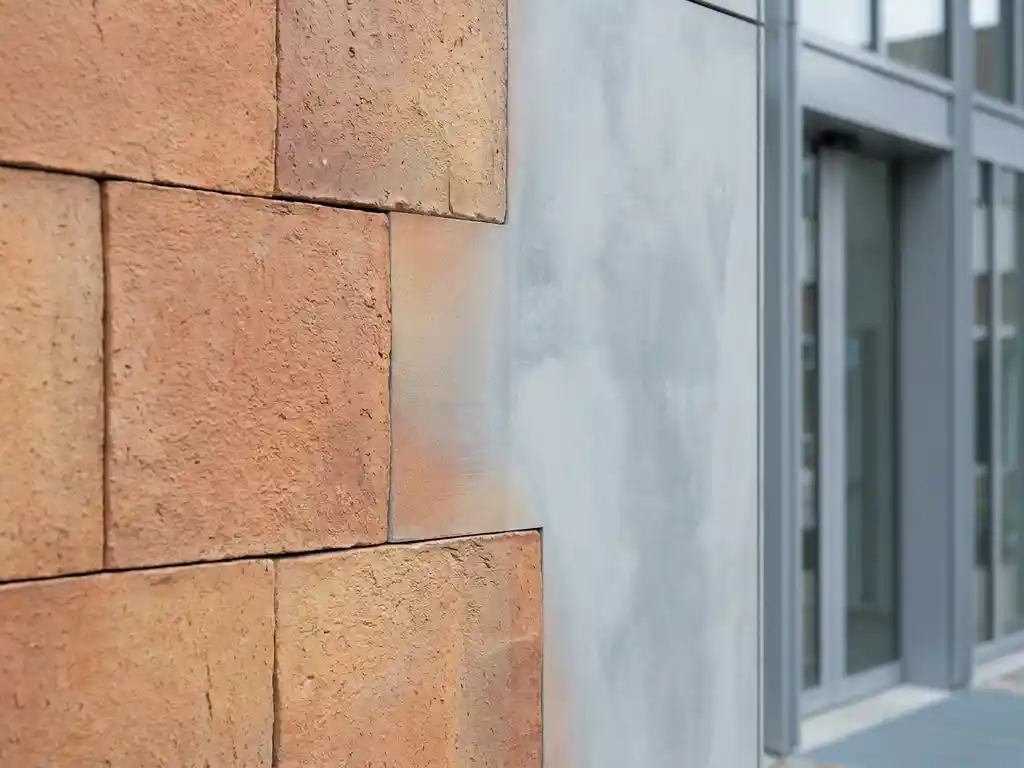
Terracotta and fibre cement are two distinct facade materials with fundamentally different compositions, performance profiles, and long-term characteristics. Terracotta is a fired ceramic material made from natural clay, while fibre cement is a composite of cement, sand, and reinforcing fibres. For construction professionals comparing facade options in 2026, the choice between them involves weighing durability, maintenance, fire safety, and sustainability against project-specific requirements.
The sections below address the most common questions side by side, giving you a clear picture of where each material excels and where it falls short.
Which material lasts longer: terracotta or fibre cement?
Terracotta facades generally outlast fibre cement by a significant margin. High-quality ceramic facade systems fired at temperatures exceeding 1,200 degrees Celsius produce an extremely dense, low-porosity surface that resists weathering, UV degradation, and moisture absorption for decades. Fibre cement, while durable under normal conditions, is more susceptible to moisture ingress, surface erosion, and colour fading over time.
The longevity advantage of terracotta comes directly from its sintering process. When clay is fired at extreme temperatures, the particles fuse into a hard, vitrified matrix that is chemically stable and physically robust. This means the surface does not degrade under freeze-thaw cycles, acid rain, or prolonged sun exposure in the way that a cement-based composite can.
Fibre cement performs well over a reasonable service life and is widely used in residential and light commercial construction. However, its fibres can break down over very long periods, particularly when exposed to persistent moisture, and the surface coatings that give it colour require periodic renewal. Terracotta facades, by contrast, carry their colour throughout the material itself, so there is no surface coating to maintain or replace. If you want to explore the full range of available terracotta surfaces and formats, you can find detailed specifications to support your material comparison.
How are terracotta and fibre cement facades manufactured?
Terracotta facades are manufactured by shaping natural clay and firing it in a kiln at temperatures above 1,200 degrees Celsius. This sinter firing process fuses the clay particles into a dense, non-porous ceramic body. Fibre cement is manufactured by mixing Portland cement, fine sand, and reinforcing fibres, then pressing and curing the mixture under controlled conditions to form rigid panels.
The raw material source matters significantly. Premium terracotta facades draw on high-quality clay deposits, which directly influences the consistency and density of the finished product. The clay’s mineral composition, combined with precise firing temperatures, determines surface smoothness, colour stability, and structural integrity. Because the colour in terracotta is inherent to the clay body and any applied mineral pigments, it cannot peel, chip, or fade in the way a surface-applied coating can.
Fibre cement panels are formed through an industrial pressing process that can produce large, flat sheets relatively quickly. The surface is typically finished with a factory-applied coating or paint system to achieve the desired colour and texture. This manufacturing approach makes fibre cement highly adaptable in terms of panel size and surface appearance, but it also means the visual finish is a separate layer from the structural substrate.
What are the maintenance requirements for each facade type?
Terracotta facades require very little maintenance over their service life. The dense, sintered surface resists dirt adhesion, biological growth, and staining, and many ceramic facade systems include integrated graffiti protection. Fibre cement facades require more active upkeep, including periodic repainting or recoating of the surface finish to maintain appearance and protect the substrate from moisture.
For construction project managers focused on total cost of ownership, this difference is meaningful. A terracotta facade that needs no repainting, no sealing, and no surface treatment over a 30 to 50 year period delivers substantial long-term value compared to a fibre cement facade that requires recoating cycles every 10 to 15 years. Each recoating cycle involves scaffolding, labour, materials, and building disruption, all of which accumulate over a building’s lifetime. Reviewing completed terracotta facade projects can give you a concrete sense of how these systems perform across different building types and climates over time.
Fibre cement facades also need careful attention around joints, fixings, and cut edges, where moisture can penetrate the substrate if not properly sealed. Terracotta’s inherent water resistance means these vulnerabilities are far less pronounced, reducing the risk of substrate damage and associated remediation costs.
How do terracotta and fibre cement facades compare in fire safety?
Terracotta facades hold a significant advantage in fire safety. Ceramic materials are classified as building material class A1, meaning they are non-combustible and contain no combustible components whatsoever. Fibre cement panels are generally classified as non-combustible or low-combustibility, but their classification can vary depending on the specific product formulation and any applied surface coatings.
For projects where fire safety regulations are a primary concern, such as multi-storey residential buildings, healthcare facilities, or educational institutions, the A1 classification of terracotta provides the highest level of assurance. This is particularly relevant in timber construction projects, where the facade material must compensate for the combustibility of the structural frame. Ceramic facades are well suited to timber construction precisely because they provide a non-combustible outer layer that meets stringent fire performance requirements.
Fibre cement is widely accepted in fire-rated assemblies and performs adequately in many regulatory contexts. However, specifiers should verify the fire classification of the specific product and coating system being used, as surface treatments can affect the overall assembly rating in ways that a purely mineral material like terracotta does not encounter.
Which facade material is better for sustainable construction?
Terracotta has a stronger overall sustainability profile than fibre cement. It is made from natural clay, is 100% recyclable at end of life, and can be deconstructed and sorted by component type for complete reuse. Fibre cement contains Portland cement, the production of which is energy-intensive and carbon-intensive, and the composite material is more difficult to recycle cleanly at the end of a building’s life.
Sustainability in facade selection goes beyond the material itself. The longevity of terracotta means fewer replacement cycles over a building’s lifespan, which reduces the embodied carbon associated with manufacturing and transporting new materials. A facade that lasts 50 or more years without surface treatment or replacement represents a fundamentally lower environmental burden than one that requires periodic renewal.
The recyclability of ceramic facades is a genuine circular economy advantage. Because terracotta elements can be fully separated from their aluminium substructure and processed independently, both material streams can re-enter production cycles without contamination. This aligns directly with the principles of sustainable construction and increasingly stringent whole-life carbon requirements that project teams are navigating in 2026.
Fibre cement is not without sustainability merits. It is relatively lightweight, which reduces transport emissions, and its long service life in typical applications is a genuine positive. However, when evaluated across the full life cycle, including raw material extraction, manufacturing energy, maintenance requirements, and end-of-life recyclability, ceramic facade systems offer a more complete sustainability story for specifiers and project managers committed to long-term environmental performance.
How TONALITY® helps you choose the right terracotta facade
When the comparison between terracotta and fibre cement points clearly toward ceramic — on durability, fire safety, maintenance, and sustainability — the next step is finding a system that delivers on all those qualities in practice. TONALITY® provides a complete terracotta facade solution built around precision-fired ceramic panels, a proven substructure system, and full project support from specification through to installation.
Here is what working with TONALITY® means in concrete terms:
- Material quality you can verify: TONALITY® terracotta panels are fired at temperatures exceeding 1,200°C, producing the dense, low-porosity ceramic body that underpins every performance advantage described in this article.
- Wide format and surface choice: A broad range of panel dimensions, textures, and natural clay colours allows precise alignment with architectural intent without compromising technical performance.
- Fire safety compliance: All TONALITY® ceramic facade panels carry an A1 non-combustibility classification, making them suitable for the most demanding regulatory environments, including multi-storey and timber-frame projects.
- Minimal maintenance by design: The inherent colour and surface density of TONALITY® panels eliminate the recoating cycles that drive up the lifetime cost of fibre cement facades.
- Sustainability documentation: Environmental product declarations and full lifecycle data are available to support BREEAM, LEED, and whole-life carbon assessments.
- Physical samples on request: You can request material samples and technical downloads to evaluate surface quality and colour options before committing to a specification.
If you are currently comparing facade materials for an upcoming project, get in touch with the TONALITY® team to discuss your requirements, receive technical guidance, and obtain project-specific advice from facade specialists.
Related Articles
- What are the acoustic benefits of terracotta facade systems?
- What technical questions should architects ask terracotta manufacturers?
- What load-bearing requirements apply to terracotta cladding?
- What are common maintenance issues with ceramic facades?
- How do you choose the right insulation system for facade renovation?