

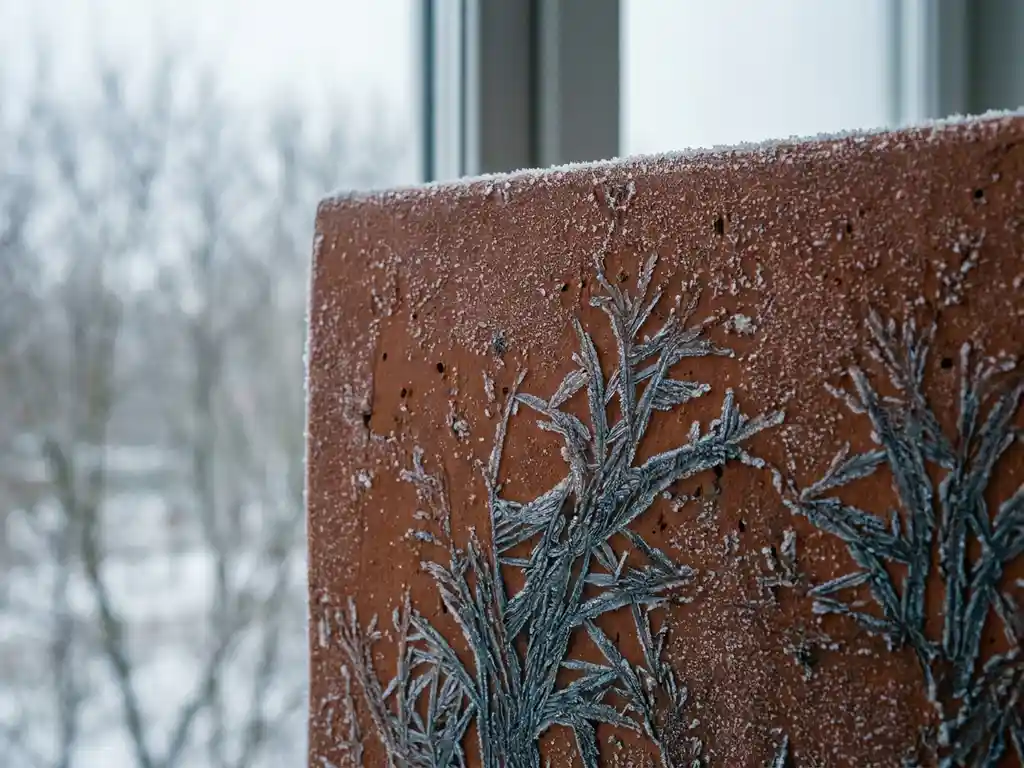
Yes, terracotta and ceramic facades are highly resistant to frost and freeze-thaw cycles. This resistance comes directly from the manufacturing process: ceramic facade tiles fired at temperatures exceeding 1,200 degrees Celsius develop an extremely dense, low-porosity structure that prevents water absorption, the primary cause of frost damage in building materials. The sections below unpack exactly how this works, what performance standards apply, and why ceramic cladding holds up reliably in cold climates.
How does the sinter firing process affect frost resistance in ceramic facades?
The sinter firing process is the single most important factor behind the frost resistance of ceramic facade tiles. When ceramic elements are fired at temperatures above 1,200 degrees Celsius, the clay particles fuse together at a molecular level, producing a dense, vitrified surface with extremely low water absorption. Because frost damage depends almost entirely on water penetrating a material and expanding as it freezes, a surface that absorbs virtually no water is inherently frost-resistant.
This is fundamentally different from traditional brick or natural stone, both of which can have measurable porosity. The sintering process closes off the micro-pores that would otherwise allow moisture ingress. The result is a surface that is not just hard and smooth to the touch, but structurally sealed against the freeze-thaw mechanism that degrades less dense materials over time.
For construction project managers and facade contractors, this matters practically: a facade material that does not absorb water does not require additional waterproof coatings or sealants to achieve frost protection. The frost resistance is inherent to the product itself, not dependent on a maintenance-sensitive surface treatment that can wear away over years of exposure. To get a closer look at how sintered ceramic performs in real-world conditions, requesting samples is a practical first step before specification.
What freeze-thaw performance standards apply to ceramic facade tiles?
Ceramic facade tiles used in European construction are tested and classified according to established standards that specifically address freeze-thaw durability. The relevant framework is EN 14411 (the European standard for ceramic tiles) and the broader EN 13501 classification system for fire and material performance. For facade applications, frost resistance testing follows protocols that subject tiles to repeated cycles of freezing and thawing under controlled conditions to verify they maintain structural integrity and surface quality.
Tiles intended for exterior and facade use must demonstrate resistance across a defined number of freeze-thaw cycles without showing cracking, spalling, or surface degradation. Products that pass these tests are classified as frost-resistant and suitable for outdoor exposure in climates where temperatures regularly drop below freezing. When specifying ceramic facade systems for a project, verifying that tiles carry the appropriate frost-resistance classification is a straightforward part of the technical documentation review.
Beyond European norms, some projects in alpine or Scandinavian regions may reference additional national standards or project-specific testing requirements. In those cases, manufacturers can typically provide extended test data to support specification and planning approval processes.
How many freeze-thaw cycles can terracotta facades withstand?
High-quality sintered ceramic and terracotta facade tiles are engineered to withstand hundreds of freeze-thaw cycles without performance loss. Standard frost-resistance testing for facade ceramics typically involves a minimum of 100 cycles, but premium sintered products routinely perform well beyond this threshold due to their near-zero water absorption. In practical terms, this translates to decades of reliable performance even in climates with harsh winters.
The key variable is the water absorption rate. Materials with water absorption below 0.5% are generally considered frost-proof under most climate conditions. Sintered ceramic facade tiles achieve absorption rates at or near this threshold, which is why their freeze-thaw performance is consistently strong across test regimes.
For project planning purposes, the number of freeze-thaw cycles a facade will actually experience depends on local climate data. A building in northern Germany or the Austrian Alps will see far more annual freeze-thaw events than one in southern Europe. The good news for contractors and project managers is that well-specified ceramic facade tiles are designed with a significant performance margin above the minimum standard, providing confidence across a wide range of exposure conditions. Browsing completed reference projects from comparable climates can be a useful way to validate real-world performance before committing to a specification.
Does the ventilated cavity in ceramic facade systems improve frost protection?
Yes, the ventilated cavity behind a ceramic facade system provides a meaningful additional layer of frost protection. In a ventilated facade, an air gap separates the outer ceramic cladding from the building’s thermal envelope. This cavity allows moisture that does penetrate behind the facade to drain away and evaporate rather than accumulating against the wall structure. The result is a consistently drier system overall, which reduces the risk of frost-related damage to both the cladding and the substrate beneath it.
The ventilation effect also moderates temperature differentials across the facade assembly. Rapid temperature swings, particularly the transition from below-freezing to above-freezing temperatures, are among the more demanding conditions for any facade material. The air cavity buffers these transitions slightly, reducing thermal stress on fixings, substructure components, and the ceramic elements themselves.
From an installation standpoint, the aluminum retaining profile systems used in modern ceramic facade construction are designed to accommodate thermal movement, which is especially relevant in cold climates where temperature ranges between summer and winter can be extreme. The combination of frost-resistant ceramic tiles, a ventilated cavity, and thermally accommodating fixings creates a system that performs reliably across the full annual temperature cycle.
Are terracotta facades suitable for cold-climate and alpine construction?
Terracotta and sintered ceramic facades are well suited to cold-climate and alpine construction. Their low water absorption, proven freeze-thaw resistance, and ventilated installation system address the primary durability challenges that cold and mountainous environments present. Projects in Scandinavia, the Alps, and northern Central Europe regularly specify ceramic cladding precisely because of its predictable long-term performance in demanding weather conditions.
Beyond frost resistance, ceramic facades offer additional properties that are particularly relevant in alpine settings:
- UV stability: High-altitude locations receive significantly more intense UV radiation. Sintered ceramic tiles maintain color and surface quality without fading, regardless of UV exposure levels.
- Non-combustibility: Ceramic facade tiles classified as building material class A1 are non-combustible, which is an important consideration in alpine regions where fire spread is a serious risk factor.
- Low dead weight: The lightweight nature of single-layer ceramic facade elements reduces structural loads, which is relevant for buildings in seismically active or load-sensitive alpine locations.
- Maintenance-free performance: Remote or high-altitude buildings benefit enormously from facade materials that do not require regular sealing, painting, or protective treatment to maintain their performance.
For construction project managers working on cold-climate or alpine projects, the combination of inherent frost resistance and low lifecycle maintenance requirements makes ceramic facade systems a technically sound and economically sensible long-term choice. The durability built into the material at the manufacturing stage means the facade continues performing without intervention, which is exactly what remote or demanding project locations require.
How TONALITY® helps with frost-resistant facade specification
TONALITY® manufactures sintered terracotta facade systems specifically engineered to meet the demands of cold-climate and alpine construction. If you are specifying a facade for a project where frost resistance, long-term durability, and low maintenance are non-negotiable, TONALITY® provides a complete solution backed by technical documentation and real-world references:
- Near-zero water absorption: TONALITY® tiles are fired at temperatures exceeding 1,200°C, achieving water absorption rates that meet and exceed frost-resistance classifications under EN 14411.
- Ventilated facade systems: Every TONALITY® facade system is designed as a ventilated assembly, combining frost-resistant cladding with thermally accommodating substructure components for reliable year-round performance.
- Extensive surface and format options: A broad range of surfaces and formats allows precise specification for both architectural and technical requirements, including alpine and high-exposure environments.
- Full technical support: From sample requests to project-specific documentation, TONALITY® supports the entire specification process with the data and materials you need.
Ready to specify a facade system that performs reliably through every freeze-thaw cycle? Contact the TONALITY® team to discuss your project requirements and receive tailored technical advice.