

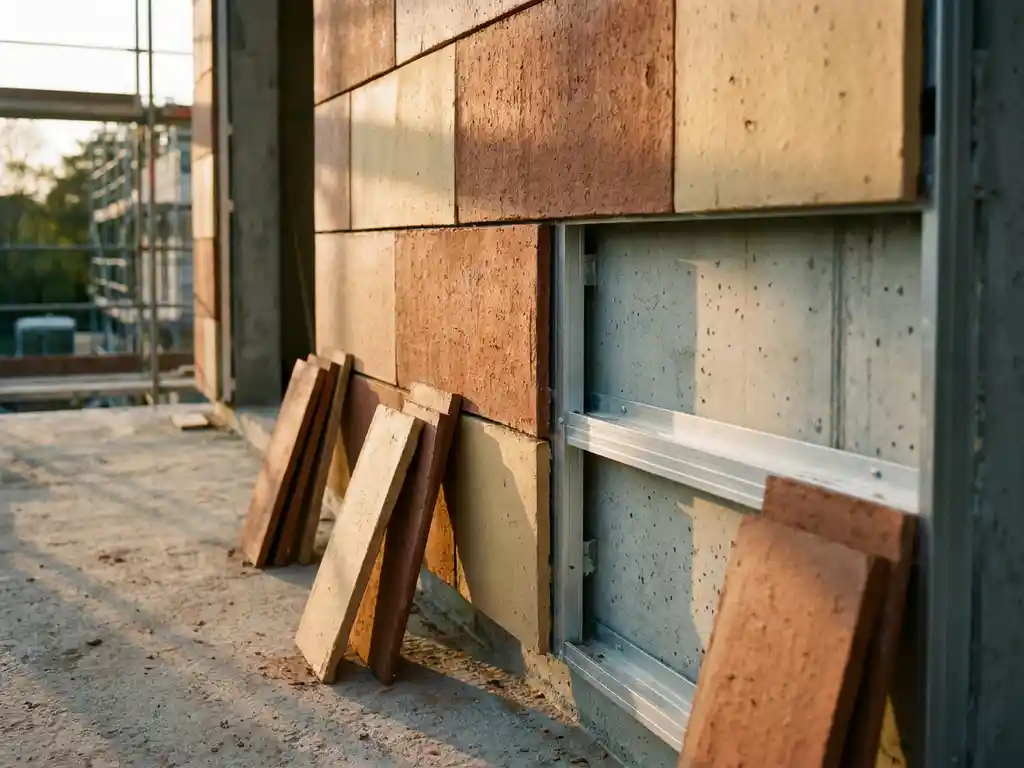
Terracotta facades can theoretically be leased rather than purchased under a product-as-a-service (PaaS) model, but no standardized leasing framework exists for facade materials yet in 2026. The concept is gaining traction in circular economy discussions because ceramic and terracotta cladding systems are among the few building envelope materials that are genuinely recoverable, reusable, and durable enough to support a multi-lifecycle ownership model. This article works through the practical, legal, financial, and project-specific questions contractors and project managers are asking right now.
What would a product-as-a-service model actually look like for facade materials?
A product-as-a-service model for facade materials would mean the manufacturer retains ownership of the ceramic or terracotta cladding throughout its service life, charging building owners or contractors a periodic fee for access to the facade system. At the end of the contract or building lifecycle, the manufacturer recovers the elements, reconditions them, and redeploys them in a new project rather than treating them as waste.
In practice, this would involve a service agreement covering installation, periodic inspection, and eventual deconstruction. The manufacturer would take on responsibility for the facade’s performance over time, while the client pays for the functional benefit of a weather-tight, aesthetically consistent exterior rather than owning the physical material. This mirrors models already operating in sectors like commercial flooring, office furniture, and industrial equipment.
For this to work with facade ceramics specifically, the product needs to meet a demanding set of criteria: it must be easy to install and remove without damage, durable enough to retain value across multiple lifecycles, and dimensionally consistent enough to be reused on different structures. Single-component systems with interlocking vertical aluminum retaining profiles, where tiles can be individually removed and replaced, are structurally well suited to this kind of arrangement. The mount-and-done installation logic that makes these systems fast to erect also makes them faster to deconstruct. Exploring available terracotta surfaces and formats gives a clear sense of the dimensional range that supports this kind of reusability.
Why is ceramic the most viable facade material for a circular leasing model?
Ceramic is the most viable facade material for a circular leasing model because it is non-combustible, dimensionally stable, UV resistant, and fully recyclable without loss of material quality. Unlike painted metal, composite panels, or fiber cement, ceramic tiles do not degrade in ways that prevent reuse. Their surface properties remain intact across decades, which is a fundamental requirement for any product intended to serve multiple building lifetimes.
The sinter firing process used to produce high-quality ceramic facade elements creates a dense, smooth surface that resists staining, graffiti, and weathering without surface coatings that could wear away. This matters for a leasing model because the manufacturer recovering tiles after a first use needs to be confident those tiles can be inspected, cleaned, and certified for reuse without costly refurbishment.
Ceramic elements produced to tight dimensional tolerances, some within one millimeter across formats ranging from small modules up to large-format panels, can also be matched and recombined more reliably than materials with greater production variance. A manufacturer who controls both the original production and the recovery process has a genuine pathway to certifying recovered tiles as equivalent to new ones, which is the commercial foundation any leasing model depends on.
The 100% recyclability of ceramic also provides a fallback. If tiles cannot be reused as facade elements after recovery, they can be fully recycled into new ceramic production, meaning the material retains value at every stage and the manufacturer never absorbs a complete write-off on recovered stock. Reviewing completed projects illustrates how these material properties perform across a range of real building types and climates.
Are terracotta facade leases legally and contractually feasible today?
Terracotta facade leases are legally feasible today in most jurisdictions, but they require bespoke contractual structures because no standard industry template exists for facade material leasing in 2026. The core legal challenge is separating ownership of the facade elements from ownership of the building, and ensuring that separation is recognized in property law, mortgage agreements, and building permits across different national contexts.
In many European jurisdictions, materials permanently affixed to a building can become part of the building in law, which would complicate a manufacturer’s right to recover them. Contracts would need to explicitly define the facade elements as chattel rather than fixtures, with clear provisions for access, deconstruction, and removal. This is not unprecedented: similar structures exist for leased solar panels, HVAC systems, and elevator equipment in commercial buildings.
Mortgage lenders and building insurers would also need to be informed, since the facade would appear on a building’s asset register differently under a leasing model. For large commercial or public sector projects, procurement rules may add another layer of complexity, as some frameworks require outright ownership of building components. None of these obstacles are insurmountable, but they do mean that a terracotta facade lease today requires legal counsel and a manufacturer willing to invest in developing the contractual infrastructure. The first projects to use this model will be pioneering rather than plug-and-play.
How does a facade leasing model affect project costs and substructure requirements?
A facade leasing model shifts upfront capital expenditure into an ongoing operational cost, which can improve a project’s initial financial profile even though total lifecycle payments may differ from an outright purchase. For contractors and project managers focused on delivering within a construction budget, this reallocation can be significant, particularly on projects where facade specification competes with other capital items.
Substructure requirements are not changed by the ownership model itself, but they are directly affected by the choice of facade material. Lightweight ceramic systems with low surface weight place reduced demands on the supporting structure compared to heavier cladding materials. This reduction in dead load translates to lighter substructure requirements, which affects material quantities, engineering costs, and installation time regardless of whether the tiles are owned or leased.
Under a leasing model, the manufacturer retains a long-term interest in the performance of the installation, which creates an incentive to specify and verify a substructure that will protect the tiles’ reusability. This could mean more rigorous installation oversight than a standard supply-and-deliver arrangement, which carries its own value for contractors who want performance accountability built into the contract rather than managed entirely in-house.
From a total cost of ownership perspective, ceramic facades already offer strong lifecycle economics through low maintenance requirements, permanent color stability, and integrated surface protection that eliminates the need for periodic recoating. A leasing model would need to be priced to reflect this durability, and contractors evaluating any PaaS offer should assess it against the full lifecycle value of the material rather than comparing the periodic fee to a simple upfront purchase price. Technical documentation and material samples can support this evaluation at the specification stage.
Which construction project types are best suited to a facade-as-a-service approach?
Commercial, institutional, and mixed-use buildings with defined tenancy cycles or planned refurbishment schedules are the best candidates for a facade-as-a-service approach. These project types have predictable end-of-use points, professional asset management structures, and the contractual sophistication to accommodate non-standard ownership arrangements. Residential buildings, particularly owner-occupied housing, face more complications because individual ownership of the underlying property makes facade recovery agreements harder to enforce over time.
Timber frame construction projects are particularly well aligned with a ceramic facade leasing model. Timber structures benefit from non-combustible cladding classified as building material class A1, and the low dead weight of ceramic systems reduces structural load on the timber frame. Since timber buildings are increasingly designed with deconstruction in mind, the idea of a facade that can be removed and reused at the end of the building’s life fits naturally into the broader design philosophy of the structure.
Public sector and government-owned buildings are also strong candidates. These buildings often have long planned service lives, professional facilities management, and sustainability mandates that make circular economy arrangements attractive. A municipality or public institution leasing rather than buying facade ceramics could align with procurement strategies focused on resource efficiency and reduced embodied carbon over time.
Modular and prefabricated construction is a third strong fit. The precision and repeatability of modular building systems match well with the dimensional consistency of high-quality ceramic tile production, and modular buildings are often designed to be relocated or reconfigured, making a recoverable facade system practically useful rather than theoretically interesting.
What should contractors ask a facade manufacturer before agreeing to a PaaS contract?
Before agreeing to a facade product-as-a-service contract, contractors should ask the manufacturer six specific questions: Who owns the tiles if the manufacturer is acquired or goes out of business? What are the deconstruction obligations at the end of the contract, and who bears that cost? How are damaged or missing tiles handled mid-contract? What performance guarantees cover color stability, surface integrity, and weather resistance? How is the tile recovery and reuse process certified? And what happens if the building owner wants to change the facade appearance before the contract term ends?
The insolvency question is not a formality. If the manufacturer retains ownership of the facade elements, a contractor and building owner need to understand what protections exist if the manufacturer cannot fulfill their end of the agreement. Escrow arrangements, third-party recovery guarantees, or clear contractual provisions for the tiles to transfer to the building owner under defined circumstances are all worth negotiating before signing.
Performance guarantees deserve particular scrutiny. A manufacturer offering a leasing model is implicitly claiming confidence in their product’s long-term performance, so they should be willing to back that claim with contractual commitments. Ask specifically about UV resistance, color permanence, surface protection against graffiti and environmental staining, and what inspection regime will be used to assess tile condition at recovery.
Finally, contractors should verify that the manufacturer’s production standards support genuine reusability. Tiles produced to tight dimensional tolerances, fired at high temperatures for dense and stable surfaces, and designed for individual removal from a clip or rail system are the ones that can realistically support a circular leasing model. A manufacturer who can demonstrate these production characteristics is one whose PaaS offer has a credible technical foundation, not just a commercial concept.
How TONALITY® supports terracotta facade projects built for circularity
TONALITY® terracotta facade systems are engineered with the material and system properties that make circular and long-lifecycle cladding arrangements practically viable. Whether you are specifying for a conventional project or exploring product-as-a-service arrangements, TONALITY® provides the technical foundation that serious facade performance demands:
- Individual tile replaceability: The clip-and-rail mounting system allows single elements to be removed and reinserted without disturbing adjacent tiles, which is a prerequisite for any recovery and reuse model.
- Tight dimensional tolerances: TONALITY® elements are produced to consistent dimensions across a wide range of formats, enabling recovered tiles to be reliably matched and redeployed on different structures.
- Permanent surface quality: The sinter-fired ceramic surface requires no coatings, resists UV degradation, and retains its appearance across decades, ensuring recovered tiles can be certified for reuse without refurbishment.
- Low dead weight: Lightweight system construction reduces structural load, which simplifies substructure planning and broadens the range of building types that can accommodate the system.
- Non-combustible classification: All TONALITY® elements meet building material class A1, making them suitable for timber frame, modular, and public sector projects where fire performance requirements are non-negotiable.
If you are working on a project where facade durability, material recovery, or circular economy credentials are part of the brief, contact the TONALITY® team to discuss your specification requirements and explore what the system can deliver for your building.