

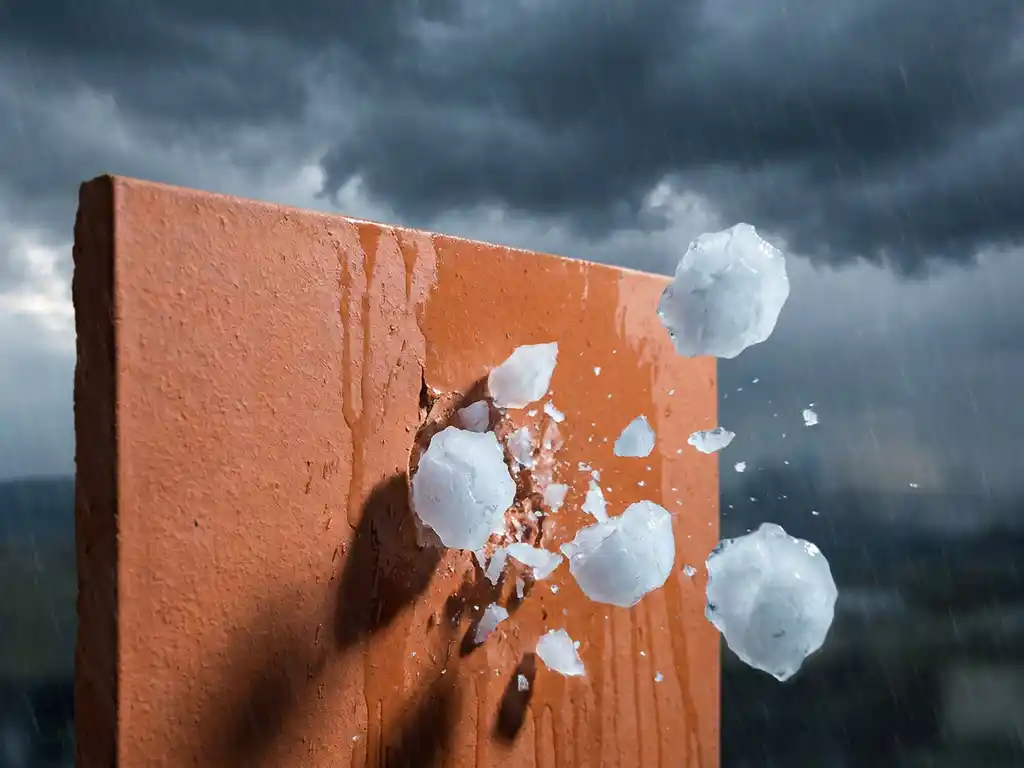
Terracotta facades handle hail remarkably well. The dense, vitrified structure created during high-temperature sinter firing gives ceramic tiles a hardness and surface integrity that resist impact without cracking or absorbing moisture. For construction professionals specifying cladding in regions with variable weather, terracotta is one of the most resilient options available. The sections below address the specific questions that matter most when evaluating hail resistance.
How hard does hail have to be to damage a facade material?
Hail causes structural damage to facade materials when impact energy exceeds the surface’s ability to absorb or deflect force. In practical terms, hailstones smaller than 20mm in diameter rarely cause visible damage to hard facade materials. Stones above 40mm, which fall at significantly higher velocities, can stress weaker or more porous cladding systems and cause cracking, chipping, or surface fracturing.
The critical factors are not just hailstone size but also velocity, angle of impact, and the density of the facade material itself. Soft or hollow materials, such as certain composite panels or fiber cement boards, are more vulnerable because they flex under impact, creating stress concentrations. Dense, solid materials distribute that same impact energy across a wider surface area, reducing the likelihood of localized damage.
Building standards in hail-prone regions often reference impact resistance classifications based on standardized drop tests, where steel balls of defined weights are dropped from set heights to simulate hail strike conditions. Facade materials that pass the highest classifications demonstrate the ability to withstand severe hailstorm events without surface degradation.
What material properties make terracotta resistant to hail?
Terracotta’s hail resistance comes directly from its fired ceramic structure. During production, clay is fired at temperatures exceeding 1,200 degrees Celsius in a sinter firing process, which fuses the mineral particles into an extremely dense, low-porosity matrix. This vitrified structure gives the material exceptional hardness and surface integrity, meaning impact energy is deflected rather than absorbed. Professionals looking to understand the full range of terracotta surfaces and formats will find that both finish and format choice play a role in overall impact performance.
Several specific properties contribute to this resistance:
- High surface density: The sintered surface leaves minimal pore space for stress fractures to propagate after an impact.
- Consistent through-body composition: Unlike coated or layered materials, ceramic tiles have the same material properties throughout their depth, so surface damage does not expose a weaker substrate.
- Smooth, non-absorbent surface: A dense surface prevents moisture ingress, which is critical because freeze-thaw cycles following hail damage can dramatically worsen cracks in more porous materials.
- Elastic modulus: Fired ceramic has a stiffness that allows it to resist deformation under sharp impact without the surface yielding.
These properties combine to make high-fired terracotta and ceramic facade tiles among the hardest surface cladding materials available for exterior use, performing well against both routine weather exposure and extreme events.
How does terracotta compare to other facade claddings in hail tests?
In comparative impact testing, terracotta and high-fired ceramic tiles consistently outperform softer cladding materials. Fiber cement, for example, can develop micro-cracks under repeated hail impact, particularly as it ages and loses flexibility. Composite aluminum panels may dent permanently. Natural stone, while hard, is more susceptible to spalling along natural grain lines. Terracotta’s uniform, dense structure gives it an advantage across all these failure modes.
Rendered or insulated facade systems present a different vulnerability: the render coat itself can chip or fracture under hail impact, exposing the insulation layer beneath and requiring repair to maintain weatherproofing. Ceramic rainscreen cladding systems, by contrast, are mechanically fixed and ventilated, meaning individual tiles can be replaced independently without disrupting the entire facade.
Glass and glazed ceramic tiles, while also hard, can be more brittle than unglazed high-fired terracotta. The absence of a glaze layer in many ceramic facade products actually works in their favor during impact events, as there is no brittle coating to fracture and detach. Reviewing completed terracotta facade projects gives a useful sense of how these material qualities translate into real-world performance across a variety of climates and building types.
Can hail cause cracking or spalling in terracotta tiles?
Under normal hailstorm conditions, well-fired terracotta tiles do not crack or spall. The dense sintered structure resists impact fracture, and the non-porous surface prevents moisture from entering any micro-stress points that might otherwise expand during freezing. Cracking would only occur under extremely severe impact events, such as large hailstones exceeding 50mm striking at high velocity, which represent the upper extreme of recorded hail events.
Spalling, which is the flaking or fragmenting of surface material, is primarily a risk in materials with layered structures or high porosity. In porous materials, water penetrates the surface, freezes, expands, and forces the surface layer apart from the substrate. Because high-fired ceramic facade tiles have a surface that does not absorb water, this mechanism simply does not apply. The material that enters winter is the same material that exits it, with no internal degradation from freeze-thaw cycling.
Where damage does occasionally occur in ceramic facade systems, it is typically the result of pre-existing installation defects, such as tiles that were not correctly seated in their retaining profiles, rather than the material itself failing under hail impact.
Does hail damage affect the long-term performance of a terracotta facade?
For a correctly installed terracotta facade, hail events have no meaningful effect on long-term performance. The material’s UV resistance, color stability, and surface integrity are not compromised by impact events that fall within the material’s design envelope. Because terracotta does not absorb water, there is no secondary degradation pathway following a hailstorm, which is the main route through which hail damage compounds over time in more porous materials.
The long-term value of ceramic facade systems lies precisely in this resistance to cumulative weathering. Maintenance requirements remain low throughout the facade’s service life because neither hail, UV radiation, nor temperature cycling degrades the surface in ways that require intervention. This is a meaningful lifecycle advantage for building owners and project managers who are evaluating total cost of ownership over a 30 to 50 year horizon rather than just initial installation. Those preparing specifications or procurement documentation can download technical data sheets and order samples to support material evaluation at the design stage.
In the rare case where an individual tile sustains visible damage from an exceptional hail event, the rainscreen installation system allows that single tile to be removed and replaced without affecting adjacent elements, keeping remediation localized and straightforward.
Should you choose terracotta cladding for hail-prone regions?
Yes, terracotta is an excellent choice for hail-prone regions. Its fired ceramic structure, non-porous surface, and uniform material composition give it impact resistance and weathering durability that outperform most alternative facade materials. For projects in climates with frequent or severe hailstorms, the combination of hard surface, moisture resistance, and replaceability makes ceramic facade systems a low-risk, high-durability specification.
When specifying for hail-prone locations, consider the following factors:
- Tile thickness and format: Larger format tiles at an appropriate thickness provide sufficient mass and rigidity to resist impact without flexing.
- Installation system integrity: A mechanically fixed rainscreen system ensures tiles are securely retained even if adjacent elements are disturbed.
- Surface finish: Smooth, dense, unglazed surfaces offer the best combination of hardness and impact resistance.
- Fire classification: In regions where hailstorms coincide with wildfire risk, ceramic tiles classified as building material class A1 provide additional non-combustibility assurance alongside their weather resistance.
How TONALITY® helps with hail-resistant facade specification
TONALITY® manufactures high-fired terracotta facade systems engineered to meet the demands of exposed locations, including regions with frequent or severe hail. For construction professionals who need a cladding solution that combines proven impact resistance with long-term weathering performance, TONALITY® offers a complete system — from material selection through to technical support:
- Dense, sinter-fired ceramic tiles with low porosity and high surface hardness, delivering reliable impact resistance across the full range of hailstone sizes encountered in practice.
- A broad range of formats and surface finishes that allow specification to be optimized for both aesthetic intent and structural performance in hail-prone climates.
- Mechanically fixed rainscreen systems that allow individual tiles to be replaced independently, keeping any remediation after exceptional weather events localized and cost-effective.
- Full technical documentation and physical samples to support specification, procurement, and client sign-off at every project stage.
To discuss your project requirements or request a consultation, get in touch with the TONALITY® team and find out how the right facade system can eliminate hail risk from your specification entirely.
Related Articles
- How does terracotta compare to glass and metal in facade sustainability?
- Buildings That Use Terracotta to Blend Modern Additions Into Historic Streetscapes
- What is the carbon footprint of ceramic cladding over its full lifecycle?
- What are the environmental benefits of recyclable facades?
- What questions should architects ask terracotta manufacturers?