

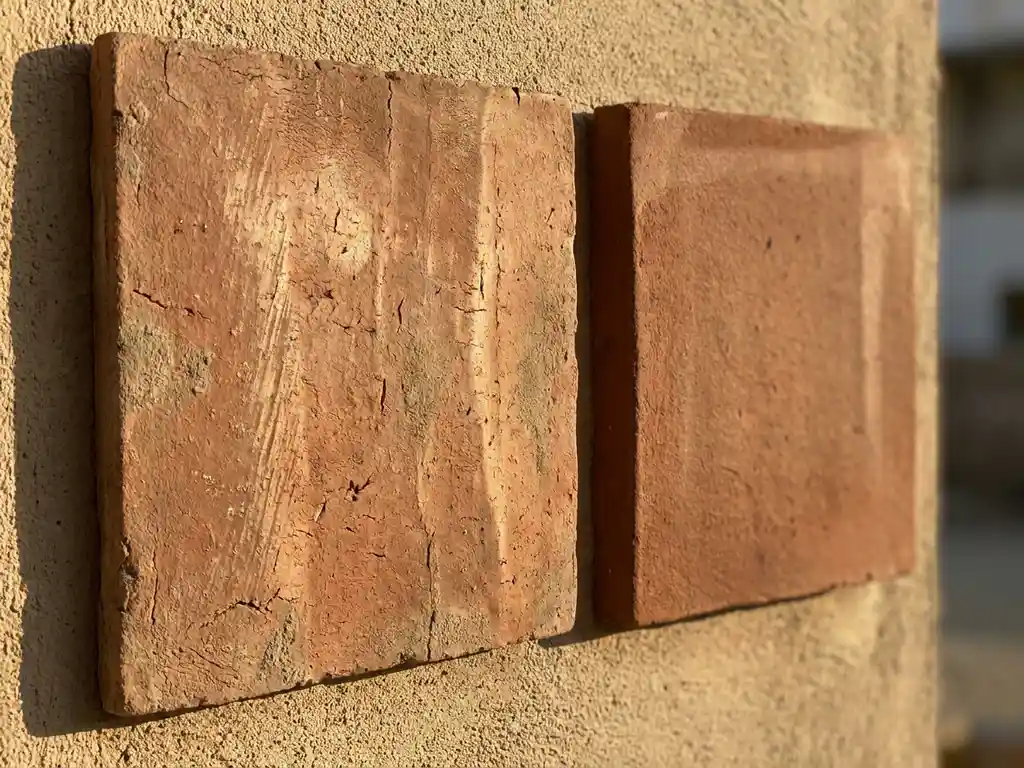
Terracotta facades do not fade in the way that painted or coated surfaces do. The colour in terracotta is not a surface treatment applied on top of the material. It is fired into the clay itself at extreme temperatures, making it structurally part of the tile rather than a layer that can peel, bleach, or wear away. The sections below explore how this works in practice and what it means for long-term appearance.
What causes building facade materials to fade over time?
Most facade materials fade because their colour exists as a coating, pigment layer, or chemical treatment applied to the surface of a substrate. When UV radiation, moisture, pollution, and thermal cycling repeatedly stress that surface layer, the bonds holding the colour in place break down. The visible result is bleaching, chalking, or uneven discolouration over time.
The root cause is the separation between the material and its colour. Painted metal panels, fibre cement boards, and polymer-based cladding all rely on a finish that sits on top of the base material. That finish is always the weakest point in the system. Heat expands and contracts the substrate, moisture infiltrates micro-cracks, and UV energy degrades organic pigments. Over years or decades, the surface finish simply cannot keep pace with the forces acting on it.
Ceramic and terracotta materials operate on a fundamentally different principle. Because their colour is determined by the mineral composition of the clay and the conditions inside a kiln, there is no separate colour layer to degrade. This distinction is the foundation for understanding why terracotta facades behave so differently from most other cladding materials over a building’s lifetime.
Does terracotta actually fade, or does its colour come from within?
Terracotta does not fade in the conventional sense because its colour is intrinsic to the material, not applied to it. The characteristic warm tones of terracotta are produced by the iron oxide content of the clay and the firing conditions in the kiln. That colour exists throughout the full depth of the tile, not just at the surface.
This is a critical distinction for anyone specifying or installing facade systems. With terracotta, there is no colour layer to scratch through, no coating to blister, and no pigment to bleach. If the surface is scuffed or abraded, the same colour is present underneath. The tile you install on day one is mineralogically identical to the tile you will see twenty or thirty years later.
Ceramic facade elements are fired at temperatures exceeding 1,200 degrees Celsius using a sinter firing process. At those temperatures, the clay particles fuse into a dense, homogeneous mass. The colour that emerges from that process is not a surface effect. It is the material itself.
How does UV exposure affect ceramic and terracotta cladding?
UV radiation has no meaningful effect on the colour of ceramic or terracotta cladding. Organic pigments and polymer-based coatings are vulnerable to UV because the energy breaks down the molecular chains that create colour. Mineral-based materials like fired clay contain no organic compounds for UV to degrade. The colour is held in inorganic iron and mineral compounds that are chemically stable under sunlight.
This UV stability is not a passive benefit. It has direct implications for lifecycle performance. Facades on south-facing elevations, in high-altitude locations, or in regions with intense solar radiation are particularly demanding environments for surface coatings. Terracotta ceramic cladding performs equally well regardless of solar orientation because the mechanism that creates its colour is simply not susceptible to UV degradation.
Permanent colour and UV resistance are core characteristics of high-temperature fired ceramic facade tiles. This is not a coating or an added treatment. It reflects the fundamental material science of high-temperature fired ceramics, where the colour-forming compounds are locked into a dense, vitrified structure that sunlight cannot alter. To better understand the range of available surfaces and formats, reviewing technical specifications before finalising a specification is strongly recommended.
What’s the difference between terracotta and painted facade panels for colour longevity?
The core difference is that terracotta’s colour is permanent and material-deep, while painted facade panels carry colour only as a surface film that degrades over time. Painted or coated panels typically require repainting or recoating within ten to twenty years, depending on exposure conditions, whereas terracotta facades maintain their original appearance without any colour maintenance.
Terracotta: colour as material
In terracotta and ceramic cladding, colour is a product of the clay’s mineral composition and the kiln environment. It cannot be stripped away, faded by sunlight, or damaged by cleaning. The appearance of the facade is the appearance of the material itself, which means no recoating schedule, no colour-matching challenges after partial replacement, and no visible weathering of the colour layer over the building’s service life.
Painted panels: colour as coating
Painted metal, fibre cement, and composite panels carry their colour in a coating system that sits above the substrate. Even high-quality industrial coatings are subject to UV degradation, moisture ingress at cut edges, and mechanical wear. Over time, colour consistency across a facade can become difficult to maintain, particularly when individual panels are replaced and the new coating does not perfectly match the aged finish of surrounding panels.
For construction project managers and contractors, this difference has real consequences at the specification stage. A facade system that requires colour maintenance introduces ongoing coordination, access costs, and the risk of visible inconsistency. A terracotta ceramic system removes those variables entirely. Completed reference projects illustrate how ceramic facades perform across a wide range of building types and climatic conditions over time.
Can weathering or pollution change how a terracotta facade looks?
Weathering and pollution can deposit material on the surface of a terracotta facade, but they cannot change the colour of the tile itself. Dust, biological growth, or urban pollution films may accumulate over time and alter the appearance of any facade. However, because terracotta ceramic surfaces are dense and non-porous after high-temperature firing, these deposits sit on the surface rather than penetrating the material and can be removed with standard facade cleaning.
The density of the fired ceramic surface is particularly relevant here. Porous materials absorb water, pollutants, and biological matter into their structure, leading to staining that becomes increasingly difficult to reverse. High-temperature fired ceramics achieve a smooth, dense surface through the sinter firing process. Contaminants have nowhere to penetrate, which means the tile’s original colour is fully recoverable after cleaning.
Many ceramic facade tiles also feature integrated graffiti protection, which further reduces the risk of surface contamination becoming a long-term appearance problem. This is not a separate coating applied after manufacture but a characteristic built into the tile’s surface properties, meaning it remains effective throughout the facade’s service life without requiring reapplication. Material samples and technical downloads are available to support specification decisions at this level of detail.
How long can a terracotta ceramic facade maintain its original appearance?
A terracotta ceramic facade can maintain its original colour and surface appearance for the full service life of the building, which in well-specified construction is typically measured in decades rather than years. Because the colour is intrinsic to the fired clay and the surface is non-porous and chemically stable, there is no mechanism by which the material’s appearance degrades under normal exposure conditions.
This is not a theoretical claim. It reflects the material properties of high-temperature fired ceramics. The sinter firing process creates a vitrified structure with no organic components, no coating layer, and no reactive surface chemistry. The factors that cause other facade materials to age visibly simply do not apply.
From a total cost of ownership perspective, this longevity is significant. Facade maintenance, recoating, and early replacement are among the largest contributors to lifecycle costs in commercial and residential construction. A ceramic facade system that requires no colour maintenance and retains its specification appearance over decades represents a fundamentally different cost profile compared to systems that need periodic intervention to maintain their original look.
For project managers and contractors working on both new construction and renovation projects in 2026, specifying a ceramic facade system with inherent colour permanence removes a category of risk from the long-term performance equation entirely.
How TONALITY® helps with colour-permanent terracotta facade cladding
TONALITY® ceramic facade systems are engineered specifically to deliver the colour permanence and long-term surface stability described throughout this article. Where other facade materials require periodic maintenance to preserve their appearance, TONALITY® removes that requirement entirely through the material science of high-temperature sinter firing. Here is what that means in practice:
- Intrinsic, permanent colour: Every TONALITY® tile is fired at over 1,200°C, locking colour into the full depth of the material. There is no surface coating to fade, peel, or require reapplication.
- Full UV stability: The mineral-based colour compounds in TONALITY® tiles are unaffected by UV radiation, making them equally reliable on south-facing, high-altitude, and high-solar-exposure elevations.
- Non-porous, dense surface: The sinter firing process produces a surface that resists pollution, biological growth, and moisture penetration, with integrated graffiti protection built into the tile itself.
- Verified long-term performance: TONALITY® facades are specified on commercial, residential, and public buildings worldwide, with a track record of maintaining original appearance across decades of service.
- Reduced lifecycle costs: No recoating schedules, no colour-matching challenges on partial replacements, and no access costs for colour maintenance — the total cost of ownership reflects a system designed to perform without intervention.
If you are specifying a facade system for a project where long-term colour stability is a requirement, contact the TONALITY® team to discuss your project, request samples, or obtain technical documentation.
Related Articles
- What should architects consider when specifying deep ceramic profiles?
- How do you match new ceramic facade tiles to an existing building during a renovation?
- What are the visual design limitations of ceramic cladding on modern facades?
- How do terracotta facades compare to glass curtain wall systems?
- How do BAS terracotta installation methods work?