

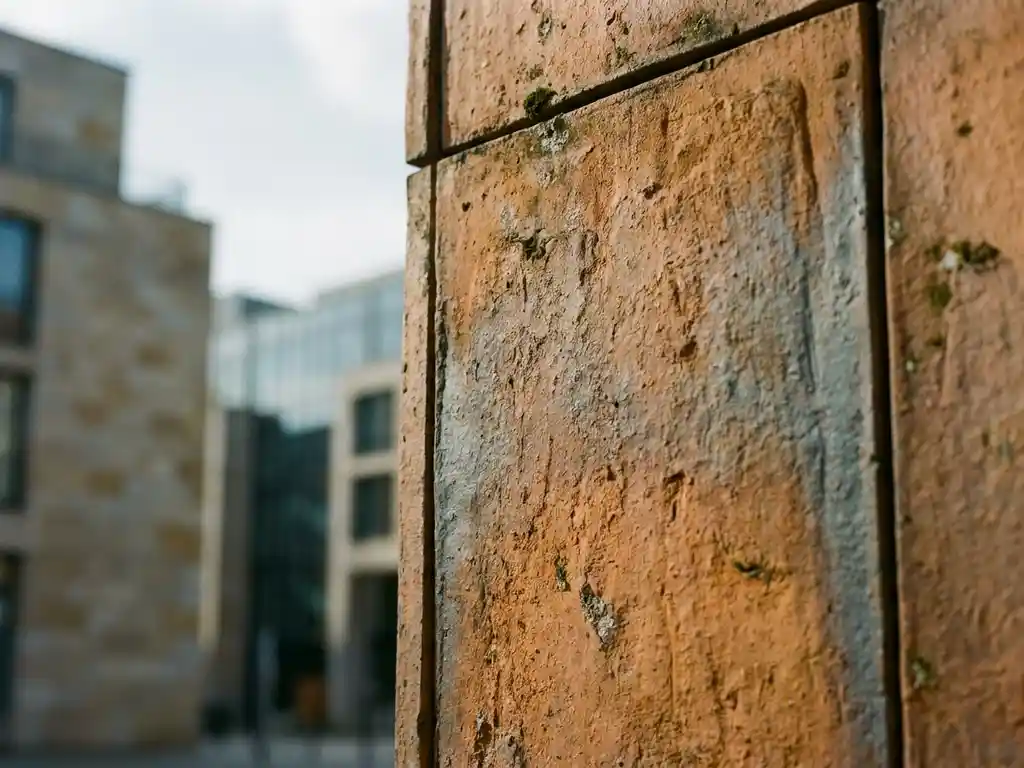
Terracotta facades can last well over 100 years when properly specified and installed. This exceptional longevity comes from the material’s natural composition: clay fired at extreme temperatures produces a dense, stable ceramic structure that resists weathering, UV degradation, and moisture over decades. The sections below explore what drives that durability and what project teams should know before specifying terracotta cladding.
What makes terracotta facades so durable?
Terracotta facades are durable because the firing process transforms raw clay into a dense, vitrified ceramic material that is chemically stable and highly resistant to the elements. When fired at temperatures exceeding 1,200 degrees Celsius, the clay particles fuse together, eliminating porosity and creating a surface that repels water, resists UV radiation, and does not degrade under freeze-thaw cycling.
This sinter firing process is central to long-term performance. The resulting material is dimensionally stable, meaning it does not expand, contract, or warp significantly in response to temperature changes. Unlike organic or composite cladding materials, ceramic facade systems contain no combustible components and no polymers that break down under prolonged sun exposure. The color is fired throughout the body of the tile rather than applied as a surface coating, so it cannot peel, flake, or fade over time.
The natural origin of the raw material also contributes to durability. High-quality clay deposits, such as those found in the Westerwald region of Germany, produce a particularly consistent and dense ceramic body. This consistency means fewer structural weak points across a facade installation, which translates directly into a longer service life and more predictable performance across the entire building envelope. To get a better sense of how this material performs in real-world conditions, it is worth reviewing completed terracotta facade projects across a range of building types and climates.
How long can a terracotta facade realistically last?
A well-installed terracotta facade can realistically last 100 years or more, and many historic terracotta buildings across Europe and North America demonstrate this in practice. Modern ceramic facade systems, produced with tighter quality controls and precision firing, are engineered to meet or exceed this lifespan under normal environmental conditions.
The key word here is “realistically.” Longevity at this level is achievable when the facade system is correctly specified for the building type, the substructure is properly engineered, and installation follows manufacturer guidelines. Terracotta that is poorly fixed, exposed to ongoing mechanical stress from incorrect detailing, or installed with incompatible substructure materials may develop issues well before the material itself would naturally degrade.
For project managers and contractors, this long service life has direct implications for total cost of ownership. A facade that performs reliably for a century without significant intervention represents a fundamentally different investment profile than materials that require replacement or major refurbishment within 20 to 30 years. Lifecycle cost analysis consistently favors materials with low maintenance requirements and long replacement cycles, and terracotta scores well on both counts.
What factors affect how long a terracotta facade lasts?
The lifespan of a terracotta facade depends primarily on installation quality, substructure integrity, and the grade of ceramic used. Environmental exposure, building location, and the facade system design also play meaningful roles. No single factor determines longevity in isolation; it is the combination of these elements that determines how a facade performs over decades.
Installation and substructure quality
The substructure is the foundation of long-term facade performance. Aluminum retaining profiles must be correctly sized and fixed to handle the dead load and dynamic forces the facade will experience. Ceramic elements that interlock securely with vertical profiles and allow for controlled thermal movement are far less likely to develop stress fractures or detachment over time. A well-designed mount-and-done installation system reduces the risk of installation errors that could compromise long-term performance.
Ceramic grade and firing quality
Not all terracotta is equivalent. The quality of the source clay and the precision of the firing process directly determine the density and consistency of the finished tile. Lower-grade ceramics may retain residual porosity that allows water ingress, accelerating freeze-thaw damage in colder climates. High-quality ceramic facade systems produced through controlled sinter firing deliver a consistently dense surface that resists this type of degradation across the full service life of the building. Specifiers evaluating products should examine the full range of available terracotta surfaces and formats to match both performance requirements and design intent.
Environmental exposure
Coastal environments with salt-laden air, urban environments with elevated pollution, and climates with extreme temperature swings all place greater demands on facade materials. Terracotta handles these conditions well compared to many alternatives, but specifiers should ensure the ceramic grade and surface finish are appropriate for the specific exposure category of the project location.
Does terracotta facade cladding require regular maintenance?
Terracotta facade cladding requires very little regular maintenance. The dense, smooth surface produced by high-temperature firing does not absorb dirt, biological growth, or pollutants in the way that porous materials do, and the color is inherently UV stable. In most installations, periodic visual inspection and occasional cleaning with water are sufficient to keep the facade performing and looking its best.
One practical advantage of modern ceramic facade systems is integrated graffiti protection. The non-porous surface makes it significantly harder for graffiti to bond, and cleaning is far simpler than on textured or porous materials. This is a meaningful consideration for urban projects where facade maintenance costs accumulate over time.
The substructure and fixings warrant periodic inspection, particularly in the first decade of a building’s life when any settling or movement is most likely to occur. The ceramic elements themselves, however, do not require sealing, repainting, or surface treatment at any point during their service life. This maintenance-free performance is one of the strongest arguments for terracotta when evaluating long-term ownership costs. For teams in the early stages of product evaluation, requesting material samples and technical documentation is a practical next step before finalizing specifications.
How does terracotta compare to other facade materials for longevity?
Terracotta consistently outperforms most alternative facade materials for longevity. Fiber cement, composite panels, and coated metal cladding typically have design lives of 30 to 50 years before surface coatings degrade or structural integrity requires attention. Natural stone is a comparable performer but is significantly heavier and more demanding to install. Terracotta combines the longevity of mineral materials with a weight profile closer to engineered facade systems.
Timber and timber composite facades can perform well but require active maintenance programs and are more vulnerable to moisture and biological attack over time. High-pressure laminate panels offer good weathering resistance but are dependent on surface coatings that eventually need renewal. Terracotta’s longevity advantage lies in the fact that its performance properties are inherent to the material rather than dependent on surface treatments that degrade.
For projects where fire performance is also a specification requirement, terracotta holds a clear advantage. Ceramic facade tiles are classified as building material class A1, meaning they are non-combustible and contain no combustible components. This classification is not achievable by most composite or polymer-based facade materials, making terracotta a strong choice where both longevity and fire safety are priorities.
Can terracotta facades be reused or recycled at end of life?
Yes, terracotta facades can be both reused and recycled at the end of a building’s life. Because ceramic facade systems are installed as individual interlocking elements rather than bonded or chemically fixed assemblies, individual tiles can be removed without damage and reinstalled on another project. At the material level, terracotta is 100% recyclable and can be processed back into raw ceramic material or used as aggregate.
This end-of-life flexibility is increasingly relevant as construction projects face greater scrutiny over embodied carbon and material circularity. A facade system that can be deconstructed and sorted by component type with minimal effort supports both reuse and recycling pathways, reducing the environmental impact of the building over its full lifecycle.
For project managers and developers working to meet sustainability targets or green building certification requirements, the recyclability and reusability of ceramic facade systems represents a genuine and documentable advantage. Unlike composite materials that must be landfilled or downcycled, terracotta retains its material value at the end of its service life, which aligns well with circular economy principles and long-term asset management strategies.
How TONALITY® helps you specify a terracotta facade built to last
TONALITY® ceramic facade systems are engineered specifically to deliver the long-term performance described throughout this article. From raw material selection to precision sinter firing and system design, every element of the product is developed to support facades that perform reliably for a century or more. Here is what TONALITY® brings to your project:
- Consistently dense ceramic body: Produced from high-quality Westerwald clay and fired at controlled temperatures, TONALITY® tiles achieve the low porosity and dimensional stability that underpin long-term durability.
- Full-body color stability: Color is fired throughout the tile, not applied as a surface coating, ensuring the facade retains its appearance without fading, peeling, or repainting over its entire service life.
- Engineered substructure compatibility: TONALITY® facade systems are designed for straightforward integration with aluminum retaining profiles, supporting correct thermal movement and reducing the risk of installation errors that compromise longevity.
- Non-combustible A1 classification: All TONALITY® ceramic facade tiles meet building material class A1, making them suitable for projects with stringent fire safety requirements.
- Circular end-of-life value: Individual tiles can be removed and reinstalled, and the material is fully recyclable, supporting circular economy commitments and long-term asset strategies.
If you are specifying a facade and want to understand which TONALITY® system best suits your project’s exposure conditions, performance requirements, and design brief, get in touch with the TONALITY® sales team for expert guidance and product recommendations.
Related Articles
- Does vertical or horizontal terracotta orientation affect building perception?
- What makes building materials sustainable?
- How durable are terracotta cladding systems?
- How do sustainable facade systems support scope 3 carbon reporting for developers?
- How do ceramic tiles compare to other sustainable options?