

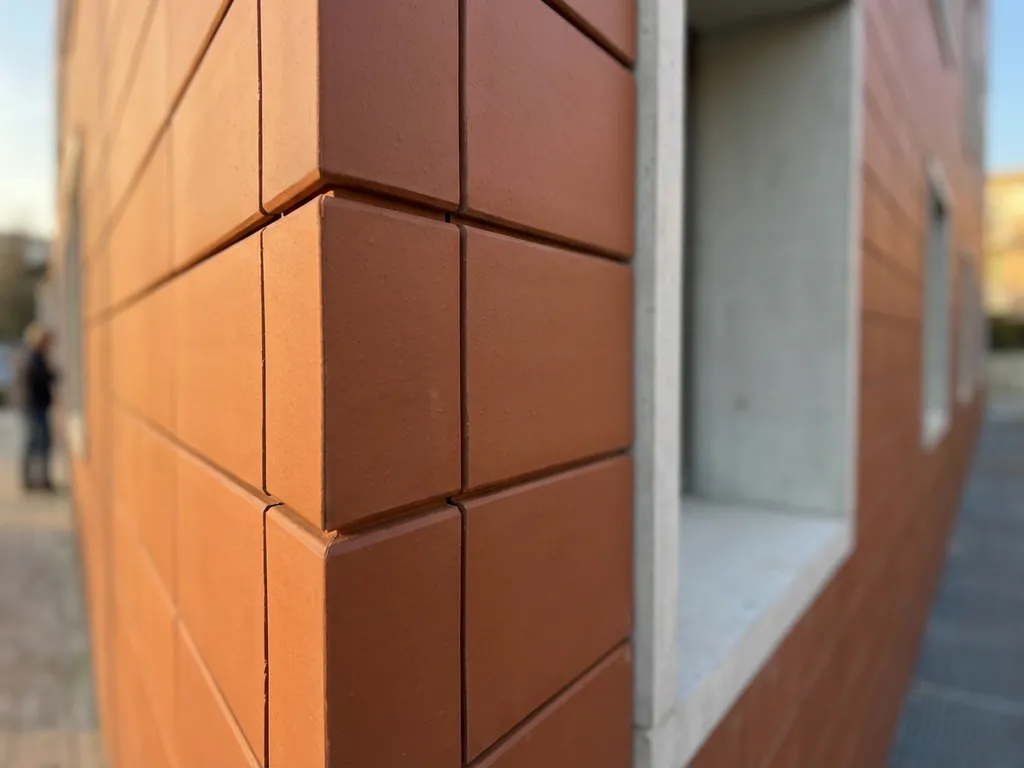
Why Proper Detailing Matters for Terracotta Facades
Proper terracotta facade detailing ensures weathertight performance and preserves the aesthetic integrity of your ceramic cladding system for decades. Critical junctions—such as corners, soffits, and window reveals—are where water infiltration typically occurs, making precise installation techniques essential for long-term building protection.
Well-executed ceramic facade corners and window reveal installations not only prevent moisture damage but also create clean, professional lines that enhance the overall architectural appearance. The thermal movement characteristics of ceramic materials require specific detailing approaches that accommodate expansion and contraction while maintaining structural integrity through seasonal temperature variations.
Essential Tools and Materials for Facade Detailing
Gather specialized tools before beginning your terracotta cladding detail installation to ensure precise cuts and secure fastening. You’ll need a wet-cut diamond-blade saw for ceramic elements, a laser level for accurate alignment, and corrosion-resistant fasteners rated for exterior facade applications.
Essential materials include aluminum retaining profiles designed for ceramic facade systems, weatherproof sealants compatible with ceramic surfaces, and appropriate flashing materials. Stock corner trim pieces, reveal profiles, and soffit transition elements specific to your ceramic facade installation system to maintain consistent appearance and performance across all junctions.
Master Corner Detailing Techniques for Ceramic Facades
External Corner Installation
Position your first ceramic element flush with the corner edge, ensuring the back-profiled surface fully engages with the vertical aluminum retaining profile. Mark and cut the adjacent panel to create a tight joint, typically using a 45-degree miter cut for clean corner transitions.
Apply structural glazing sealant to the corner joint before positioning the second element. The interlocking aluminum profiles should align perfectly to distribute the load evenly across both facade planes while accommodating thermal movement.
Internal Corner Solutions
Internal corners require a different approach, where ceramic elements meet at inside angles. Install aluminum corner profiles first, then slide ceramic panels into position from both directions until they meet at the internal corner junction.
Verify that both panels maintain consistent reveal dimensions and that the corner profile adequately supports the ceramic elements without creating stress concentrations. Seal the junction with an appropriate weatherproof sealant rated for adhesion to ceramic substrates.
Execute Soffit Details with Ceramic Elements
Begin facade soffit detail installation by establishing a level reference line across the entire soffit span using a laser level. Mount aluminum retaining profiles perpendicular to the wall-mounted system, ensuring proper spacing to accommodate your ceramic element dimensions.
Cut ceramic elements to fit the soffit dimensions, accounting for thermal expansion joints at regular intervals. The lightweight nature of high-quality ceramic facade systems simplifies overhead installation, but maintain consistent support spacing to prevent sagging over time. Install elements from one end to the other, checking alignment frequently to maintain straight sight lines.
Finish soffit edges with appropriate trim profiles that create weathertight transitions to adjacent wall surfaces. The junction between the soffit and wall-mounted ceramic elements requires careful flashing installation to direct water away from the building envelope.
Perfect Window Reveal Installation Methods
Window reveal terracotta installation begins with precise measurement of the opening dimensions and calculation of reveal depth to ensure consistent shadow lines around the entire window perimeter. Install reveal profiles before mounting adjacent flat ceramic elements to establish proper alignment references.
Cut ceramic elements for reveal applications using wet-cutting techniques to achieve clean edges without chipping. The reveal depth should accommodate thermal movement while maintaining the integrity of the weather seal around window frames. Install elements starting at the bottom and working upward, ensuring each piece properly engages with the aluminum retaining system.
Apply continuous flashing behind reveal elements to direct any moisture that penetrates joints away from the window frame and building structure. The flashing should extend beyond the ceramic element edges and integrate with the overall building weather barrier system.
Troubleshoot Common Detailing Problems
Address alignment issues immediately when ceramic elements don’t sit flush with adjacent panels by checking the aluminum profile installation and adjusting mounting points as needed. Gaps between elements often indicate incorrect profile spacing or dimensional variations in the ceramic elements that require field adjustment.
Water staining on ceramic surfaces typically results from inadequate flashing installation or failed sealant joints at critical details. Inspect corner and reveal sealant applications regularly, and renew weatherproof sealants according to the manufacturer’s recommendations to maintain long-term weather resistance.
Thermal movement cracks usually occur when expansion joints are omitted or improperly located. Review your facade corner solution design to ensure adequate movement accommodation, particularly at building corners where thermal stresses concentrate.
How TONALITY® Ceramic Facade Systems Simplify Complex Detailing
TONALITY® ceramic facade systems streamline terracotta facade detailing through precision-manufactured elements and engineered aluminum profiles that ensure consistent installation results. Our system addresses common detailing challenges with these integrated solutions:
- Back-profiled ceramic elements that interlock securely with aluminum retaining profiles for simplified corner and reveal installations
- Precision manufacturing tolerances within one millimeter ensure consistent gaps and alignment across all facade details
- Lightweight ceramic elements at only 40 kg per square meter reduce structural requirements and simplify overhead soffit installations
- A complete system approach includes compatible flashing, sealants, and trim components for weathertight performance
- An A1 fire rating and integrated graffiti protection eliminate additional treatments at detail locations
Our technical team provides detailed installation drawings and on-site support to ensure your ceramic facade installation achieves both aesthetic excellence and long-term performance. Contact TONALITY® to discuss how our engineered ceramic facade systems can simplify your next project’s detailing requirements while delivering maintenance-free performance for decades.
Ähnliche Beiträge
- Terracotta vs Brick Slips: Choosing the Right Clay-Based Cladding
- 5 Historic Buildings Successfully Restored with New Terracotta
- What acoustic insulation benefits do terracotta ventilated facades provide?
- 5 Landmark Historic Buildings Successfully Restored with Custom Terracotta
- What maintenance do ceramic facades require?