

Understanding Seismic Requirements for Terracotta Facades
Designing terracotta cladding for high-seismic-risk zones requires an understanding of how earthquake forces affect building facades and the specific performance requirements that ceramic facade systems must meet. Seismic activity creates both horizontal and vertical building movements that can cause facade failures if they are not properly accommodated during the design phase.
Start by identifying your project’s seismic zone classification and the corresponding design requirements in local building codes. Most seismic design standards require facades to withstand interstory drift ratios between 1/400 and 1/100, depending on the zone’s earthquake intensity. The facade system must also accommodate thermal expansion, wind loads, and construction tolerances while maintaining structural integrity during seismic events.
What You Need Before Designing Seismic Terracotta Systems
Gather comprehensive structural information about your building before beginning facade design work. You’ll need the structural engineer’s calculations for expected building movements, interstory drift values, and the building’s natural frequency to ensure your earthquake-resistant facades do not create resonance issues.
Document the substrate conditions and structural grid dimensions, as these directly affect your ceramic facade system’s attachment strategy. Obtain wind load calculations, thermal movement projections, and any building-specific seismic response analyses. This data forms the foundation for selecting appropriate connection methods and designing adequate movement joints throughout the terracotta cladding system.
Select Appropriate Terracotta Elements and Fixing Systems
Choose terracotta elements with dimensions and profiles that accommodate the calculated building movements while maintaining structural performance. Smaller-format tiles typically perform better in seismic zones because they distribute stress more effectively and require fewer expansion joints than large-format panels.
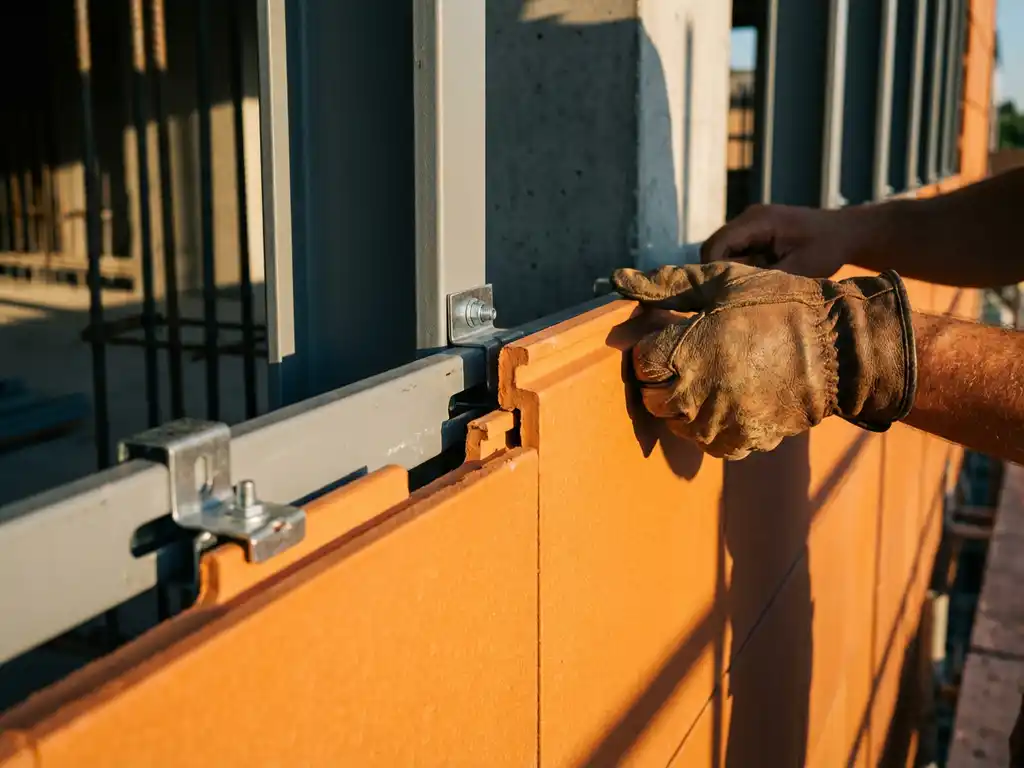
Select fixing systems specifically engineered for seismic applications, focusing on mechanical attachments that allow controlled movement in multiple directions. Avoid rigid connections that can transfer excessive forces to the ceramic elements during earthquake events. The attachment system should include provisions for both in-plane and out-of-plane movements, with connection points designed to slide or flex within predetermined limits.
Mechanical vs. Adhesive Systems
Prioritize mechanical fixing systems over adhesive-only installations in seismic zones, as mechanical connections provide more predictable performance under dynamic loading. If adhesive systems are necessary, combine them with mechanical backup attachments to prevent progressive failure.
Design Flexible Connections for Earthquake Movement
Create connection details that accommodate the full range of expected building movements without compromising the facade’s weather resistance or structural integrity. Design connection points with sufficient clearance, and use flexible gaskets or sealants that maintain their properties under dynamic loading.
Implement a hierarchy of movement accommodation, starting with flexible connections at individual elements, then movement joints at panel interfaces, and finally structural separation joints at building expansion points. Each level should handle progressively larger movements while maintaining overall system performance. Calculate connection loads based on the maximum expected accelerations, and ensure adequate safety factors for both static and dynamic conditions.
Joint Design and Sealing
Size movement joints to accommodate 150% of the calculated maximum movements to provide adequate safety margins. Use structural glazing sealants or preformed gaskets specifically rated for seismic applications, ensuring they maintain adhesion and flexibility through repeated loading cycles.
Validate Your Design Through Testing and Analysis
Perform a structural analysis of your terracotta cladding system using the building’s seismic response data to verify that connection forces remain within acceptable limits. Model the facade system’s response to the expected building movements, and confirm that no components exceed their design capacities during seismic events.
Conduct physical testing of critical connection details and movement joints to validate their performance under cyclic loading conditions that simulate earthquake movements. Test programs should include both individual component testing and assembly-level evaluation to identify potential failure modes. Document all testing procedures and results for approval by the building authority and for future reference during facade installation.
Address Common Seismic Design Challenges
Manage the interface between different building materials and structural systems, as these transition zones often experience the highest stress concentrations during seismic events. Pay particular attention to connections at floor lines, where interstory drift creates the most significant facade movements.
Resolve conflicts between seismic requirements and other performance criteria, such as thermal efficiency, water resistance, and architectural aesthetics. Building safety requirements take precedence, but creative detailing can often achieve multiple objectives simultaneously. Address maintenance access requirements early in the design process, as seismic-rated connections may require periodic inspection and adjustment throughout the building’s service life.
How TONALITY® Supports Seismic Terracotta Design
TONALITY® ceramic facade systems provide several advantages for earthquake-resistant facades through their lightweight construction and flexible installation methods. Our ceramic elements weigh only 40 kilograms per square meter, significantly reducing seismic loads compared to heavier cladding materials, while maintaining superior durability and fire resistance with an A1 building material classification.
Key seismic design benefits include:
- An interlocking aluminum profile system that accommodates building movement while maintaining weather protection
- Precise manufacturing tolerances within one millimeter for predictable installation and performance
- A modular design that allows selective replacement of individual elements after seismic events
- Reduced substructure requirements due to low dead weight, simplifying structural engineering
Our technical team provides comprehensive support for seismic design applications, including connection detail development and structural analysis assistance. View our successful seismic facade projects to see how we’ve helped architects and engineers create earthquake-resistant terracotta installations. Contact TONALITY® today to discuss your earthquake-resistant facade requirements and access our seismic design resources.