

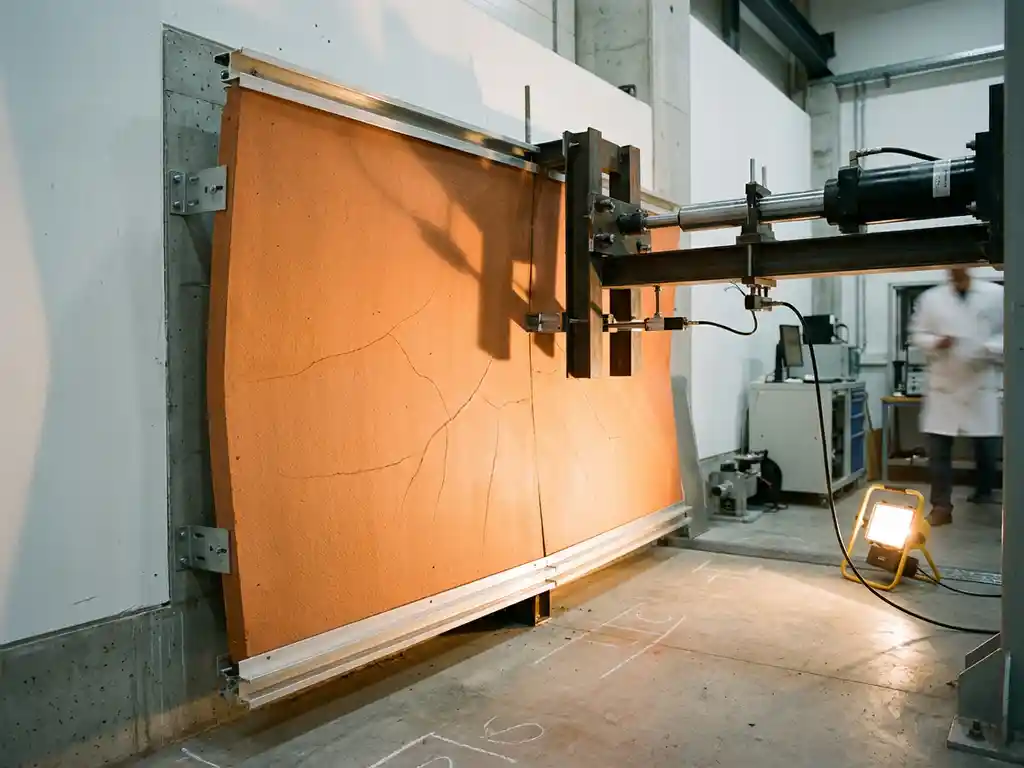
What are the key seismic forces that affect terracotta facades?
Terracotta facades experience three primary seismic forces during earthquakes: horizontal inertial forces that push the facade laterally, vertical accelerations that create uplift and compression, and interstory drift that causes differential movement between building floors. These forces can reach magnitudes of 0.4g to 1.5g, depending on the seismic zone and building height.
The horizontal inertial forces represent the most critical concern for ceramic facade systems. When ground motion accelerates the building structure, the facade elements tend to continue moving in their original direction, creating substantial lateral loads on the anchoring system. These forces are amplified at higher elevations due to building dynamics and can exceed the facade’s own weight by several times.
Interstory drift presents another significant challenge, as adjacent floors move at different rates during seismic events. This differential movement can cause racking forces that stress facade connections and panels. Modern seismic design must accommodate drift ratios typically ranging from 1% to 2.5% of story height, depending on the building’s structural system and local building codes.
How do building codes address seismic requirements for ceramic facades?
Building codes classify ceramic facades as nonstructural components and require them to resist seismic forces calculated using specific acceleration coefficients and importance factors. Most codes mandate that facade systems withstand forces ranging from 0.4 to 1.6 times the component weight, depending on the building’s seismic design category and the facade’s location on the structure.
The International Building Code (IBC) and similar standards worldwide establish minimum seismic loads using the formula Fp = 0.4 × ap × SDS × Wp, where ap represents the component amplification factor, SDS is the design spectral acceleration, and Wp is the component weight. For ceramic cladding systems, the amplification factor typically ranges from 1.0 to 2.5.
Codes also specify drift accommodation requirements, mandating that facade systems maintain their integrity while allowing for interstory movements. European standards such as Eurocode 8 provide similar provisions, emphasizing the need for adequate clearances and flexible connections. These regulations ensure that ceramic facade systems don’t compromise building safety or their own performance during seismic events.
What’s the difference between seismic design for lightweight vs. heavy facade systems?
Lightweight ceramic facade systems experience lower absolute seismic forces due to reduced mass but require more flexible connection details to accommodate building movement. Heavy facade systems generate higher seismic forces but can use more robust, less movement-sensitive anchoring approaches. The choice significantly affects both structural design and installation complexity.
Lightweight systems, typically weighing 40-60 kg/m², benefit from reduced inertial forces during earthquakes. This lower mass translates to proportionally smaller seismic loads on the building structure and anchoring points. However, lightweight facades often require more sophisticated connection systems that can accommodate greater relative movement between the facade and the structure.
Heavy facade systems, exceeding 80-100 kg/m², generate substantial seismic forces that demand robust structural support and anchoring. The increased mass creates higher inertial loads but allows for more rigid connection details. Structural engineering for heavy systems focuses on strength rather than flexibility, often requiring enhanced backup structure and more substantial anchor points to resist the amplified seismic loads.
How should terracotta facade anchoring systems be designed for earthquake resistance?
Terracotta facade anchoring systems require flexible connections that allow controlled movement while maintaining structural integrity during seismic events. Effective facade anchoring combines sliding connections for horizontal movement, pinned connections for rotation, and adequate clearances to prevent binding during earthquake-induced building deformation.
The anchoring strategy should incorporate multiple connection types to address different movement requirements. Horizontal sliding connections accommodate interstory drift and thermal expansion, while vertical connections must resist uplift forces while allowing controlled vertical movement. Connection hardware should be fabricated from corrosion-resistant materials such as stainless steel to ensure long-term reliability.
Proper anchor spacing and load distribution prevent stress concentrations that could lead to connection failure. Seismic engineering principles recommend distributing loads across multiple anchor points rather than relying on single high-capacity connections. This approach provides redundancy and prevents progressive failure if individual anchors become overloaded during extreme seismic events.
What movement joints and tolerances are required in seismic terracotta design?
Seismic terracotta design requires movement joints sized to accommodate interstory drift plus additional safety factors, typically ranging from 20 mm to 50 mm, depending on building height and seismic zone. Horizontal joints must allow for vertical building compression and extension, while vertical joints accommodate lateral building movement and thermal effects.
Joint sizing calculations must consider the maximum expected interstory drift, usually 1-2.5% of floor height, plus thermal movement and construction tolerances. The total joint width should provide at least 50% additional capacity beyond calculated maximum movements to prevent joint closure during extreme events. Weather-sealing systems within these joints must maintain their integrity throughout the expected movement range.
Tolerance management becomes critical in seismic design, as accumulated dimensional variations can consume movement capacity. Installation tolerances should be minimized through precise manufacturing and careful field measurement. Ceramic cladding systems benefit from factory-controlled dimensions that can achieve tolerances within 1-2 mm, helping preserve joint movement capacity for seismic accommodation rather than construction variations.
How TONALITY® Ceramic Facades Excel in Seismic Applications
TONALITY® ceramic facade systems provide exceptional earthquake resistance through their lightweight construction and precision-engineered anchoring system. Our ceramic elements weigh only 40 kg/m², significantly reducing seismic loads while maintaining superior durability and fire protection classified as building material class A1.
Key seismic advantages of TONALITY® systems include:
- Lightweight construction reduces inertial forces by up to 50% compared to heavy facade systems
- Precision manufacturing tolerances within 1 mm preserve critical movement joint capacity
- Interlocking aluminum retention profiles provide flexible connections that accommodate building movement
- Single-layer ceramic construction eliminates delamination risks during seismic events
- Quick installation system reduces construction tolerances and field variables
Our engineering team provides comprehensive seismic design support to ensure optimal performance in earthquake-prone regions. Contact TONALITY® today to discuss how our advanced ceramic facade systems can meet your project’s seismic engineering requirements while delivering lasting architectural excellence.
Ähnliche Artikel
- Wie finanzieren Kommunen den Schulgebäude Neubau in Deutschland?
- Can architectural design improve energy efficiency?
- How do terracotta facades contribute to urban heat island reduction?
- Does vertical or horizontal terracotta panel orientation affect how a building is perceived?
- Can terracotta facades withstand extreme weather conditions?