

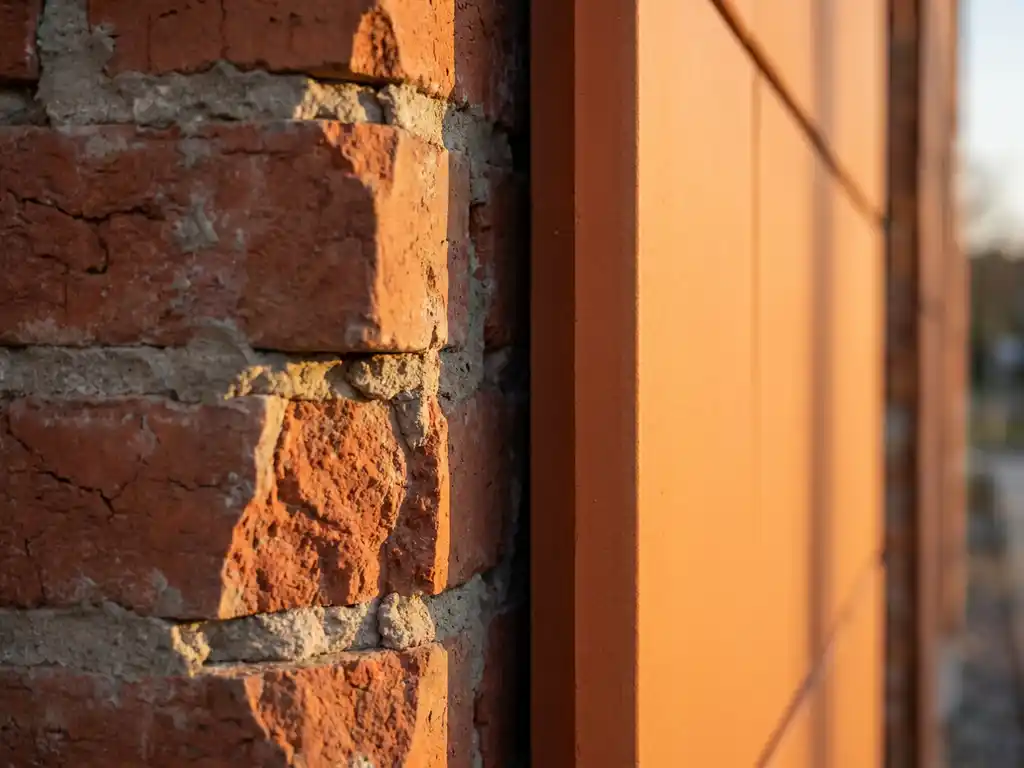
Terracotta facade systems typically last 50 to 100 years or more with minimal maintenance, making them highly competitive with traditional brick in terms of longevity. The key advantage of modern ceramic facade systems is that their dense, sintered surface resists moisture, frost, and UV degradation far more effectively than older masonry materials. The sections below break down how each material performs over time and what that means for your project.
How long does a terracotta facade system actually last?
A well-installed terracotta or ceramic facade system can realistically last 50 to 100 years, and in many cases significantly longer. The material’s durability comes from the manufacturing process: ceramic facade elements fired at temperatures exceeding 1,200 degrees Celsius develop an exceptionally dense, low-porosity surface that resists moisture ingress, frost cycles, and UV radiation that gradually break down lesser materials.
Modern ceramic facade systems go further than raw material quality alone. The ventilated rainscreen principle, used in systems where ceramic elements interlock with vertical aluminum retaining profiles, allows moisture to drain and air to circulate freely behind the facade. This prevents trapped moisture from building up behind the cladding, which is one of the most common causes of premature facade failure. The result is a system that maintains its structural integrity and visual appearance across decades of exposure.
Permanent color stability is another factor that extends the effective lifespan. Because the color in high-quality ceramic facades runs through the fired body rather than sitting as a surface coating, fading is not a concern in the same way it is for painted or polymer-coated alternatives. The facade looks as good in year 40 as it did at installation. If you want to explore the range of available terracotta surfaces and formats, it is worth reviewing the options early in the design process to align material selection with long-term performance requirements.
How long does a brick facade last in comparison?
Traditional brick facades are well established as durable building elements, with lifespans commonly cited in the range of 50 to 150 years, depending heavily on brick quality, mortar specification, local climate, and maintenance history. Historically, brick has been the benchmark for facade longevity in Central European construction.
However, the comparison is more nuanced than raw lifespan numbers suggest. Brick is a monolithic, load-bearing or semi-structural material, meaning its long-term performance is tied closely to the mortar joints between units. Mortar is typically the weaker element: it absorbs moisture, expands and contracts with temperature fluctuations, and gradually carbonates and erodes. Repointing is a standard maintenance requirement for brick facades, typically needed every 20 to 40 years depending on exposure.
Ventilated ceramic facade systems sidestep the mortar dependency entirely. Individual ceramic elements are mechanically fixed and can be replaced independently if damage occurs, without disturbing the surrounding cladding. This modular approach gives ceramic systems a practical maintenance and repairability advantage that is difficult for traditional brickwork to match.
What causes facade materials to degrade over time?
The primary causes of facade degradation are moisture penetration, freeze-thaw cycling, UV radiation, and thermal stress. Each of these forces acts on facade materials continuously, and how well a material resists them determines how long it performs without intervention.
- Moisture penetration: Water entering pores or cracks expands when it freezes, forcing open micro-fractures over successive winters. Porous materials like some brick types or lower-fired ceramics are particularly vulnerable.
- Freeze-thaw cycling: In climates with cold winters, repeated freezing and thawing accelerates surface spalling and joint erosion, especially where moisture has already penetrated.
- UV radiation: Prolonged sun exposure degrades surface coatings, dyes, and polymer components. Materials with inherent color stability, such as through-body fired ceramics, are largely unaffected.
- Thermal stress: Daily and seasonal temperature swings cause materials to expand and contract. Facades that cannot accommodate this movement develop cracks at joints and fixings over time.
Ventilated facade systems address thermal stress directly by allowing each panel to move independently within its fixing system. This designed-in flexibility prevents stress from accumulating at joints, which is a structural advantage over rigidly mortared masonry.
Which facade system requires less maintenance over its lifespan?
Ceramic and terracotta ventilated facade systems generally require significantly less maintenance than traditional brick over their lifespan. The combination of a dense, low-porosity fired surface, integrated graffiti protection, and a mechanical fixing system that does not rely on mortar means that routine interventions are minimal.
Brick facades, as noted, require periodic repointing to address mortar erosion. Depending on the building’s location and exposure, this can be a substantial undertaking, particularly on multi-story structures where scaffolding access adds to the overall effort and disruption. Facade cleaning is also more involved with textured or porous brick surfaces that trap dirt and biological growth.
High-quality ceramic facades, by contrast, feature smooth, dense surfaces that shed dirt effectively and resist biological growth such as algae and moss. The integrated graffiti protection found in premium ceramic systems means that surface contamination can be removed without specialist treatments or surface damage. Over a 50-year lifecycle, the reduced maintenance burden translates into a meaningful long-term value advantage that is worth factoring into any total cost of ownership analysis. Reviewing completed reference projects can give a useful sense of how ceramic facade systems perform across different building types and climates over time.
Does facade system weight affect long-term structural performance?
Yes, facade system weight has a direct and lasting impact on structural performance. Heavier facades impose greater permanent loads on the building structure, which affects everything from foundation sizing to the long-term behavior of fixings, substructures, and the building frame itself under cumulative load.
Traditional brick cladding is relatively heavy, and its weight must be accounted for in structural calculations from the outset. Over time, heavy facades can contribute to differential settlement, increased stress at structural connections, and greater seismic vulnerability in applicable regions.
Single-layer ceramic facade systems offer a distinct advantage here. With a surface weight of around 40 kilograms per square meter, they impose substantially lower permanent loads than comparable masonry solutions. This low dead weight allows for lighter substructures, which simplifies installation and reduces material requirements. For timber frame construction in particular, where load capacity and fire performance are both critical considerations, the combination of low weight and non-combustible A1 classification makes ceramic facade systems an especially practical long-term choice.
What happens to terracotta and brick facades at end of life?
At end of life, both terracotta and brick are inert, mineral-based materials that do not leach harmful substances. However, ceramic ventilated facade systems have a clear advantage in terms of deconstruction, material recovery, and recyclability compared to traditional mortared brickwork.
Brick facades bonded with mortar are difficult to deconstruct cleanly. Separating brick from mortar for reuse requires significant manual effort, and the mortar contamination often means that recovered bricks are downcycled rather than reused at their original specification. The demolition waste stream from traditional masonry is typically mixed and difficult to sort.
Ventilated ceramic facade systems are designed with end-of-life recovery in mind. Because the ceramic elements are mechanically fixed rather than bonded, they can be removed individually and sorted by component type with minimal effort. The ceramic elements themselves are 100% recyclable, and the aluminum substructure components can be separated and recovered independently. This component-level sortability supports circular construction principles and aligns with increasingly stringent requirements for building material documentation and lifecycle assessment in 2026 and beyond.
For project teams planning buildings with long service lives and an eye on future adaptability, the deconstruction advantage of ceramic facade systems is a practical consideration worth weighing alongside initial installation factors. Technical documentation and material samples are available to support lifecycle planning and specification work at any project stage.
How TONALITY® supports long-term facade performance
TONALITY® ceramic facade systems are engineered specifically to meet the durability, maintenance, and lifecycle demands outlined throughout this article. For architects, developers, and contractors evaluating facade solutions with a long-term perspective, TONALITY® offers a concrete set of advantages:
- Proven material longevity: Through-body fired ceramic elements with a dense, low-porosity surface that resists moisture, frost, and UV degradation across decades of exposure.
- Ventilated rainscreen construction: Mechanical fixing systems that eliminate mortar dependency, allow independent panel replacement, and prevent moisture accumulation behind the cladding.
- Minimal maintenance requirements: Smooth, dirt-resistant surfaces with integrated graffiti protection, reducing the frequency and cost of facade interventions over the building’s service life.
- Low dead weight: At approximately 40 kg/m², TONALITY® systems impose significantly lower structural loads than traditional masonry, supporting lighter substructures and broader applicability across construction types.
- End-of-life recyclability: 100% recyclable ceramic elements and separable aluminum substructure components designed for straightforward deconstruction and material recovery.
To discuss your project requirements or request technical documentation and samples, get in touch with the TONALITY® team directly.
Related Articles
- What are the most common failure points in ceramic cladding installations?
- What does a ceramic facade cost compared to natural stone, per square meter?
- Can terracotta facades reduce noise pollution in buildings?
- What makes a building design truly timeless?
- Terracotta vs Large-Format Porcelain: A Technical Specification Comparison