

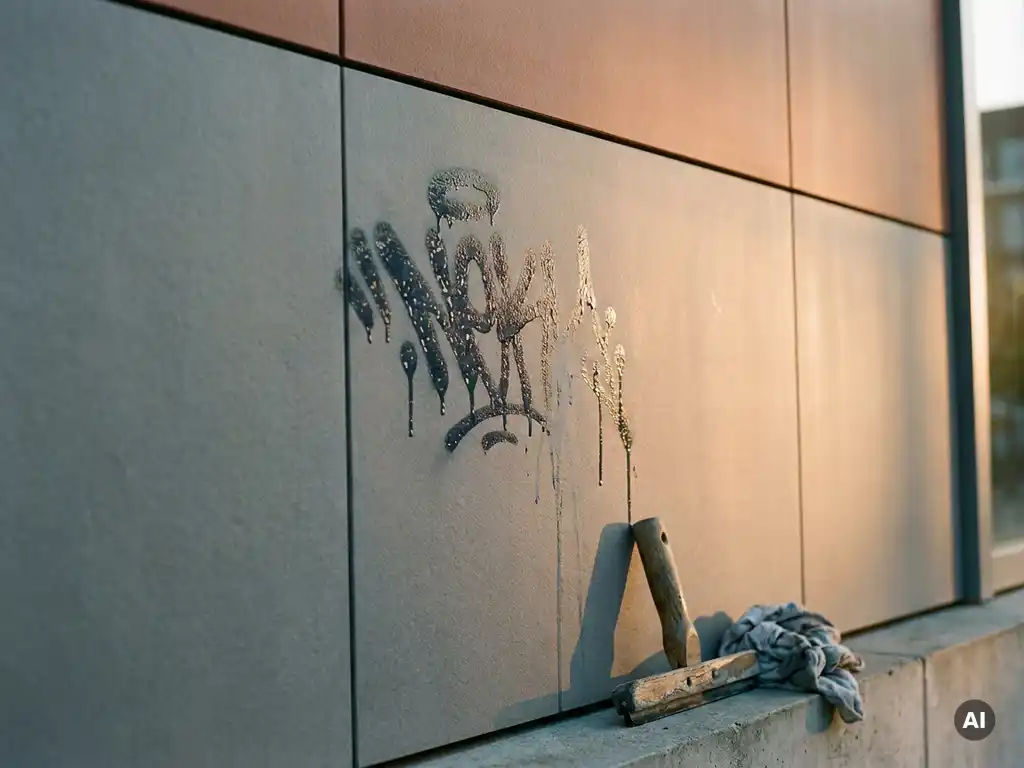
Yes, graffiti resistance can meaningfully reduce property management costs over the long term. Buildings without protective facade surfaces often require repeated, labor-intensive cleaning or repainting after each incident, and those recurring expenses accumulate quickly. The sections below break down where the real costs lie, what graffiti resistance actually means in practice, and which materials deliver the strongest protection.
How much does graffiti removal actually cost property managers?
Graffiti removal is one of the most unpredictable recurring expenses in property management. The total cost depends on the facade material, the type of paint or marker used, the surface area affected, and how quickly the removal is carried out. Left untreated, graffiti invites further vandalism, which means a single incident can quickly escalate into a pattern that demands ongoing intervention.
The real financial burden is not just the cleaning itself. Property managers typically absorb costs across several categories:
- Professional cleaning services for surfaces that cannot be treated with standard methods
- Surface restoration when aggressive solvents or pressure washing damage the underlying material
- Repainting or recoating when the original finish cannot be recovered
- Scaffolding or access equipment for facade areas above ground level
- Repeat interventions when the same location is targeted again
For property managers responsible for multiple buildings or large facades, these costs compound over time into a significant line item in the annual maintenance budget. The total cost of ownership of a facade is therefore shaped not just by installation, but by how much ongoing intervention it demands.
What does graffiti resistance in facade materials mean?
Graffiti resistance in facade materials refers to the surface’s ability to prevent paint, markers, and adhesives from bonding permanently, allowing them to be removed cleanly without damaging the underlying material. A genuinely graffiti-resistant surface does not simply make removal easier; it eliminates the need for aggressive cleaning agents or abrasive methods that can degrade the facade over time.
There is an important distinction between applied anti-graffiti coatings and materials that are inherently resistant by nature of their composition. Applied coatings are added after manufacturing and can wear down, require reapplication, and may alter the visual appearance of the facade. Inherent resistance, by contrast, comes from the density and non-porosity of the material itself, meaning the protection is permanent and does not diminish with age or weathering.
For a material to be considered reliably graffiti-resistant, it typically needs to meet several criteria: a sealed, non-porous surface that prevents paint penetration, chemical stability that allows cleaning without surface damage, and UV resistance so that any residue left after cleaning does not discolor or stain the facade permanently.
How does a graffiti-resistant facade reduce long-term maintenance costs?
A graffiti-resistant facade reduces long-term facade maintenance costs by eliminating or dramatically shortening the cleaning process after each incident. When paint cannot penetrate the surface, it can often be removed with water and mild cleaning agents rather than specialist chemicals or mechanical treatment. This reduces both the time and the materials required for each intervention.
The lifecycle cost advantage becomes clearest when comparing two identical buildings over a ten- or twenty-year period. A facade that requires professional graffiti removal multiple times per year, plus periodic surface restoration, accumulates maintenance expenditure that a resistant facade largely avoids. Over that same period, the resistant facade retains its original appearance without repainting, recoating, or material replacement.
There is also an indirect cost benefit: facades that look well-maintained signal active management to both tenants and the surrounding community, which can reduce the frequency of further vandalism. Research into urban environments consistently shows that visible neglect tends to attract repeat incidents, while well-kept surfaces are less frequently targeted.
Which facade materials offer the best graffiti resistance?
Among facade materials, dense, non-porous surfaces offer the strongest inherent graffiti resistance. Ceramic, glass, and certain metal panels perform well because their surfaces do not allow paint to penetrate at a microscopic level. Porous materials such as untreated concrete, brick, or natural stone are far more difficult to clean and often require surface restoration after graffiti incidents.
Ceramic facade panels
High-fired ceramic panels are among the most graffiti-resistant building materials available. The sintering process used in their production creates an exceptionally dense, smooth surface with virtually no open pores. Paint and adhesives sit on the surface rather than bonding with it, which means they can be removed without aggressive intervention. Ceramic facades also carry this resistance permanently, with no coating to reapply or maintain.
Coated metal and glass panels
Coated aluminum and glass panels can also offer good graffiti resistance, particularly when factory-applied coatings are used. However, these coatings are a separate layer added to the base material, and their performance depends on the coating’s durability. Over time, UV exposure, temperature cycling, and cleaning can degrade the protective layer, requiring reapplication to maintain the same level of protection.
Does graffiti protection affect other facade performance properties?
In materials where graffiti resistance is inherent rather than applied, it does not compromise other facade performance properties. In fact, the same surface characteristics that prevent paint from bonding also contribute to UV stability, color permanence, and resistance to environmental soiling. A dense, non-porous surface repels not just graffiti but also atmospheric pollutants, moisture, and biological growth.
For applied coatings, the picture is more nuanced. Some anti-graffiti coatings can slightly alter the surface texture or sheen of a facade, which may affect its visual appearance or breathability. Property managers and specifiers should verify that any applied coating is compatible with the underlying material and does not affect fire classification, particularly for buildings where non-combustibility is a regulatory requirement.
The strongest-performing facades combine inherent material resistance with other durable properties: UV stability, permanent color retention, and low surface weight that simplifies installation and reduces structural load. When these properties are built into the material rather than added on, the facade delivers consistent performance across its entire service life without requiring periodic maintenance interventions to sustain any single characteristic.
How TONALITY® supports graffiti-resistant facade design
TONALITY® ceramic facade panels are produced using a sinter-firing process at temperatures exceeding 1,200 degrees Celsius, which creates a surface so dense and smooth that it offers integrated graffiti protection without any additional coating. This means the protection is permanent, does not wear away, and requires no reapplication over the building’s lifetime. For property managers focused on reducing long-term maintenance expenditure, this built-in resistance is a direct operational advantage.
Key performance properties that support low-maintenance property management include:
- Integrated graffiti protection as a permanent material characteristic, not an applied layer
- Permanent UV and color resistance that keeps the facade looking consistent over decades
- Non-combustibility (building material class A1) for compliance with fire protection requirements
- Low surface weight of approximately 40 kg per square meter for reduced substructure requirements and faster installation
- 100% recyclability and component-sorted deconstruction for sustainable lifecycle management
- Formats from 150 x 300 mm up to 400 x 1,600 mm, produced to within one millimeter, for precise and flexible design
TONALITY® panels have been specified across a wide range of building types where durability and low upkeep are priorities. You can explore completed projects to see how the system performs in real applications, or request samples to assess surface quality directly.
[cta_contact_form]
If you are evaluating facade options for a new project or a refurbishment and want to understand how TONALITY® fits your specific requirements, get in touch with the sales team for tailored guidance on formats, surfaces, and system specifications.
Related Articles
- 7 Benefits of Integrated Prefabricated Facade Renovation
- How can windows, facades and ventilation be renovated together?
- What standard formats do ceramic facade tiles come in, and how do you pick one?
- Why choose ceramic facades for architectural projects?
- 8 Questions to Ask Before Specifying Terracotta Facades