

Circular facade systems reduce whole-life building costs by eliminating or drastically reducing the recurring expenses that accumulate over a building’s operational life. Because circular materials are designed for durability, low maintenance, and eventual reuse rather than disposal, they shift cost pressure away from ongoing upkeep and toward a single, well-justified upfront investment. The sections below unpack each dimension of that value, from material properties to end-of-life recovery.
What makes a facade system truly circular?
A facade system is truly circular when its materials can be recovered, reprocessed, and reused at full value at the end of the building’s life, without generating waste or requiring energy-intensive downcycling. Circularity in facade design depends on three conditions: the material must be durable enough to outlast multiple building cycles, it must be separable from the substructure cleanly, and it must retain its material quality after recovery.
Ceramic facade elements meet all three conditions. Fired at temperatures exceeding 1,200 degrees Celsius through a sinter-firing process, ceramic tiles achieve a dense, stable surface structure that does not degrade over decades of exposure. Unlike composite cladding materials that bond dissimilar layers together, ceramic facade systems use a mechanical fixing approach where elements interlock with vertical aluminum retaining profiles. This means individual tiles can be removed without destroying adjacent components, and both the ceramic and the aluminum substructure can be sorted by material type and directed back into production streams. For a closer look at how these surfaces and formats are engineered for longevity, exploring the full range of terracotta surfaces and formats gives a practical sense of the material options available.
True circularity also means the system does not require chemical treatments, coatings, or sealants to perform, because those additions complicate recovery and introduce contaminants. Ceramic is a single-material product with no combustible components and no surface treatments needed to maintain appearance or weather resistance.
How do circular facades lower maintenance and replacement costs?
Circular facade systems lower maintenance and replacement costs primarily through material permanence. Because the underlying material does not corrode, fade, or require periodic recoating, the routine maintenance schedule is dramatically shorter than for painted, coated, or composite alternatives. Over a typical building lifecycle of several decades, the cumulative savings from reduced maintenance interventions are substantial.
Ceramic cladding, for example, carries permanent UV resistance and color stability baked into the material itself rather than applied as a surface layer. This means the facade appearance does not degrade with sun exposure, eliminating the repainting and re-coating cycles that other facade materials require every several years. Integrated graffiti protection adds another layer of operational simplicity, removing the need for specialist cleaning contractors after vandalism events.
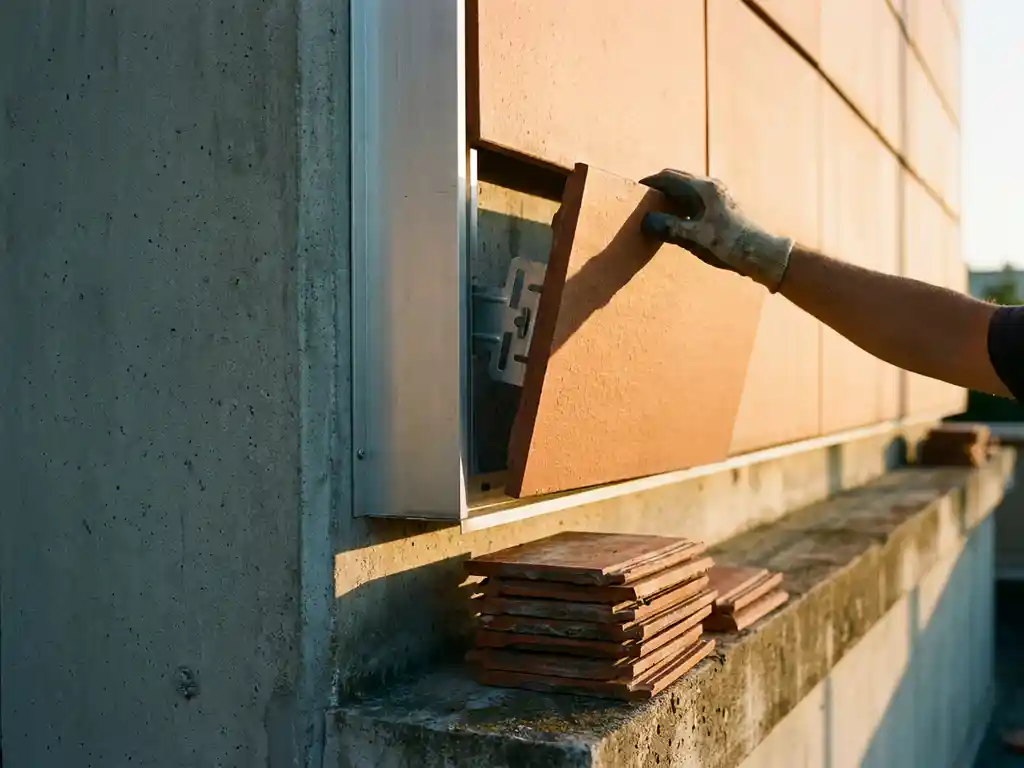
When individual tiles do need replacement due to impact damage, the mechanical fixing system allows single-element swap-outs without disturbing the surrounding facade. This targeted replaceability avoids the disproportionate cost of large-scale remediation work triggered by localized damage, which is a common cost driver in adhered or composite systems where removing one element often means removing many.
Does lighter cladding actually reduce total project costs?
Yes, lighter cladding genuinely reduces total project costs, and the savings appear at multiple stages of the construction process. A lower surface weight reduces the structural load the substructure and the building frame must carry, which directly affects the specification and quantity of materials needed for both. Less material in the substructure means lower procurement costs, shorter installation time, and reduced labor input.
Single-layer ceramic facade elements carry a surface weight of around 40 kilograms per square meter, which is significantly lower than many traditional cladding materials. For timber construction in particular, this weight reduction is meaningful because timber frames have tighter load tolerances than concrete or steel structures. A lighter facade system can be specified without requiring structural upgrades that would otherwise add cost and program time to a project.
The installation benefits compound the material savings. Lighter elements are easier to handle on site, require less lifting equipment, and can be installed more quickly per square meter. For project managers working against tight program schedules, facade installation systems that combine low weight with a mount-and-done fixing logic reduce the risk of facade work becoming a program bottleneck. Reviewing completed building references provides a useful benchmark for how these installation efficiencies translate across different project types and scales.
What happens to ceramic facade tiles at end of life?
At end of life, ceramic facade tiles can be fully recovered and recycled without loss of material quality. Because ceramic is an inorganic, single-material product, it does not degrade during the recovery process and can be reprocessed into new ceramic products. The mechanical fixing system used in profiled ceramic facade elements means deconstruction is systematic and clean, with tiles removed component by component and sorted by material type with minimal effort.
This deconstruction-by-design approach contrasts with adhered cladding systems where tiles are bonded to substrates, making clean separation difficult and often impossible without breaking the material. When separation is not clean, the recovered material is contaminated and can only be downcycled into lower-grade applications rather than re-entering the production stream at full value.
The aluminum retaining profiles used in ceramic facade substructures are equally recoverable. Aluminum is one of the most efficiently recycled construction materials available, retaining nearly all of its material value through repeated recycling cycles. A facade system where both the facing material and the substructure are fully recyclable and easily separated represents a genuine contribution to circular construction, not just a marketing position. Specifiers who want to verify material and system data before committing to a specification can request samples and download technical documentation to support their evaluation.
How does facade material choice affect whole-life cost calculations?
Facade material choice affects whole-life cost calculations by determining how costs are distributed across the building’s operational life rather than concentrated at the point of construction. Materials with high upfront specification but low maintenance requirements shift the cost profile toward the beginning of the lifecycle, where costs are predictable and financeable. Materials with lower upfront costs but recurring maintenance, replacement, or remediation needs create unpredictable cost exposure across the building’s life.
Whole-life cost analysis accounts for initial material and installation costs, maintenance frequency and intensity, expected service life before replacement, end-of-life disposal or recovery costs, and the environmental liabilities that increasingly translate into regulatory and financial risk. Ceramic facade materials perform well across all of these dimensions: the material does not require periodic treatment, its service life extends across multiple decades without degradation, and its end-of-life value is recoverable rather than a disposal liability.
For construction project managers and specifiers, the practical implication is that a whole-life cost analysis often reverses the apparent cost hierarchy between material options. A material that appears more economical at the procurement stage may carry significantly higher costs when maintenance schedules, replacement cycles, and disposal costs are modeled across a 30 or 50-year building life.
When does investing in a circular facade system pay off?
Investing in a circular facade system pays off most clearly in buildings with long intended service lives, high maintenance cost sensitivity, or sustainability certification requirements. The longer a building remains in use, the more the low-maintenance and durable properties of circular materials generate compounding cost advantages relative to alternatives that require periodic intervention.
For new construction, the payoff calculation is straightforward: a facade system that requires no recoating, resurfacing, or significant maintenance over its service life avoids costs that would otherwise appear at predictable intervals across the building’s life. For renovation projects, the calculus also includes the value of not disrupting building occupants or operations with maintenance work, which carries its own indirect cost in commercial or residential settings.
Sustainable facade materials also increasingly affect a building’s asset value and regulatory standing. As embodied carbon requirements, circular economy obligations, and green building certification frameworks become more prevalent in procurement and planning processes in 2026, specifying materials that can demonstrate recyclability, durability, and low environmental impact moves from a differentiator to a baseline expectation. A facade system that satisfies these requirements from the outset avoids the retrofit cost of addressing them later, which is rarely efficient and never cheap.
How TONALITY® helps reduce whole-life facade costs
TONALITY® ceramic facade systems are engineered specifically to deliver the durability, low maintenance, and end-of-life recoverability that make circular construction economically viable rather than aspirational. For project teams looking to reduce whole-life costs without compromising on performance or appearance, TONALITY® addresses the key cost drivers directly:
- No maintenance coatings required: Permanent UV resistance and color stability are inherent to the fired ceramic material, eliminating recurring recoating and resurfacing costs across the building’s life.
- Single-element replaceability: The mechanical fixing system allows individual tiles to be swapped out without disturbing adjacent components, keeping localized damage from becoming a large-scale remediation expense.
- Low surface weight: At approximately 40 kg/m², TONALITY® panels reduce structural load requirements, lowering substructure specification costs and installation time.
- Full end-of-life recoverability: Both the ceramic tiles and aluminum substructure profiles are cleanly separable and fully recyclable, supporting circular economy compliance and avoiding disposal liabilities.
- Verified performance across project types: TONALITY® systems have been specified on a wide range of commercial, residential, and public buildings, with documented results available for cost benchmarking.
To discuss how TONALITY® can be specified for your project, get in touch with the TONALITY® sales team for tailored advice and project support.
Related Articles
- Can ceramic cladding solutions be retrofitted onto existing building facades?
- How do terracotta facades perform in hurricane-prone regions?
- How have building codes changed for facades in 2026?
- Terracotta vs GFRC Panels: Weight, Cost, and Design Flexibility Compared
- How durable are terracotta cladding systems?