

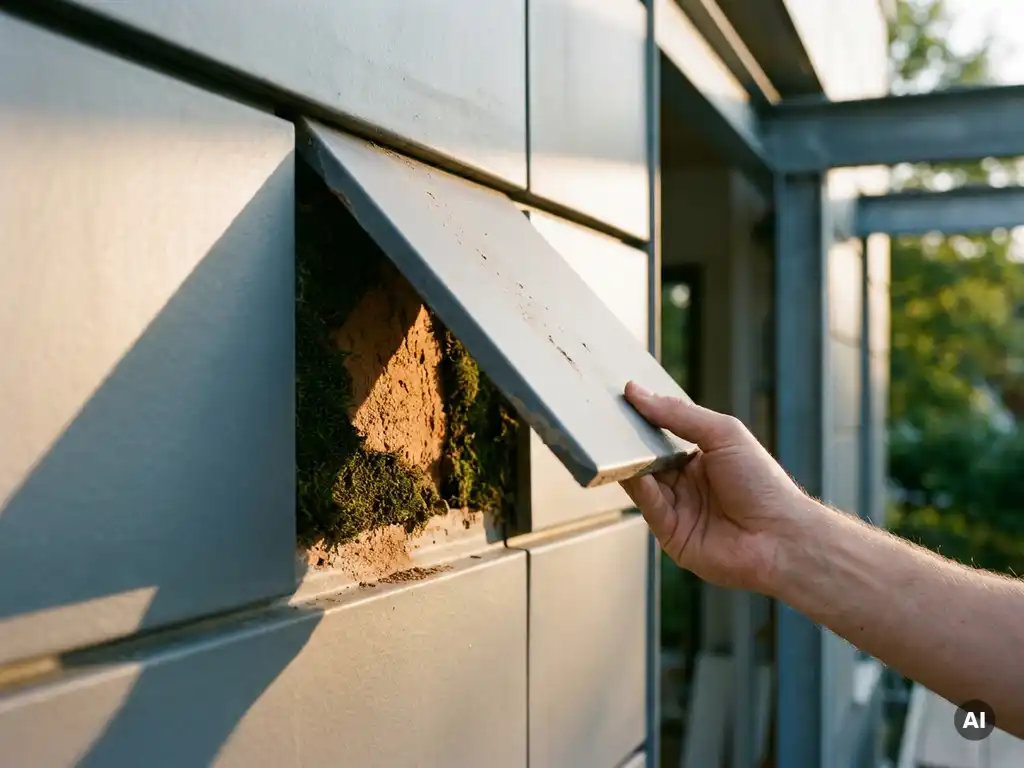
Circular economy principles are transforming the facade industry because they shift the focus from a linear “produce, use, demolish” model to one where building materials are designed from the outset to be reused, recycled, or recovered at the end of a building’s life. This shift is driven by growing regulatory pressure, rising material costs, and the construction sector’s significant share of global resource consumption and waste. The questions below unpack what this means in practice, from how circularity is measured to which facade materials and systems are best positioned to meet these demands.
What does circular economy actually mean in construction?
In construction, a circular economy means designing buildings and selecting materials so that resources remain in use for as long as possible, are recovered efficiently when a structure is altered or demolished, and generate minimal waste throughout their life cycle. Rather than treating a building as a one-time asset, circular construction treats it as a material bank.
In practice, this involves three interconnected principles. First, materials should be durable enough to outlast multiple building life cycles. Second, they should be designed for disassembly, meaning they can be removed without being destroyed. Third, at the end of their useful life, they should be fully recyclable or reusable with minimal processing. For the construction industry, which accounts for a substantial share of global raw material consumption and demolition waste, adopting these principles is both an environmental imperative and an increasingly common regulatory requirement across Europe and beyond.
How are facade materials evaluated for circularity?
Facade materials are evaluated for circularity based on four core criteria: material longevity, ease of disassembly, recyclability at end of life, and the environmental footprint of production. A material that scores well on all four is considered genuinely circular rather than simply sustainable in one dimension.
Longevity matters because a material that lasts decades without replacement reduces the total resources consumed over a building’s life. Disassembly potential is assessed by how the material is fixed to the building: mechanically fastened systems score better than adhesive or composite systems because components can be removed intact. Recyclability is evaluated by material purity and whether different components can be cleanly separated. Production footprint considers energy use, emissions, and whether raw materials are sourced responsibly. Architects and specifiers increasingly use life cycle assessment tools to score materials across these dimensions, and building certification schemes such as DGNB, BREEAM, and LEED reward high-performing facade systems accordingly.
Why are ceramic facades well suited to circular economy principles?
Ceramic facades are well suited to circular economy principles because the material is inherently inert, non-combustible, and 100% recyclable. Ceramic does not degrade, off-gas, or lose structural integrity over time, which means facade elements can remain in service for the full life of a building and be fully recovered afterwards without quality loss.
Unlike composite cladding materials that bond dissimilar substances together, ceramic is a single-material product. This purity makes end-of-life processing straightforward: ceramic can be crushed and reintegrated into new ceramic production or used as aggregate, with no need for chemical separation. The production process for high-quality ceramic tiles, which involves firing at temperatures above 1,200 degrees Celsius, creates an extremely dense and stable surface that resists weathering, UV degradation, and biological growth without the need for coatings or sealants that would complicate recycling. Integrated graffiti protection and permanent colour stability mean the surface performs without additional chemical treatments across its entire service life. You can explore the available surfaces and formats to understand the breadth of options available within a single recyclable material family.
How does a ventilated facade system support deconstruction and reuse?
A ventilated facade system supports deconstruction and reuse because its components are mechanically fixed rather than bonded, allowing each layer to be removed independently without damaging the elements beneath. The facade cladding, substructure, and insulation remain separate and sortable, which is the foundation of design for disassembly.
In a typical ventilated facade, ceramic elements interlock with vertical aluminium retaining profiles. This mechanical connection means individual tiles or entire facade sections can be detached and reinstalled elsewhere, or sorted by material type for recycling, without demolition equipment or chemical stripping. The aluminium substructure is itself highly recyclable and retains significant value as a secondary material. Compared to adhesive-fixed or render-based cladding systems, ventilated facades produce dramatically less mixed waste at end of life and allow far greater material recovery rates. This makes them a natural fit for circular economy construction, where the ability to account for and recover materials at the end of a building’s life is becoming a standard design requirement rather than an optional extra.
What role does material longevity play in circular facade design?
Material longevity is central to circular facade design because the longer a material performs without replacement, the fewer resources are consumed over a building’s total life. A facade that lasts the full lifespan of a building without intervention is inherently more circular than one that requires periodic replacement, even if the replacement material is itself recyclable.
Longevity reduces what is sometimes called the “hidden” resource cost of maintenance: the energy, labour, and materials involved in repainting, resealing, or replacing facade elements that have degraded. Ceramic facades, by virtue of their fired density and surface stability, require no repainting, no sealing, and no protective coatings over their service life. Colour and UV resistance are permanent properties of the material rather than applied finishes, which means the facade looks the same in its twentieth year as it did on the day of installation. From a total cost of ownership perspective, this longevity translates directly into reduced life cycle expenditure and a lower cumulative environmental impact, both of which are core metrics in circular economy evaluation frameworks. To see how these properties perform across real projects, the project references section provides concrete examples across different building types and climates.
Which facade sectors benefit most from circular material choices?
The facade sectors that benefit most from circular material choices are those with the highest material volumes, the longest building lifespans, or the greatest pressure to meet sustainability certification requirements. In practice, this means commercial office buildings, public and civic buildings, educational facilities, and the rapidly growing timber construction sector.
Timber construction deserves particular attention. Buildings with timber frames require facade materials that are lightweight, fire-safe, and compatible with the structural and environmental credentials of the primary material. Ceramic facades are classified as building material class A1, meaning they are non-combustible and contain no combustible components, which satisfies the stringent fire protection requirements that apply to timber structures. Their low surface weight of approximately 40 kilograms per square metre also reduces the load on timber substructures, making them technically and logistically straightforward to specify. For public and civic buildings, where long service lives and public accountability for material choices are both relevant, the combination of longevity, recyclability, and maintenance-free performance makes ceramic a compelling circular economy choice. Educational and healthcare facilities, which often operate under sustainability mandates and require low-maintenance exteriors, similarly benefit from the life cycle advantages that circular facade materials provide.
How TONALITY® supports circular facade design
TONALITY® ceramic facade systems are built around the same principles that define genuine circularity: single-material construction, mechanical fixing, permanent surface performance, and full recyclability. For architects, developers, and specifiers working to meet circular economy targets, TONALITY® offers a facade solution that delivers on each of the criteria that matter most:
- 100% recyclable ceramic elements produced as a single, pure material with no composite bonding that would complicate end-of-life recovery
- Mechanical interlocking system with aluminium retaining profiles that enables clean disassembly and component-level sorting without demolition waste
- Building material class A1 classification, meaning non-combustible and suitable for timber construction and other fire-sensitive applications
- Low surface weight of approximately 40 kg/m², reducing substructure requirements and total material volumes across the building envelope
- Permanent colour and UV resistance with integrated graffiti protection, eliminating the need for coatings or treatments that would compromise recyclability
- Precision manufacturing to within one millimetre, with formats ranging from 150 x 300 mm to 400 x 1,600 mm, allowing efficient use of material with minimal waste on site
TONALITY® facades are designed to remain in service for the full life of a building and to be fully recovered at the end of it. This is not a sustainability claim added after the fact but a direct consequence of how ceramic is made and how the facade system is assembled. For teams working on projects that require life cycle assessment documentation or sustainability certification, technical downloads and material samples are available to support the specification process.
[cta_contact_form]
If you are specifying a facade system and want to understand how TONALITY® ceramic elements can support your circular economy targets, get in touch with the sales team to discuss your project requirements in detail.
Related Articles
- How do circular facade systems reduce whole-life building costs?
- How to Evaluate and Shortlist Terracotta Manufacturers for Your Project
- How to Calculate and Compare Embodied Carbon for Different Facade Materials
- 5 Universities That Chose Terracotta Facades (And Why)
- What terracotta colors work best for different building types?