

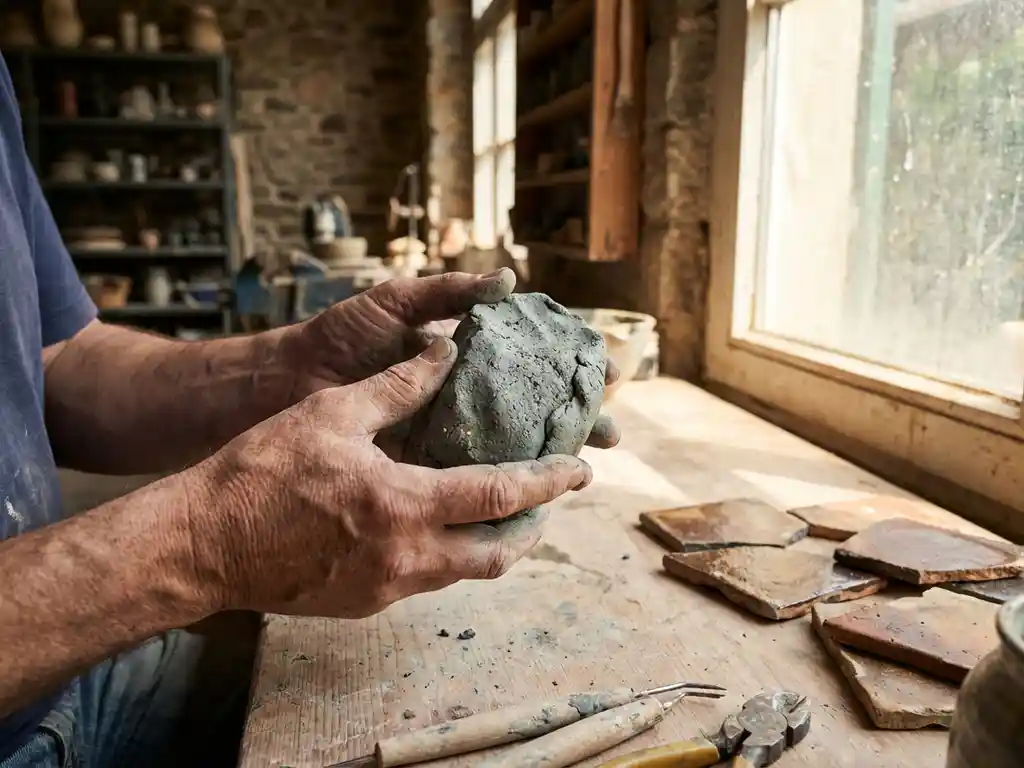
The Westerwald region in Germany has earned a reputation as one of Europe’s premier sources of high-quality clay, particularly for ceramic manufacturing. This unique geological area, located in the states of Rhineland-Palatinate, North Rhine-Westphalia, and Hesse, contains some of the continent’s largest and most valuable clay deposits, making it a cornerstone of German ceramic production.
Understanding why ceramic manufacturers gravitate toward Westerwald clay offers important insights into the relationship between raw materials and final product quality. The region’s geological history and specific clay composition create advantages that directly translate into superior ceramic performance, particularly for demanding applications such as façade systems.
What makes Westerwald clay special for ceramic production?
Westerwald clay is distinguished by its exceptional purity, consistent mineral composition, and ideal plasticity, which together produce superior ceramic products. The region’s unique geological formation over millions of years has created clay deposits with remarkably low impurity levels and optimal firing properties.
The clay’s mineral composition includes high levels of kaolinite and illite, which provide excellent workability during shaping and exceptional strength after firing. These minerals also contribute to the clay’s ability to achieve dense, non-porous surfaces when fired at high temperatures. The natural iron oxide content gives Westerwald clay its characteristic color range and contributes to the material’s durability.
What sets this clay apart is its consistent behavior throughout the ceramic manufacturing process. The uniform particle-size distribution ensures predictable shrinkage rates, while the clay’s natural plasticity allows for precise shaping and detailed surface texturing. This reliability is crucial for manufacturers producing architectural ceramics, where dimensional accuracy and surface quality are paramount.
How does Westerwald clay improve ceramic façade quality?
Ceramic façades made from Westerwald clay achieve superior density, weather resistance, and dimensional stability thanks to the clay’s optimal firing characteristics and mineral composition. The high-quality clay enables manufacturers to create façade elements with consistently smooth, non-porous surfaces that resist moisture penetration and environmental degradation.
During the sinter-firing process at temperatures exceeding 1,200 degrees Celsius, Westerwald clay undergoes complete vitrification, creating an extremely dense ceramic body. This density translates directly into improved freeze-thaw resistance, a critical factor for façade applications in varying climates. The clay’s low porosity after firing also means reduced water absorption, preventing damage from moisture-related expansion and contraction cycles.
The mineral stability of Westerwald clay ensures that ceramic façades maintain their structural integrity and appearance over decades. The clay’s natural composition resists chemical weathering and provides excellent color retention, even under intense UV exposure. This durability reduces maintenance requirements and significantly extends the service life of ceramic façade systems compared to alternatives made from lower-quality clay sources.
Why do German ceramic manufacturers prefer local Westerwald clay?
German ceramic manufacturers choose local Westerwald clay for its proven consistency, reduced transportation costs, and a reliable, nearby supply chain. The region’s established mining infrastructure and centuries-old ceramic tradition provide manufacturers with dependable access to premium raw materials.
The proximity advantage extends beyond simple logistics. Working with local clay sources allows manufacturers to develop deep expertise in specific material characteristics, optimizing their production processes for maximum quality and efficiency. This intimate knowledge of the raw material enables fine-tuning of firing schedules, forming techniques, and quality-control procedures.
Environmental considerations also play a significant role in this preference. Sourcing clay locally dramatically reduces the carbon footprint associated with raw-material transportation. For manufacturers focused on sustainable production practices, local sourcing aligns with broader environmental goals while maintaining product quality. Established relationships between Westerwald clay suppliers and German ceramic manufacturers also help ensure consistent quality standards and reliable delivery schedules.
What’s the difference between Westerwald clay and other ceramic clays?
Westerwald clay differs from other ceramic clays primarily in its superior purity, consistent mineral composition, and exceptional firing behavior, which produces denser, more durable ceramic products. While many clay deposits contain significant impurities that can cause defects or inconsistencies, Westerwald clay maintains remarkably uniform quality across different extraction sites.
Compared with clays from other regions, Westerwald clay exhibits superior plasticity during forming while maintaining excellent dimensional stability during drying and firing. This combination is relatively rare and allows manufacturers to create complex shapes and precise dimensions with minimal waste or rework. The clay’s firing characteristics are particularly noteworthy, as it achieves complete sintering at optimal temperatures without overfiring or warping.
Other clay sources often require blending with additives to achieve desired properties, but Westerwald clay frequently performs excellently in its natural state. This reduces processing complexity and costs while ensuring more predictable results. The natural color range available from different Westerwald clay deposits also provides manufacturers with greater design flexibility than clays that require extensive coloring additives to achieve aesthetic variety.
How TONALITY® maximizes Westerwald clay advantages
TONALITY® leverages the exceptional properties of Westerwald clay through advanced ceramic manufacturing techniques that fully realize the material’s potential. Located in Weroth, in the heart of the Westerwald region, TONALITY® has direct access to Europe’s largest and highest-quality clay deposits, ensuring consistent raw-material excellence for every ceramic façade element produced.
Our specialized sinter-firing process at temperatures exceeding 1,200 degrees Celsius maximizes the natural advantages of Westerwald clay:
- Achieving unrivaled smooth, dense surfaces with exceptional durability
- Creating ceramic elements with precise dimensional accuracy to within one millimeter
- Producing façade tiles with integrated graffiti protection and permanent UV resistance
- Delivering A1-classified, non-combustible building materials ideal for modern construction
- Ensuring 100% recyclable ceramic elements that support sustainable building practices
Ready to experience the superior quality that comes from combining premium Westerwald clay with expert ceramic manufacturing? Contact TONALITY® today to discuss your ceramic façade project and discover how our locally sourced materials and advanced production techniques can deliver exceptional results for your building design.