

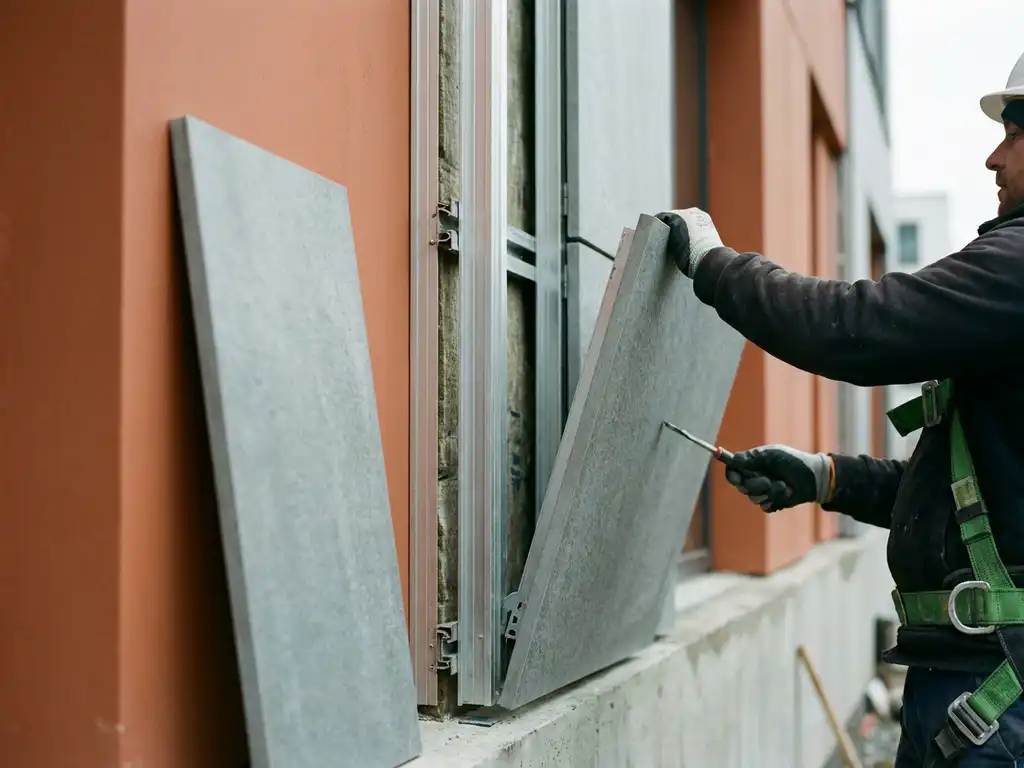
Yes, ceramic facade panels can be removed and reused on a different building. Because they are mechanically fixed rather than bonded with adhesive, they can be detached without damaging the panels themselves, making relocation to a new structure entirely feasible. The sections below walk through how the system works, what removal involves, and what reuse looks like in practice.
How are ceramic facade panels attached to a building?
Ceramic facade panels are attached using a mechanical fixing system rather than adhesive bonding. The panels are profiled on the back and slot into vertical aluminum retaining profiles that are anchored to the building’s substructure. This click-in, mount-and-done approach means no mortar or glue is involved, and the panels are held securely in place by the interlocking geometry of the system.
This method of attachment has a direct impact on removability. Because the connection is mechanical, each panel can be released by reversing the installation process. The aluminum profiles and the substructure remain separate components, which means the system can be fully disassembled and sorted by material type without requiring destructive techniques. The low surface weight of approximately 40 kilograms per square meter also reduces the physical effort involved in handling panels during removal, which is a meaningful practical advantage on site.
The ability to separate components cleanly by type is also what makes ceramic facade systems particularly well suited to circular construction approaches, where end-of-life planning begins at the design stage.
Can ceramic facade panels be removed without damage?
In most cases, yes. Because ceramic facade panels are mechanically fixed rather than adhered, careful removal typically leaves the panels intact and undamaged. The key factor is the installation method: panels that slot into retaining profiles can be unclipped or slid out without applying force that would crack or chip the ceramic surface.
The durability of the ceramic material itself also works in favor of damage-free removal. Panels produced through a high-temperature sinter firing process develop an exceptionally dense, smooth surface that resists mechanical stress better than softer cladding materials. This means that even after years of service, the panels retain the structural integrity needed to survive deconstruction and reinstallation.
That said, the condition of the panels after removal depends on how carefully the work is carried out. Rushed or poorly planned deconstruction can cause chipping at panel edges, particularly if profiles have corroded or if panels have been in place for a very long time. Working with experienced installers who understand the system is the most reliable way to protect panels through the removal process.
What happens to ceramic facade panels after removal?
After removal, ceramic facade panels have two primary pathways: direct reuse on another building or recycling as a raw material. Because the panels are non-porous and chemically stable, they do not degrade during service in the way that some organic or composite cladding materials do, which means structurally sound panels are genuinely viable for reinstallation elsewhere.
Panels that are still dimensionally accurate and surface-intact can be inspected, cleaned, and re-fixed to a new substructure using the same type of aluminum retaining profiles. This is particularly relevant for building owners managing a portfolio of properties or for projects where a facade is being updated for aesthetic reasons rather than structural ones.
Panels that are no longer suitable for reuse as facade elements are 100% recyclable. Ceramic is an inorganic material with no combustible components, and it can be processed back into raw material without producing harmful byproducts. This means that even at the true end of a panel’s service life, the material does not become waste in the conventional sense.
Are there any limitations to reusing removed ceramic panels?
There are a few practical limitations worth considering. The most significant is dimensional compatibility: ceramic facade panels are manufactured to precise tolerances, and a reused panel must fit the profile system and joint spacing of the new installation. If the receiving building uses a different substructure geometry or requires a different panel format, the removed panels may not integrate cleanly without adaptation.
Other factors that can limit reuse include:
- Surface condition: Panels with visible chips, cracks, or significant staining may not meet the aesthetic standard required for the new facade.
- Color consistency: Ceramic panels produced in different batches can vary slightly in tone. Mixing older removed panels with new ones on the same elevation can create visible inconsistencies.
- Quantity: Reuse works best when the removed panels are sufficient in number to cover the new facade without needing to supplement with panels from a different production run.
- Fire and building code compliance: The panels themselves are classified as building material class A1 and are non-combustible, so they typically meet fire performance requirements. However, the full facade system, including substructure and fixings, must comply with the building regulations of the new project.
None of these limitations are insurmountable, but they do require planning. The most successful reuse scenarios involve early coordination between the architect, the facade installer, and the manufacturer to confirm compatibility before deconstruction begins.
How does ceramic facade reusability compare to other cladding materials?
Ceramic facade panels compare favorably to most other cladding materials when it comes to reusability. The combination of mechanical fixing, material durability, and chemical stability gives ceramic a clear advantage over alternatives that rely on adhesive bonding or that degrade meaningfully over time.
Fiber cement panels, for example, are often adhered or fastened in ways that make damage-free removal difficult, and the material itself can absorb moisture over time, reducing its integrity for reuse. Composite panels with polymer cores can delaminate or warp, and their mixed-material construction complicates both reuse and recycling. Natural stone is highly durable but heavy, and the fixing methods used often make removal destructive.
Ceramic sits in a strong position because it is a single-material product with no adhesive layers, no polymer components, and no organic content that degrades. The long-term performance of ceramic facades in service also means that panels removed after ten or fifteen years of use are often in excellent condition, which is not always the case with lighter or more composite alternatives.
Does reusing ceramic facade panels support sustainability goals?
Reusing ceramic facade panels directly supports sustainability goals by extending the useful life of already manufactured materials and reducing the demand for new production. Every panel that moves from one building to another rather than going to landfill or even recycling represents a saving in the energy and resources that would otherwise be required to produce a replacement.
This aligns with the principles of circular construction, which prioritizes keeping materials in active use for as long as possible before recovery or recycling. Ceramic is particularly well suited to this model because its performance characteristics do not diminish with age in the way that organic or composite materials do. UV resistance, color stability, and surface density are intrinsic to the material rather than dependent on coatings that wear away.
The recyclability of ceramic at end of life also means that the material never truly becomes waste. When reuse is no longer viable, the material can re-enter the production cycle. For projects pursuing green building certifications or whole-life carbon assessments, the ability to document both reuse potential and recyclability is a concrete, verifiable contribution to sustainability credentials rather than a marketing claim.
How TONALITY® supports ceramic facade reuse and sustainability
TONALITY® ceramic facade systems are designed from the ground up with deconstruction and reuse in mind. The mechanical fixing system, the single-layer panel construction, and the A1 fire classification all contribute to a facade that can be installed, removed, and reinstalled with minimum waste and maximum material recovery.
Specifically, TONALITY® facades offer:
- Mechanical fixing with aluminum retaining profiles that allow clean, damage-free panel removal without adhesives or mortar
- 100% recyclability with components that can be sorted and recovered by material type at end of life
- Precise manufacturing tolerances of within one millimeter, supporting compatibility and reuse across projects
- Building material class A1 classification, meaning panels are non-combustible and meet fire performance requirements in new installations
- Permanent UV and color resistance that ensures panels removed after years of service still meet aesthetic standards for reuse
- Low surface weight of approximately 40 kilograms per square meter, reducing handling effort during removal and reinstallation
Whether you are planning a new build with end-of-life deconstruction in mind, evaluating a facade refurbishment, or exploring sustainable facade options for a timber construction project, TONALITY® can provide the technical detail and product support you need to make an informed decision.
[cta_contact_form]
Get in touch with the TONALITY® team to discuss your project requirements, request samples, or find out more about how the facade system supports your sustainability and circular construction goals. You can also contact the sales team directly for project-specific advice.