

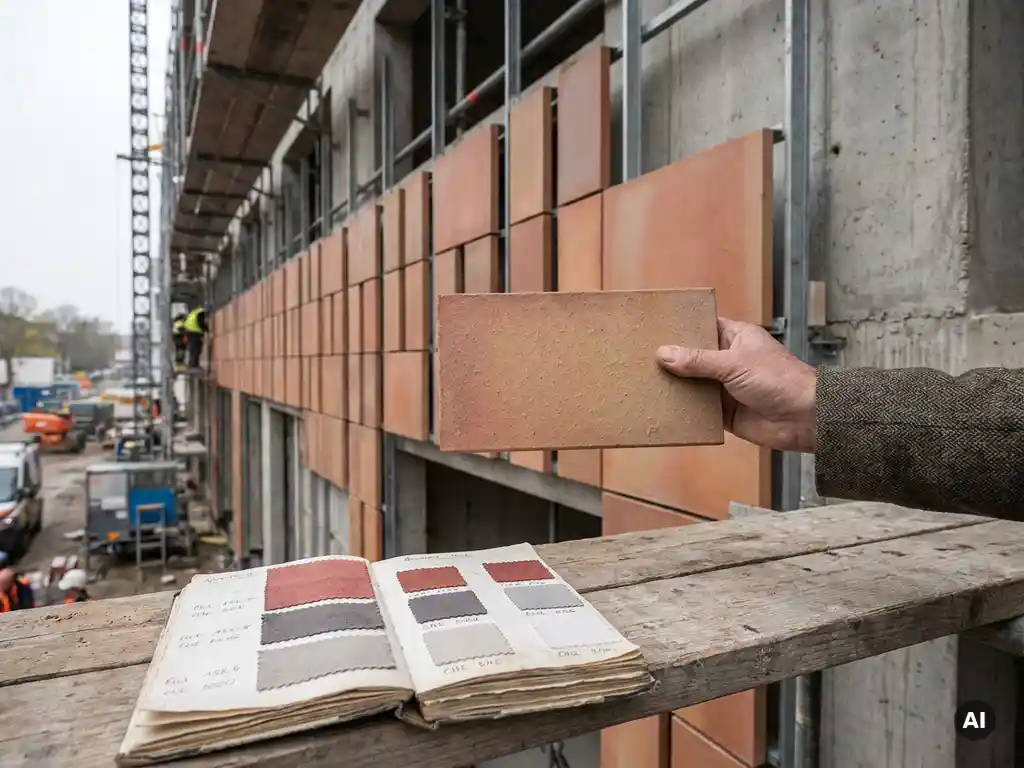
Color consistency across a large ceramic facade order is one of the most critical, and most commonly underestimated, challenges in facade specification. When hundreds or even thousands of square meters of ceramic tiles arrive on site, even subtle variation between production batches can become visible at scale, particularly in raking light conditions or across large uninterrupted wall planes. Getting this right requires deliberate action at every stage of the process, from the initial brief through to installation sign-off.
This guide walks you through five practical steps to specify and secure ceramic facade color consistency on large projects, helping you avoid costly surprises and protect the design intent you worked hard to develop.
Gather color references and project requirements first
Before you can specify color consistency, you need a clear and documented picture of what color you are actually trying to achieve. Vague references like “warm terracotta” or “light grey” are not enough to anchor a production run. Start by assembling concrete references that can travel through the supply chain without losing meaning.
- Collect physical material samples, mood boards, or approved precedent images that represent the intended facade color in context.
- Identify the viewing conditions under which the facade will be seen: orientation, typical daylight angle, and distance from the street or public realm.
- Note any adjacent materials, such as glass, metal cladding, or brickwork, whose color the ceramic must coordinate with.
- Document the total order quantity in square meters, broken down by elevation if different faces of the building have different requirements.
With this information assembled, you have a solid foundation for the next step. A well-documented color brief protects you when communicating with manufacturers and gives everyone involved a shared reference point from day one. If you want to explore the available surfaces and formats early in this process, doing so alongside your color brief helps narrow the specification efficiently.
Define color tolerances in the specification document
Color tolerances translate your design intent into measurable, enforceable requirements. Without them, there is no objective basis for accepting or rejecting a delivery, and disputes become a matter of opinion rather than specification compliance.
- Specify an acceptable Delta E value, which is the standard unit used in colorimetry to measure the difference between two colors. A Delta E of 1 or below is generally imperceptible to the human eye; values above 3 become visible in side-by-side comparison.
- Reference the measurement standard to be used, such as CIE Lab color space, so that both parties are measuring color in the same way.
- State whether the tolerance applies to individual tiles, to the average of a sample set, or to both.
- Include a clause specifying that the approved master sample (see the next step) serves as the benchmark against which all deliveries are measured.
Including these tolerances in the project specification and later in the order contract gives you a clear, agreed standard. Manufacturers who take quality seriously will welcome this level of clarity because it removes ambiguity for their production team as well.
Request production samples and approve a master batch
Physical production samples are the most reliable tool for confirming that a manufacturer can actually hit your color target under real production conditions. This step bridges the gap between the color reference you gathered and what will ultimately be fired and delivered.
Request pre-production samples
Ask the manufacturer to produce a sample run using the same raw materials, firing temperatures, and process settings that will be used for the full order. Samples produced from a different clay body or at a different firing temperature may look similar but will not predict the final result accurately. Request a minimum quantity of samples large enough to assess natural variation within a single batch, typically at least ten to twenty tiles.
Approve and archive the master sample
- Review the samples under multiple lighting conditions, including daylight, overcast sky, and artificial light if the facade is visible at night.
- Select and formally approve a master sample set that represents the acceptable color range, including both the target and the outer limits of acceptable variation.
- Retain physical copies of the approved master sample in your office, with the manufacturer, and ideally with the main contractor. Store them in a stable environment away from direct sunlight to prevent fading.
- Document the approval in writing, referencing the sample batch number and the date of approval.
The approved master batch now becomes the contractual color standard. Every subsequent delivery can be checked against it, giving you a consistent and objective benchmark throughout the project. You can also request samples directly from manufacturers early in the design phase to inform your color brief before committing to a specification.
Specify single-batch production in the order contract
Even with a well-defined color tolerance and an approved master sample, color variation can creep in if the full order is produced across multiple production batches. Natural raw material variation, kiln load differences, and seasonal changes in clay composition all introduce subtle shifts that accumulate over a large order. The most effective way to control this is to require single-batch production in the contract.
- Include a clause stating that the entire order must be produced from the same raw material batch and fired within a defined production window.
- If single-batch production is not feasible due to order volume, require that each batch is color-matched against the approved master sample before dispatch, with written confirmation provided.
- Specify that tiles from different batches must be clearly labeled and segregated on delivery so that any variation can be managed during installation by interleaving tiles from different batches across the facade.
- Request a production schedule from the manufacturer so you can track when production starts and flag any unplanned interruptions that might affect consistency.
This contractual step is where many specifications fall short. Color tolerances and master samples are only as effective as the production controls that back them up. Locking in single-batch production, or at minimum rigorous batch-to-batch matching, is the practical mechanism that makes the rest of your specification work.
Verify color consistency on delivery and during installation
Specification work done in the office only pays off if it is followed through on site. Delivery and installation are the final checkpoints where color consistency is confirmed or, if problems are caught early enough, corrected before they become permanent.
On delivery
- Inspect a representative sample from each pallet against the approved master sample before tiles are unloaded into storage. Do this in natural daylight where possible.
- Check batch labeling against the production records provided by the manufacturer.
- Reject any delivery that falls outside the agreed tolerance before tiles are moved to the installation area. Once tiles are installed, the leverage to resolve color issues drops significantly.
During installation
- Instruct the installation team to mix tiles from multiple pallets as they work, rather than exhausting one pallet before opening the next. This distributes any residual variation evenly across the facade surface.
- Step back regularly during installation to view the facade from the intended viewing distance and in different lighting conditions.
- Document any areas of concern with photographs and batch numbers so that patterns can be traced back to specific production runs if needed.
A consistent verification routine on delivery and during installation is the last line of defense for your color specification. It also provides the documentation you need if a formal quality claim becomes necessary. Reviewing completed facade references from manufacturers can also give you a realistic sense of what color consistency looks like at scale before you finalize your specification.
How TONALITY® supports ceramic facade color consistency
TONALITY® ceramic facades are produced using a special sinter-firing process at temperatures exceeding 1,200 degrees Celsius, which results in exceptionally dense and uniform surfaces. This high-temperature process is central to achieving the color stability and batch-to-batch consistency that large facade projects demand. Here is how TONALITY® directly supports the steps outlined in this guide:
- Physical samples on request: TONALITY® provides production-grade samples so architects can evaluate color and surface quality under real project conditions before committing to an order.
- Precision manufacturing: Tiles can be produced to within one millimeter in formats ranging from 150 x 300 mm up to 400 x 1,600 mm, supporting consistent visual rhythm across large facade areas.
- Permanent UV and color resistance: The sintered ceramic surface does not fade or shift over time, meaning the color approved at specification remains the color visible on the building for the long term, with no maintenance required to preserve it.
- Transparent production process: The TONALITY® team works closely with architects and specifiers to align production scheduling, batch documentation, and sample approval to project timelines.
If you are working on a project that requires tight color control across a large ceramic facade order, the TONALITY® team is ready to support you from the first color brief through to delivery sign-off. Get in touch with the team to discuss your project requirements and request samples.
Related Articles
- What surface finish options are available for ceramic cladding on contemporary facades?
- What is the difference between a ventilated facade and a rainscreen system for circularity?
- What is an EPD (Environmental Product Declaration) and why should specifiers care?
- 10 Reasons Terracotta Outperforms Aluminum Composite Panels
- How do aluminum and steel substructures compare for terracotta?