

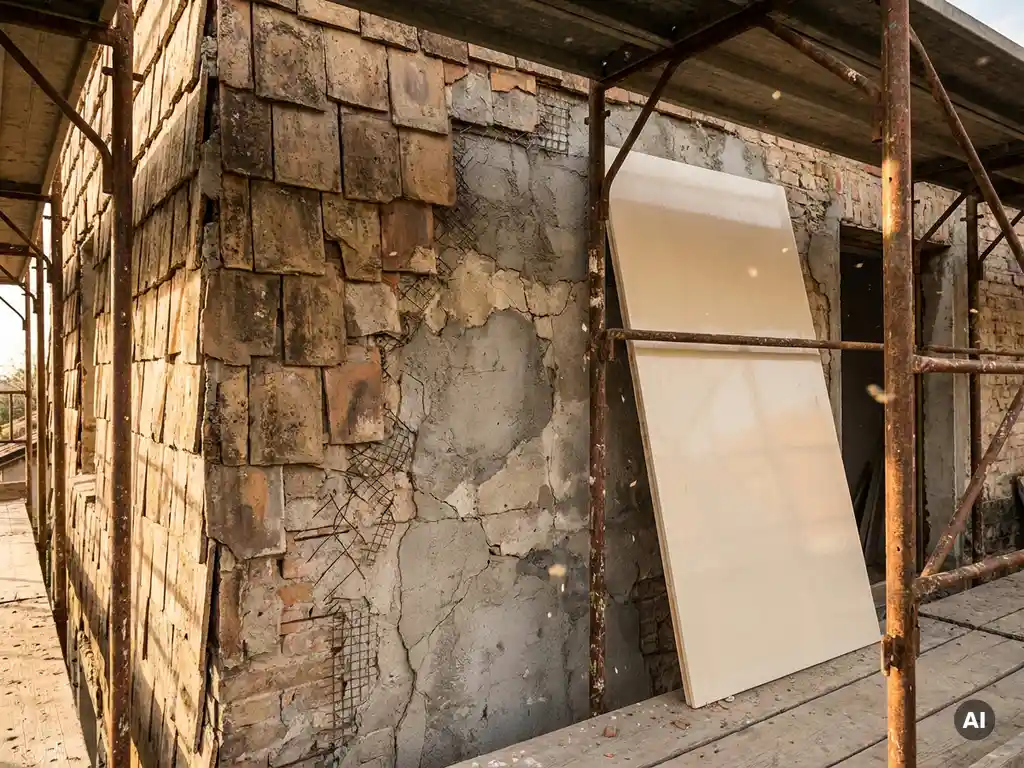
Partial facade renovation is riskier than complete replacement when the underlying structure or substrate has deteriorated beyond a certain threshold, when the existing and new materials are incompatible, or when hidden damage is likely to spread after partial work is completed. The risk is not always visible from the outside, which is precisely what makes the decision so consequential. The following questions unpack the key factors that determine whether a partial approach is a smart investment or a costly gamble.
What makes partial facade renovation riskier than it looks?
Partial facade renovation carries hidden risks because visible damage rarely tells the whole story. When only sections of a facade are replaced, underlying problems in the substrate, insulation, or structural connections often remain unaddressed. These concealed issues can accelerate deterioration in adjacent areas, leading to further repair cycles that ultimately cost more than a full replacement would have.
One of the most underestimated risks is moisture. Water infiltration behind a facade can travel far from its point of entry, saturating insulation layers and weakening fixings across a wide area. Replacing a visibly damaged panel without investigating the surrounding structure leaves the root cause intact. Within a few seasons, the problem resurfaces, sometimes in a different location entirely.
There is also the challenge of access. Scaffolding, site logistics, and installation labor represent a significant portion of any facade project’s total investment. Partial renovation often means paying for that infrastructure more than once. A building that undergoes two or three rounds of partial repair over a decade may have spent considerably more than a single comprehensive replacement would have required.
What are the signs that a facade needs full replacement?
A facade needs full replacement when damage is widespread, structural connections are compromised, or the existing system is no longer compatible with current building performance standards. Isolated defects suggest repair; systemic failure suggests replacement. The distinction matters because piecemeal intervention on a failing system rarely restores long-term performance.
Specific indicators that point toward full replacement include:
- Widespread cracking or delamination across multiple facade zones, not confined to one area
- Corroded or loose substructure fixings that compromise the load-bearing capacity of the entire system
- Persistent moisture ingress that has damaged insulation or the building envelope beneath the cladding
- Thermal performance gaps that cannot be addressed without removing the existing system entirely
- Material discontinuation, where the original tiles or panels are no longer manufactured and matching replacements are unavailable
- Regulatory non-compliance, particularly around fire resistance classifications that current materials do not meet
If three or more of these conditions are present simultaneously, the case for full replacement is strong. Continuing to patch a system in systemic decline is rarely cost-effective when measured across the building’s full lifecycle.
When does partial renovation actually make sense?
Partial facade renovation makes sense when damage is genuinely localized, the surrounding structure is sound, and replacement materials are compatible with the existing system. It is a viable strategy for impact damage, isolated weathering in a specific zone, or targeted upgrades to a facade that is otherwise performing well.
The conditions that favor a partial approach include:
- Damage confined to a clearly defined section with no evidence of spread
- A substructure that has been independently assessed and confirmed as structurally sound
- Access to matching or compatible replacement materials from the same product family
- A facade system that was installed relatively recently and is otherwise within its expected service life
Partial renovation is also appropriate when a building is scheduled for full replacement in the near future and the goal is simply to maintain weathertightness or appearance in the interim. In that context, a targeted repair buys time without the full investment of a comprehensive project. The key is being honest about whether the repair is a genuine solution or a temporary measure.
How do material compatibility issues affect long-term facade performance?
Material compatibility issues affect long-term facade performance by creating points of differential movement, moisture transfer, and thermal stress between old and new elements. When dissimilar materials are placed side by side on a facade, they expand and contract at different rates with temperature changes. Over time, this movement can open joints, crack sealants, and allow water to penetrate the system.
Compatibility concerns extend beyond the visible cladding layer. Fixings, substructure profiles, and insulation materials all interact with one another. Introducing a new cladding material that is heavier than the original, for example, may overload existing aluminum profiles that were not designed for that load. Similarly, mixing materials with different vapor permeability ratings can trap moisture within the wall build-up, leading to condensation and mold.
When specifying replacement sections, it is worth reviewing the available surfaces and formats to understand how dimensional and material properties align with the existing installation. Mismatches in surface density, thermal mass, or coefficient of thermal expansion are easy to overlook at the specification stage but become significant over a facade’s service life.
What are the cost differences between partial and full facade replacement?
The total cost difference between partial and full facade replacement is not always as large as it appears at the outset. While partial renovation requires less material and shorter installation time initially, it often involves repeated mobilization costs, scaffolding cycles, and ongoing maintenance that erode the apparent savings over time. Full replacement, by contrast, typically delivers a longer period of maintenance-free performance.
A lifecycle cost perspective is the most reliable framework for this decision. A facade system that requires intervention every five to seven years carries a cumulative burden in labor, access infrastructure, and disruption to building occupants. A high-quality replacement system that performs without significant maintenance for several decades often represents a lower total investment when the full timeline is considered.
Durability, UV resistance, and low upkeep requirements are the factors that most strongly influence long-term value. Materials that retain their appearance and structural integrity without surface treatments or frequent inspection cycles reduce the hidden costs that accumulate over a building’s life. When evaluating the economics of partial versus full replacement, the question to ask is not what the project costs today, but what the facade will cost to own over the next thirty years.
Which facade materials are easiest to replace section by section?
Facade materials that are easiest to replace section by section are those installed as individual, mechanically fixed units rather than bonded or continuous systems. Ventilated rainscreen cladding systems, where each panel or tile slots into a substructure profile independently, allow individual elements to be removed and replaced without disturbing adjacent sections. This makes them inherently more repair-friendly than adhesive-bonded or rendered systems.
Ceramic facade tiles installed in a click-and-lock or hook-on system are a strong example of this principle. Because each tile is mechanically retained rather than chemically bonded, a damaged element can be released and swapped without affecting the tiles around it, provided the substructure is intact. The same logic applies to certain metal composite panels and fiber cement boards designed with concealed fixing systems.
By contrast, EIFS (exterior insulation and finish systems) and mineral renders are among the most difficult to repair in sections. Matching the texture, color, and surface profile of an existing render is technically demanding, and the repair boundary is rarely invisible. Bonded stone and large-format glass panels also present challenges, as their installation typically requires specialized equipment and precise alignment that makes isolated replacement labor-intensive.
For buildings where long-term repairability is a priority, the choice of facade system at the outset matters enormously. You can explore completed projects to see how different systems perform in real-world conditions before committing to a specification.
How TONALITY® supports the facade renovation decision
TONALITY® ceramic facade systems are designed with the challenges of both partial and full renovation in mind. Whether a project involves replacing a failing system entirely or upgrading sections of an existing building envelope, TONALITY® offers a technically robust and visually consistent solution built for long-term performance.
Key advantages relevant to facade renovation decisions include:
- Mechanical fixing system: TONALITY® tiles interlock with vertical aluminum retaining profiles, making individual tiles easy to remove and replace without disturbing adjacent elements
- Precise dimensional consistency: Tiles are produced to within one millimeter, ensuring tight alignment when replacing sections within an existing installation
- Building material class A1: Non-combustible classification supports compliance with current fire protection requirements, which is often a driver for full facade replacement
- Low surface weight: At approximately 40 kilograms per square meter, TONALITY® tiles place minimal load on substructures, making them compatible with a wide range of existing building types, including timber construction
- Permanent color and UV resistance: The sinter-fired surface retains its appearance without surface treatments, reducing the lifecycle maintenance burden that often makes partial renovation uneconomical
- 100% recyclable: Components can be deconstructed and sorted by material type, supporting sustainable end-of-life management
[cta_contact_form]
If you are weighing a partial renovation against full facade replacement and want to understand which approach makes sense for your specific building, the TONALITY® team can provide technical guidance tailored to your project. You can also request samples and downloads to evaluate material compatibility before committing to a specification. Reach out via the contact and sales page to start the conversation.
Related Articles
- How do you design a facade today so its panels can be reused in 20 years?
- How do terracotta facades help meet US building regulations in 2026?
- Can terracotta facades be recycled at end of life?
- What seismic considerations apply to terracotta facade design?
- How does facade material choice affect net zero building goals?